
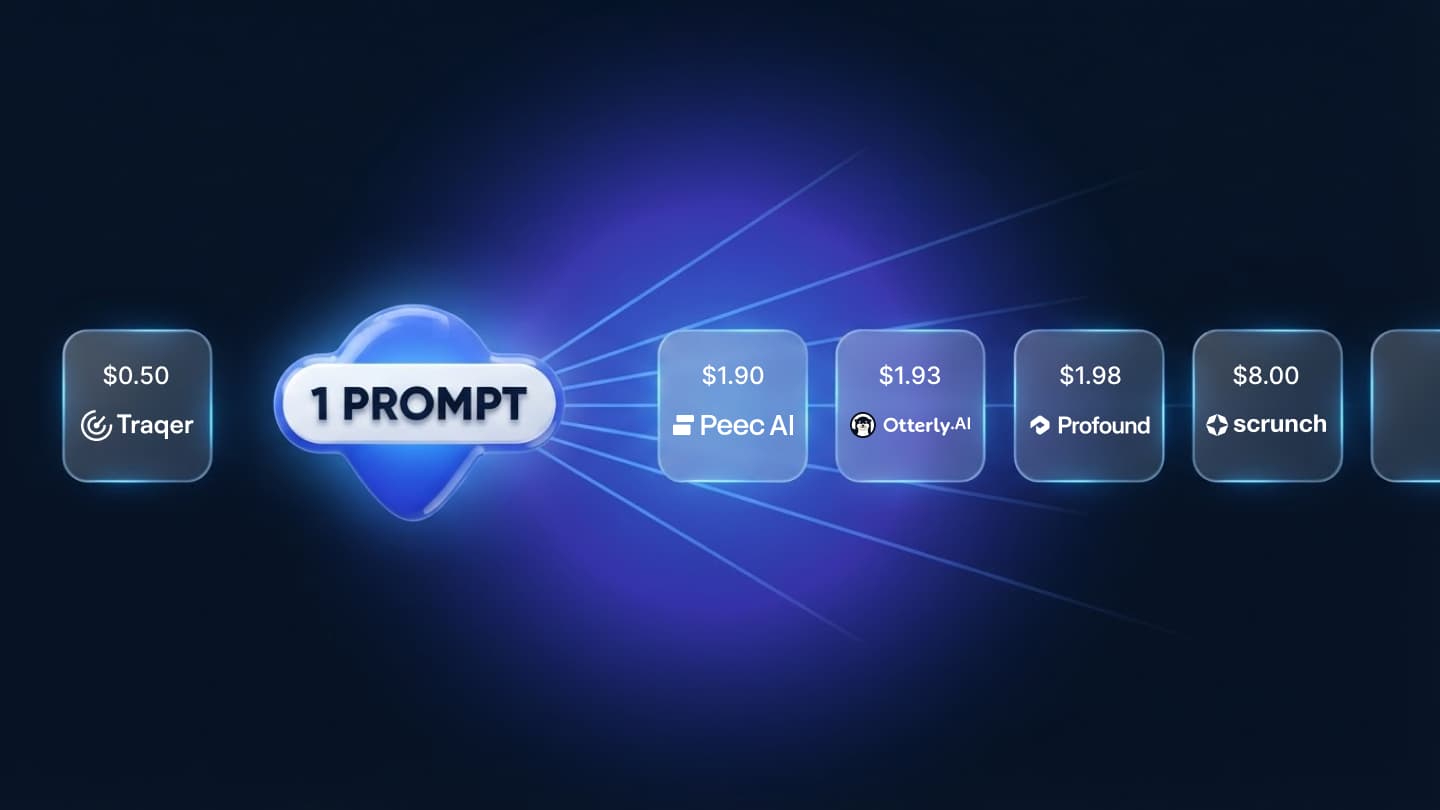
Prices for AI search visibility tools vary widely. Some plans start at around $20 a month, while enterprise platforms can cost thousands. The monthly price on its own tells you little, because a cheaper plan may track fewer prompts, cover fewer models, or cost far more once you run a full set of prompts across several models. Different pricing structures make comparison tricky, and it’s often hard to know the full cost of a tool until you start using it.
This article is focused on the most established LLM visibility tracking platforms out there right now. A number of smaller startup products have launched into the market recently, but in our experience these have limited functionality and extremely confusing user interfaces. Therefore this article compares some of the well-known platforms and what they cost to use, and where the affordability of our tool, Traqer, sits.
What it costs to track one prompt in the established platforms
Tools in this category price themselves around the prompt; i.e., each individual question you want to monitor. Among the established platforms, tracking a single prompt costs anything from about $2 to $8 a month at the entry-level plans.
What that figure actually covers depends on how the tool defines a prompt.
Peec, for instance, starts at $95 a month for 50 prompts, or $1.90 each, with three engines included. A fourth engine costs another $35 to $165 a month, and Claude tracking requires the Enterprise plan.
Profound's $99 Starter comes to $1.98 a prompt and covers ChatGPT only. Tracking three engines requires the $399 Growth plan, and Claude again requires Enterprise.
Scrunch counts prompts per engine, so its $250 Core plan lists 125 prompts, but because the allowance is drawn down once for each engine, 125 prompts across four engines is closer to 31 questions tracked, which works out to roughly $8 a prompt.
Otterly is the cheapest of the four at $29 a month, though that covers 15 prompts across four engines and Claude is an add-on option, starting at $29 for the starter plan.
In short, the costs rise well above the headline figures once you cover a topic across the models your buyers use and add Claude. In each case, the entry price is only the start.
A realistic program might track 10 topics with five prompts each, 50 prompts in total, across the mainstream models your buyers use. On our tool, Traqer, one entered prompt covers every model; so that is the $25 entry plan. On Peec, the $95 Starter includes fifty prompts but only three engines, and a fourth costs another $35 a month or more, so around $130.
Otterly needs its $189 plan for the volume, with Gemini as a paid add-on on top. Profound's $99 Starter tracks ChatGPT alone. Three engines start at the $399 Growth plan, and a fourth points toward a custom Enterprise quote. Scrunch's $250 Core plan stretches to about 30 prompts across four engines, so 50 would need a higher tier.
Peec, Profound, and Scrunch all place Claude behind an Enterprise contract, which independent pricing puts in the low thousands a month. On Traqer, it is an at-cost add-on on the same plan.
As you can see below, Traqer’s entry plan works out at $0.50 a prompt for ChatGPT, Perplexity, Google AI Overviews, AI Mode, and Gemini, with Claude available on any plan as an at-cost add-on.
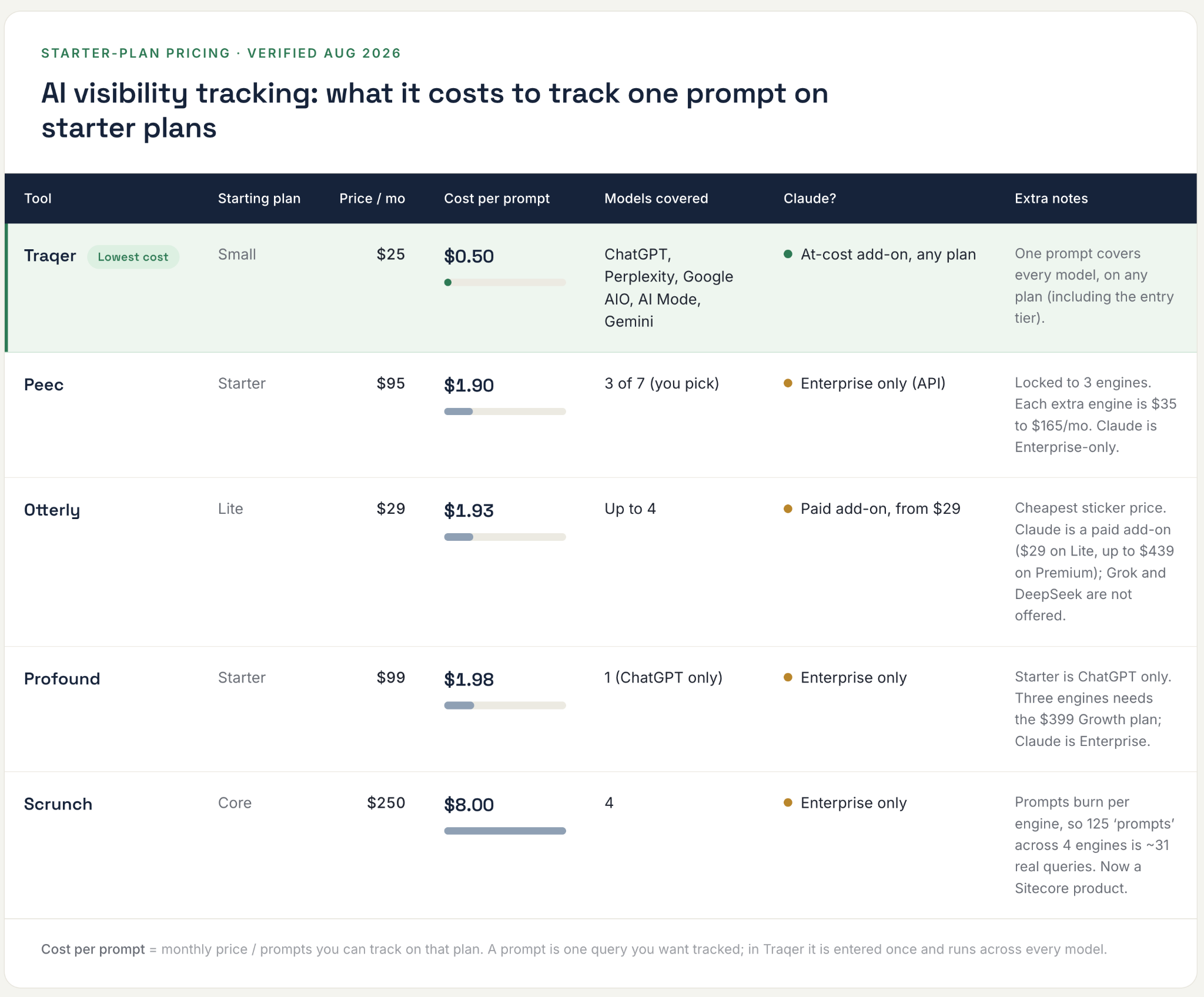
The figures in the table above show each tool's cost per prompt on its entry self-serve plan, worked out as the monthly price divided by the prompts included. Scrunch's number allows for its allowance being spent once per engine, which effectively leaves fewer prompts than the plan lists. (Prices were checked in August 2026 and change often, so it’s best to treat these as illustrative rather than exact.)
What sets Traqer apart as an affordable AI visibility tracker
We strongly believe that the most important unit to track is the topic, rather than any single prompt. A single prompt checked once records how one phrasing performed in one anonymous session, but people actually phrase the same question many different ways and bring personal context no tool can see. This is an issue that many tools out there still ignore.
For each topic you need to be able to enter and track a rich set of customizable prompts, run them across every model, and read the aggregate data over time rather than getting a tiny snapshot. Without this kind of coverage, you don’t get value. So we’ve built our product and our pricing to allow for this.
This setup is particularly appealing to agencies who want to track AI visibility for multiple clients.
Here’s what topic-level tracking actually looks like:
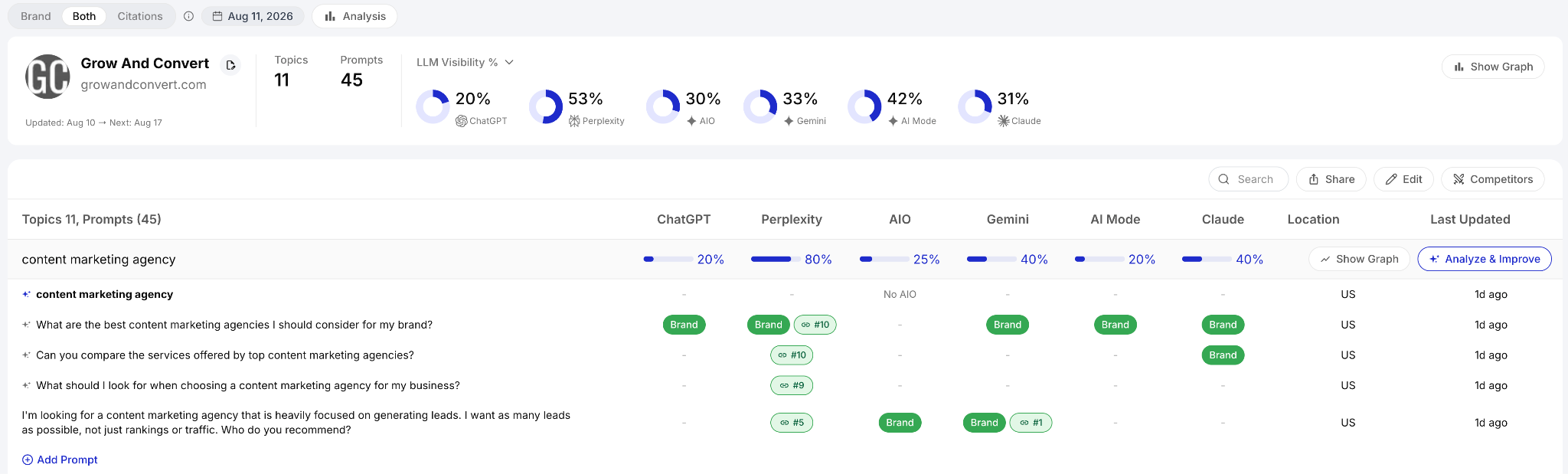
As you can see above, a single topic (“content marketing agency”) is broken into the related prompts that make it up, and each individual prompt is scored across every model. Steady visibility on some prompts and gaps on others sit side-by-side, which means you can see which models recommend you or cite your content, and which prompt phrasings you’re currently missing out on.
Our pricing plan is flat, with no credit meter counting down as you add prompts, run checks, or select models to track. For the scrapable models, we capture the interface a user sees rather than using an API reading. Claude runs through its API, and is available as an extra on any plan (not just Enterprise plans, as with some other tools). The functionality you get for such a low price is pretty exceptional:
Brand mentions and citations tracked across LLMs, tracked separately by default (with a toggle to switch between them or combine them if needed).
Visibility is measured by topic and per model, the share of prompts in a topic where your brand appears on each LLM, with topic coverage, competitive comparison, and trends over time.
Every prompt opens the LLM’s actual response, captured from the logged-out web interface rather than an API, with your brand highlighted and its cited sources listed.
Updates run weekly, with date comparison built in, so you can pull any two dates and see what shifted at the brand and topic level.
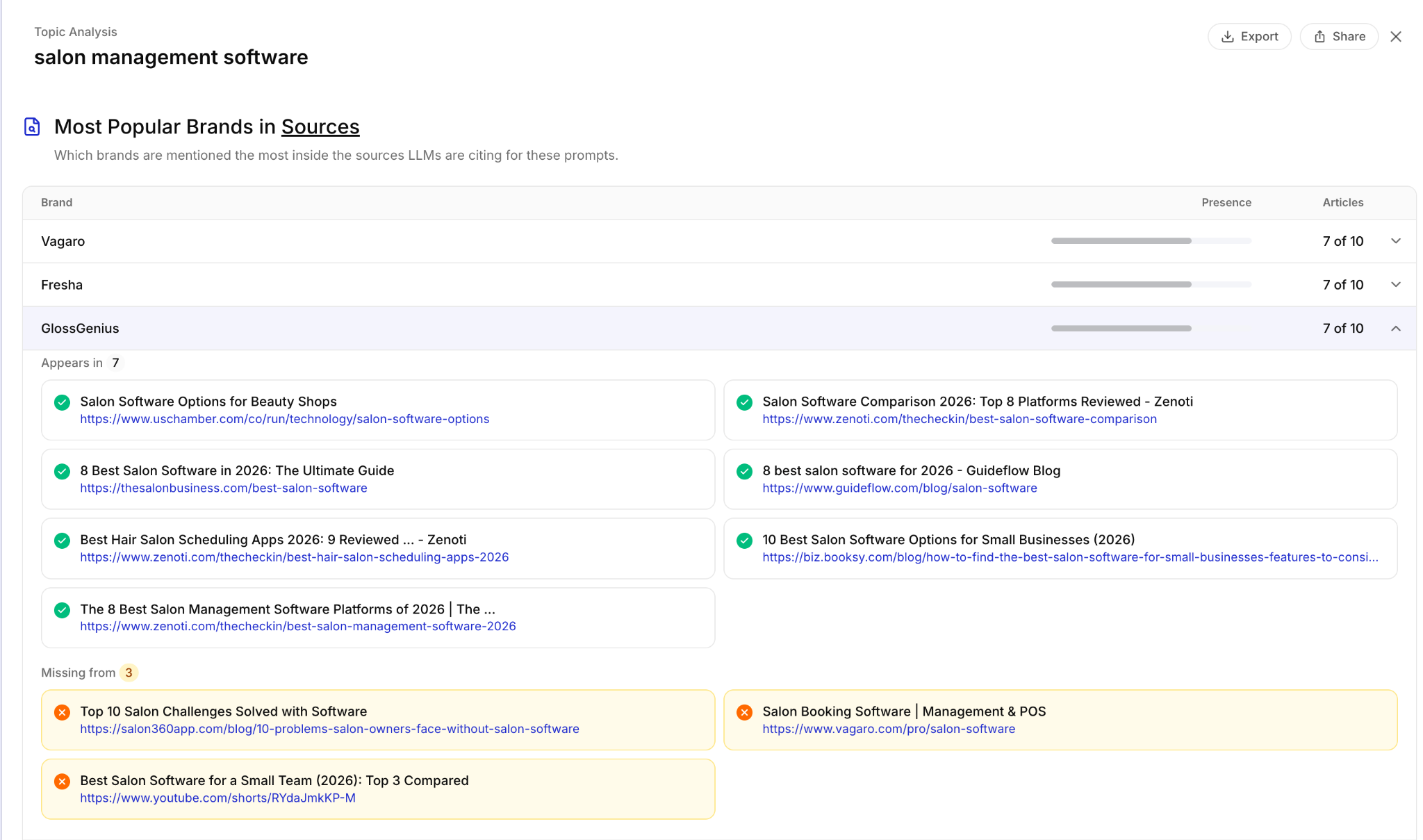
Each topic contains an Analyze and Improve function that shows which brands the models name most, which URLs they cite, and which brands are mentioned most inside the top 10 sources. That lets you see whether the brands appearing most in those cited sources are also the ones the models name most in their answers, or whether the two diverge.
The established platforms are generally well-built, usable, and reputable, but their cost keeps them out of reach for most startups and small businesses.
We built Traqer out of our own need as an agency tracking visibility across many clients, when the existing tools were all priced for enterprises, which is why it undercuts our larger competitors (and will continue to do so). It also came from a firm view that a single tracked prompt doesn’t tell us much about how clients are performing on LLMs, so we designed it to track a deep set of related prompts within each topic.
That shaped both the product and its pricing.
You can start small and keep the same method as you grow, whether you are operating in a lean in-house team or you’re working at an agency tracking several clients, without the per-engine charges or credit math that make the other platforms harder to budget than their headline price suggests.
Whatever you choose, compare the tools on cost per prompt at the coverage you need. If that points you to Traqer, it starts at $25 a month, with Claude available as an affordable extra on any plan.