
Look for an “AI visibility checker” and you get a dozen free tools that ask for your domain, run a handful of prompts through ChatGPT, Perplexity, Gemini and Google AI Overviews, and hand you back a score. Ahrefs has one. So does Semrush, Birdeye, Loamly, and many of the other smaller names. If you enter your brand, you get a number showing how visible you are in AI search.
These tools are pretty useful as a first stop. If you’ve never looked at how LLMs talk about your brand, a free check is a decent way to discover whether you show up at all. We offer a free one too, and we’ll point you to it below. But the score most of them give you is a snapshot of a few prompts in a single moment, and AI answers never stay still. If you run the same prompt through ChatGPT tomorrow you’ll get a different set of brands, a different order, and different sources. So the number a checker gives you is a start, but not a measurement you can rely on over time.
AI visibility checkers you can use right now
There are two kinds of free AI visibility check. The one-off AI visibility scanners (Ahrefs, Semrush, Birdeye, SUSO, Loamly and others) take your domain, run a small set of prompts once, and give you a single brand-wide score with a per-platform breakdown and a list of competitors that showed up. That’s a fine first look, but it needs to be treated as a rough directional datapoint.
The free option we’ve created works differently. Traqer’s AI visibility rankings show, by industry, which brands the AI tools recommend most often, across CRMs, project management software, SEO tools, help desk software, ecommerce platforms and dozens of other verticals.
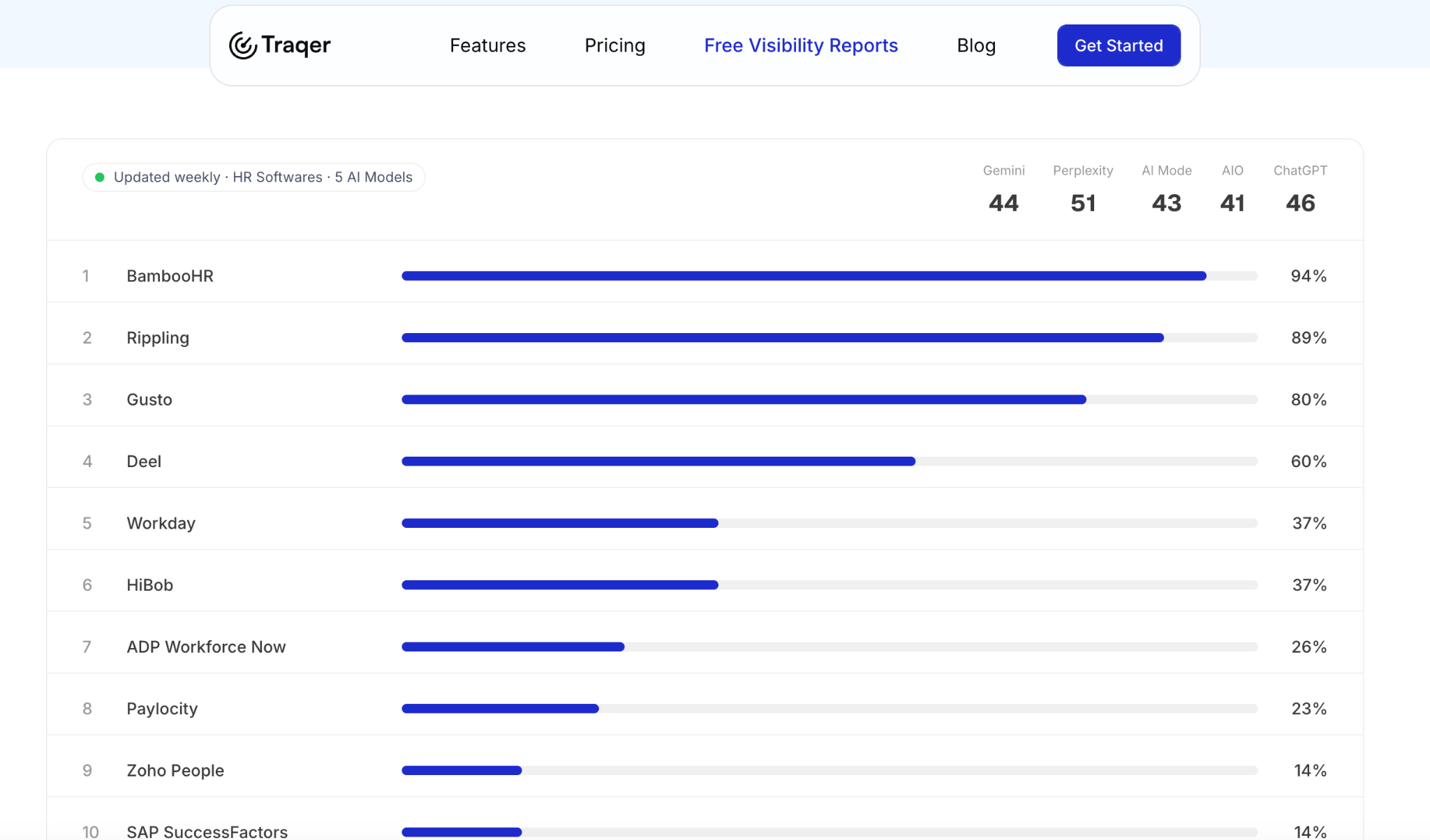
Each industry is tracked across several prompts rather than one, run across ChatGPT, Perplexity, Gemini, Google AI Overviews and AI Mode, and refreshed weekly. So instead of a one-time score for your own domain, you get a per-industry leaderboard you can check yourself against and watch move week to week. If your category isn’t listed yet, you can ask us to add it.
The rankings won’t score your specific domain, though. They show the competitive picture in your category, not a number for your own brand. If you want to check your own brand directly right now, the closest free option is a seven-day trial of our full product, which lets you enter your domain and track your own topics rather than read a leaderboard.
If all you wanted was a check, that’s the quickest answer. The rest of this article explains why the two kinds of check give you such different reads, and what to look for once you want to improve your visibility.
What most AI visibility checkers do, broken down
Most free checkers work the same way. You give the tool your brand name or domain, and it generates a set of prompts related to your category, something like “what’s the best project management software for a small team” or “top alternatives to [competitor].” It sends those prompts to the major LLMs, reads the responses, and checks whether your brand gets named or cited. Then it packages the results into the score and breakdown you get back.
That’s a fast way to find out whether you’re there or thereabouts. But the limitation is inherent in how these tools operate. A checker will fire off a small number of prompts once and report what returns. It’s fine for a directional read, but not a basis for strategic marketing decisions.
Why a single score is a snapshot, not a measurement
Variability. Ask an LLM the same product question several times and you won’t get the same answer each time. The brands mentioned change, the ordering changes, and sometimes the recommendation changes entirely.
There are patterns underneath the noise (the most established brands in a category tend to show up in most responses), but there’s no fixed position like there is with a Google ranking. Any tool that reports you’re “in position 2” for a prompt is describing LLMs as if they were search engines. This isn’t a fringe view anymore. Some of the checker tools themselves now note that a single query is a snapshot rather than a measurement, and that repeated sampling gives you a more representative reading than one run.
Context. Real users don’t type short, repeatable prompts. They have long conversations, and the LLM factors in everything they’ve shared. That includes their company size, their industry, the tools they already use, and the specific problem they’re trying to solve.
Someone at an enterprise switching off Jira and someone running their first small business will get different recommendations from the same opening question, because the model knows things about each of them that never appear in the prompt. We call this the invisible prompts problem. A checker running a clean, logged-out prompt with no personal context is measuring a neutral baseline, not what any particular customer sees.
Nothing can fully recover a real user’s context. But topic-level tracking over time reduces the influence of any single random output, so you get a more representative picture than one prompt run once. That’s the difference between the two kinds of free check above, and it’s why a one-off score and an industry leaderboard can tell you such different things about the same brand.
What differentiates a useful AI visibility tool from a score
If you’ve run a checker and decided you want to do something about your AI visibility, the question shifts from “what’s my score?” to “how do I measure this in a way I can act on?”
A few things differentiate a strategically useful tool from one that gives you a number:
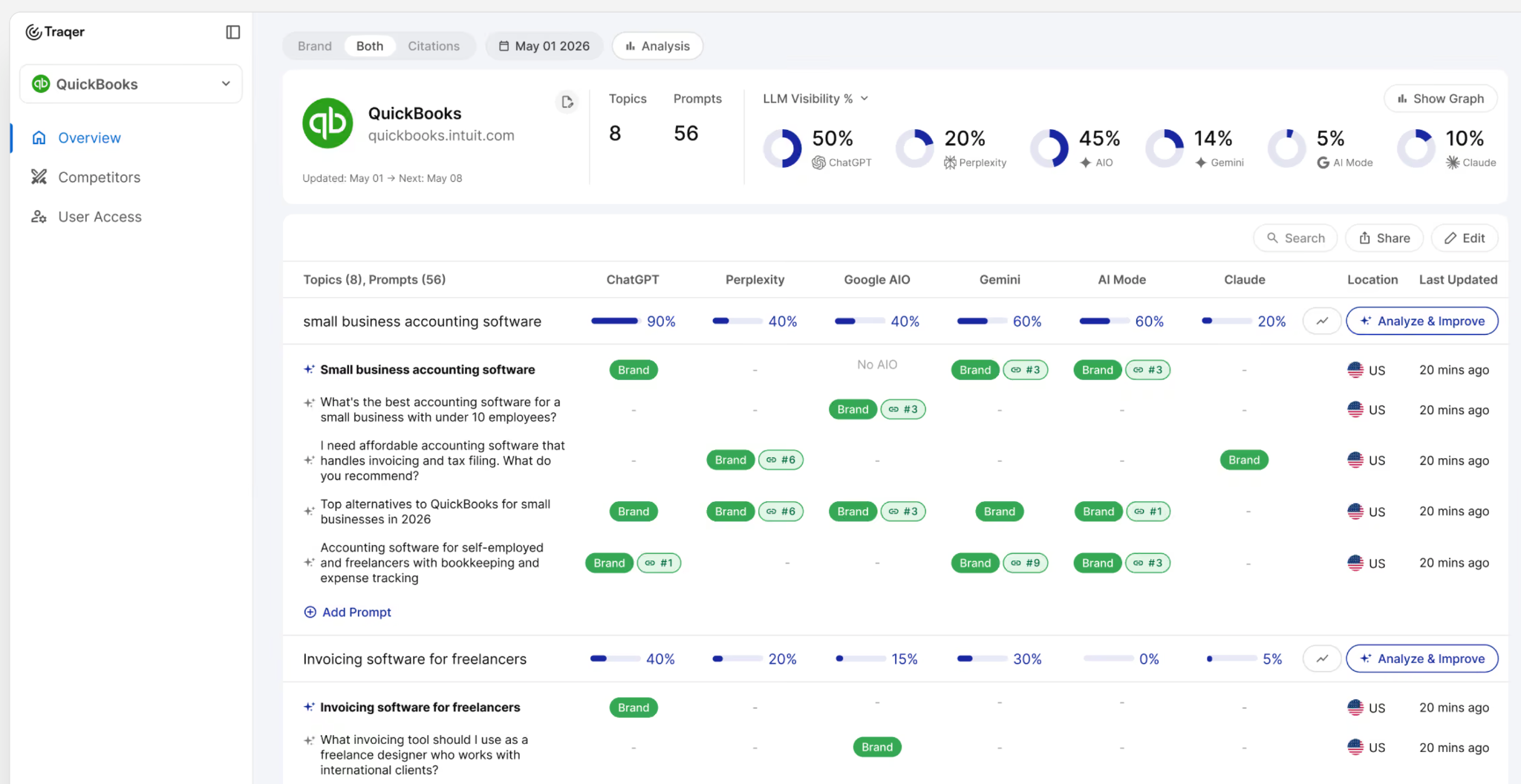
It tracks topics rather than relying on individual prompts. A single prompt produces one output that might not be reproducible. What you actually want is a set of prompts that approach the same buying-intent topic from different angles, so you can see the pattern across all of them. The useful thing to know is how often your brand is showing up when certain relevant topics get researched in the LLMs, however they’re phrased.
Also read: Topic-Based GEO: A Content Strategy that Gets LLMs to Recommend Your Brand
It separates brand mentions from citations. Some checkers fold two different things into one score. A brand mention means the LLM named you in its recommendation, which is what drives leads. A citation means your URL appeared as a source link, which tells you the model drew on your content but says nothing about whether it recommended you. They’re not the same, so you need to see each one on its own. We go deeper on this distinction in our piece on LLM citation tracking.
It breaks results out per LLM. Different LLMs behave differently. Perplexity and Google AI Overviews, for instance, work as web-search summarizers, so brands with strong traditional SEO tend to do reasonably well there. ChatGPT leans more on training data, so strong SEO doesn’t always carry over. Across the brands we track, Perplexity and Gemini tend to sit at roughly 40 to 50% of the visibility that Google AI Overviews and AI Mode produce for the same brand. Average all of that into one score and you lose the insight that informs you where to focus.
Also, some tools query LLMs through their API setups. These tend to return different results from the web products real users see. While it’s impossible for any tool to grasp the customized answers for each user’s search due to their unique context, real logged-out web sessions get far closer to it than an API response does (which is why that’s what we track at Traqer).
Track your own brand with a free trial
The free checkers tell you who’s winning an industry, or where you appear at a given moment for a single search. They don’t track your domain across your own topics over time.
That’s what our full product, Traqer, does, and you can try it free for seven days.
Traqer monitors your visibility across ChatGPT, Claude, Perplexity, Google AI Overviews and Gemini, organized by topic, with brand mentions separated from citations, from real web responses (rather than APIs), refreshed weekly so you can watch it move.
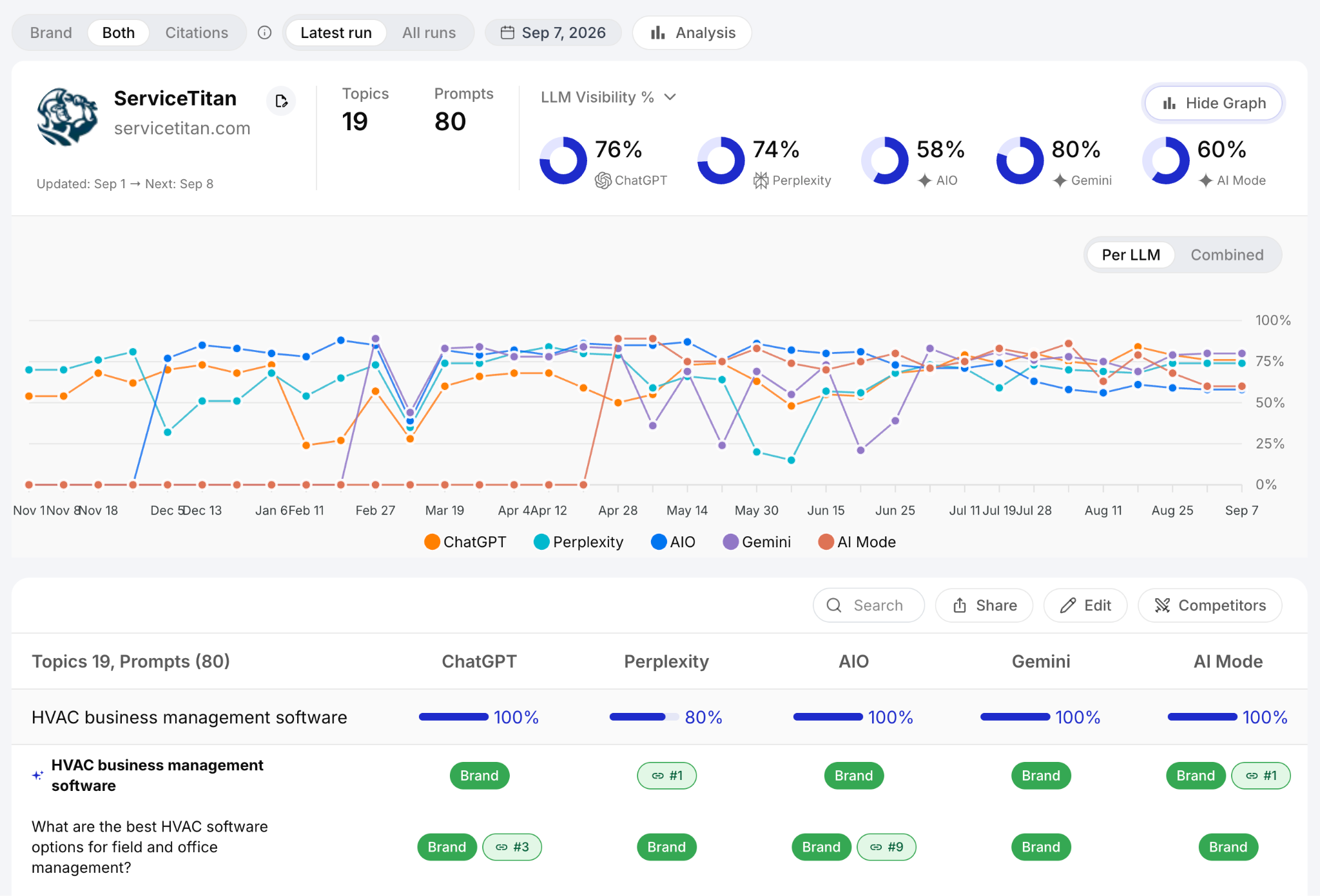
Pricing scales with the number of prompts you track rather than the number of brands, so a second brand or a full client roster doesn’t multiply your bill the way per-brand tools do. If you manage several clients, we broke down what that changes in AI visibility tracking tools for agencies.
A check tells you where you stand today, while ongoing tracking tells you whether anything you do about it is working. To see who the AI tools are recommending in your space right now, look up your category in Traqer’s free AI visibility rankings. To track your own brand and watch the topics that matter to you move week over week, start a free trial.
Traqer is built by Grow and Convert. For the strategy behind how we approach AI visibility, topic-based GEO and prioritized GEO explain the thinking that shaped the tool.