
When Grow and Convert (the agency that built Traqer) started tracking Redline Capital in Traqer, the baseline performance was zero: no citations, no brand mentions across any of the 83 prompts or five LLMs being tracked. Redline is a business funding company with almost no prior web presence. This case study covers what Traqer showed as content was published and rankings started to build.
The baseline: zero visibility across 83 prompts
Redline started investing in content in May 2025 and began tracking progress in Traqer that same November. Across 83 prompts and five LLMs (ChatGPT, Perplexity, Google AI Overviews, AI Mode, and Gemini) Redline had zero visibility; no citations, no brand mentions across any topic or platform.
This is an expected starting position for a brand with no prior web presence. New brands are largely absent from the training data LLMs were initially built on, which reflects the coverage distribution of the broader web: large, established brands appear frequently; newer ones typically don’t.
Therefore, the route into visibility for a brand like Redline is through live web search. When LLMs search the web to answer buying-intent questions, they often pull from pages that rank in traditional search. Content that ranks produces AI visibility. Content that doesn't rank yet, doesn’t.
The Traqer baseline confirmed that position and gave a fixed reference point for everything that followed.
What the combined visibility number showed, and what it hid
By the time this case study was put together, Traqer's combined visibility figure across all 83 prompts being tracked had reached 29%. As a rough directional indicator, that reflects decent growth for Redline. But as an operational metric that can guide strategy, it actually conceals almost everything useful.
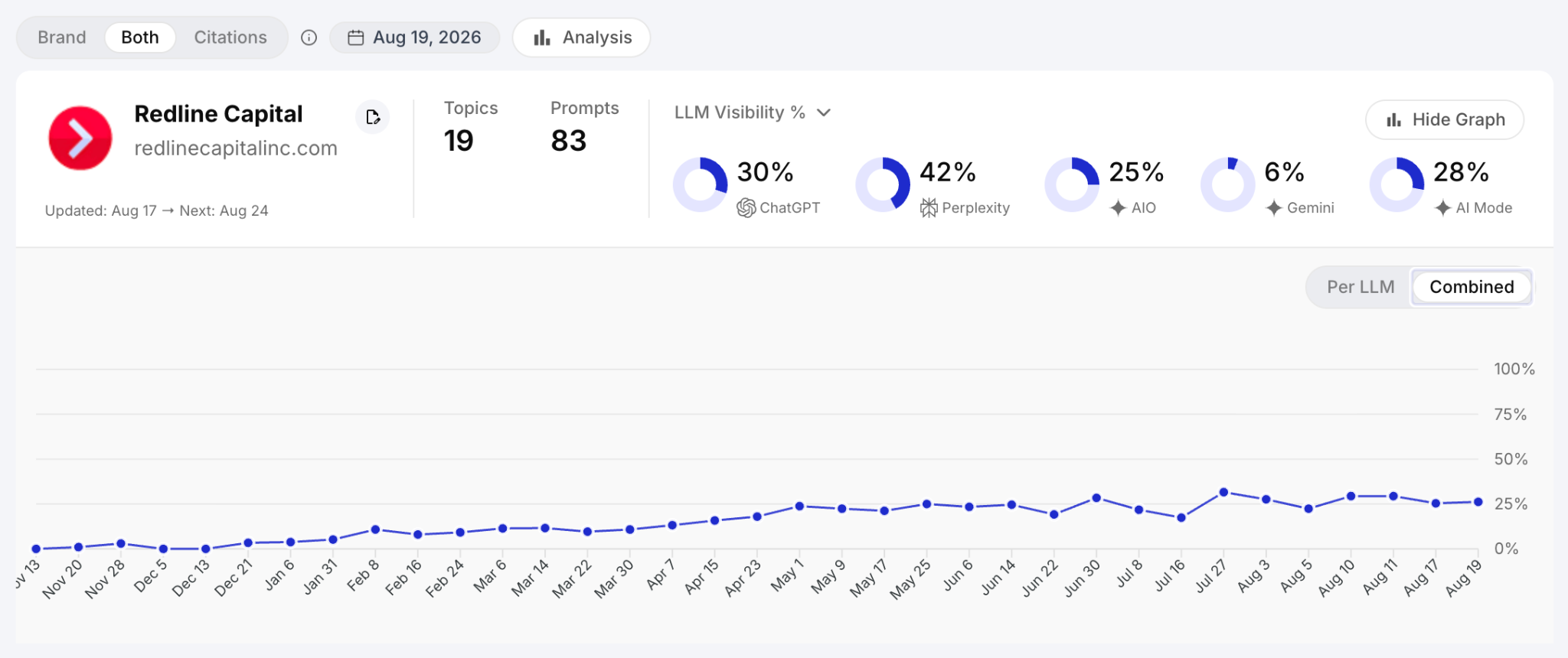
Many AI visibility tools out there default to this kind of single blended percentage: all prompts, all LLMs, citations and brand mentions combined into one number. That figure can be pushed upward by removing topics or prompts where a brand has zero visibility. A team that stops tracking the categories where it isn’t appearing will see the percentage rise without anything changing in how the brand appears in practice.
Traqer tracks visibility by topic rather than a flat prompt list, and reports raw counts as well as percentages. For Redline, that’s 19 topics tracked across five different LLMs; 95 topic-and-LLM combinations. The relevant measures are how many of those 95 combinations show visibility, and how many show high visibility, defined as appearing in more than 50% of the prompts within a topic.
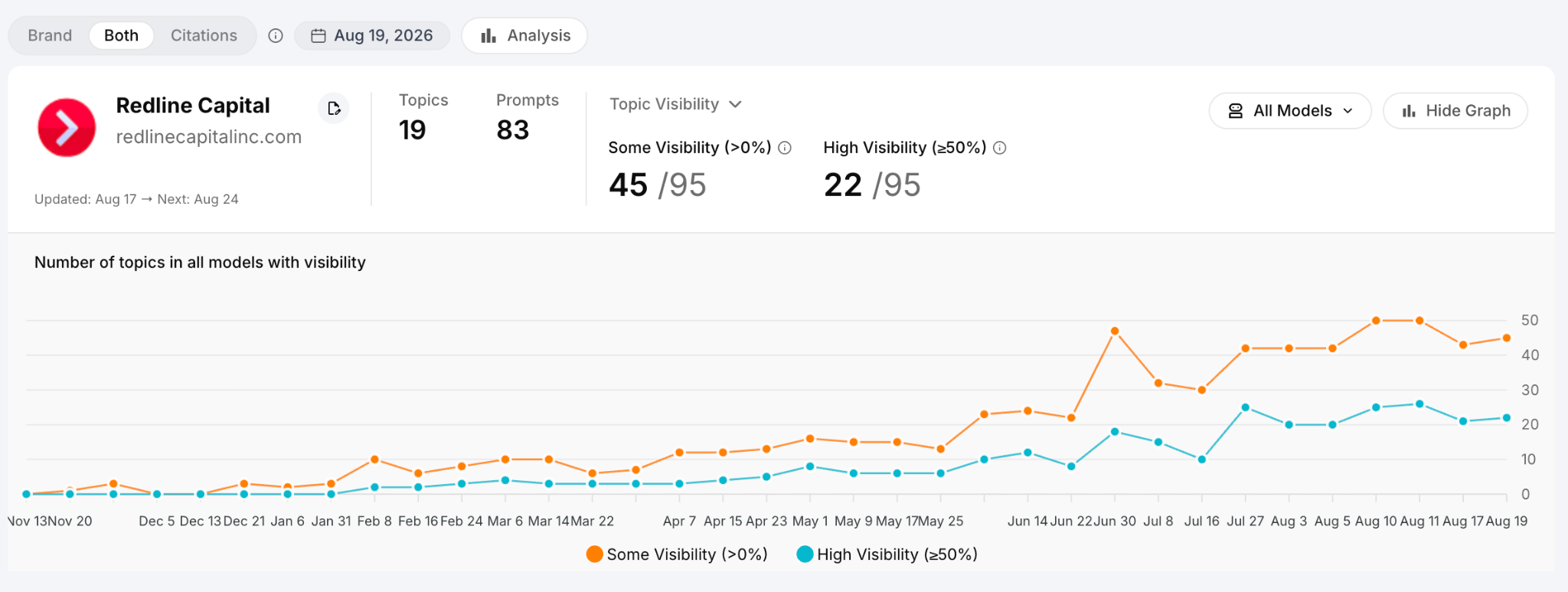
Both counts have grown steadily. Because they're raw counts, removing a topic where Redline has zero visibility doesn't change them. Growth in these numbers reflects actual growth in LLM visibility for topics that actually drive leads and customers. (Note how different this is than measuring AI visibility by counting how often you’re cited for any and all prompts; including ones with no buying intent).
What the topic-level view revealed
The topic-level view is where the Traqer data produces something the marketing team can act on.
Redline has built visibility across a specific cluster of topics: “merchant cash advance for senior care facilities”, “merchant cash advance for electricians”, and “merchant cash advance for lawn care businesses” to name just three. Across these topics, multiple LLMs are citing Redline’s content and regularly naming Redline as a brand in their recommendations.
For other topics, the data looks different. “Revenue-based financing companies” shows zero visibility across all five prompts and all five LLMs: 25 topic-and-LLM combinations with no citation or brand mention. “Construction line of credit” shows one Perplexity citation on one prompt, nothing elsewhere.
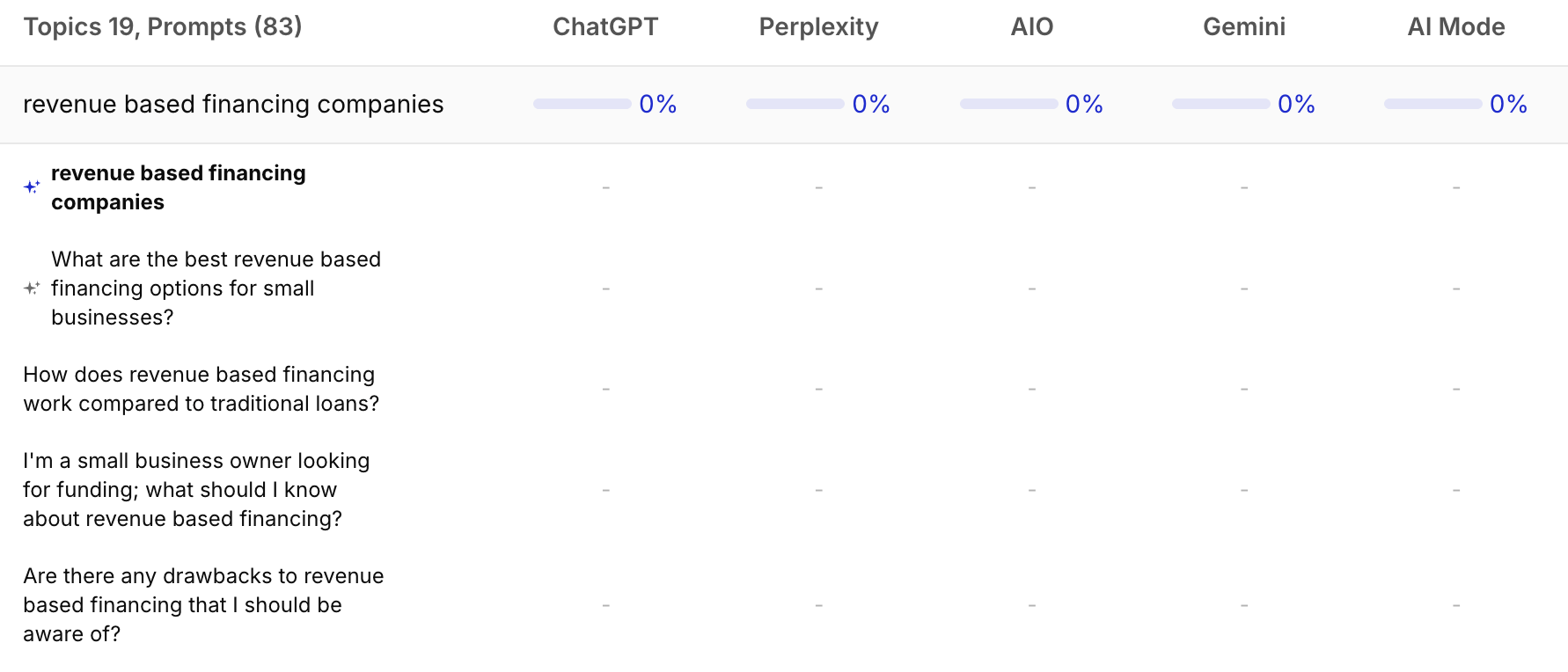
In a blended percentage, those two situations are indistinguishable. They both contribute data points that shift the aggregate number in either direction. But in the topic-level view, they're clearly distinct; and the distinction is the most useful information for guiding content strategy.
The gap between these different levels of performance reflects content coverage. For senior care facilities, electricians, and lawn care, Redline has published specific articles that rank in Google search.
When LLMs search the web for content relevant to a user asking about merchant cash advances for a senior care business, they find those articles. For revenue-based financing companies, that content hasn't been produced yet, and the existing results are dominated by established brands with years of SEO history. In this case, the AI visibility gap is a direct reflection of the SEO gap.
What the “brand mentions” toggle shows about LLM visibility
Traqer separates brand mentions from citations and allows filtering between the two. Switching to “brand mentions only” drops the visibility numbers for Redline, though this is common (i.e., not alarming) because brand mentions are generally harder to acquire than citations. Citations appear in the source list below an AI response. Brand mentions appear in the text of the recommendation itself.
Users are far more likely to act on a recommendation (meaning the LLM literally lists a product or service as a good option for the user in its response) than to scroll down to a citation list and click through to the source. This means being cited and being recommended are different outcomes with different values.
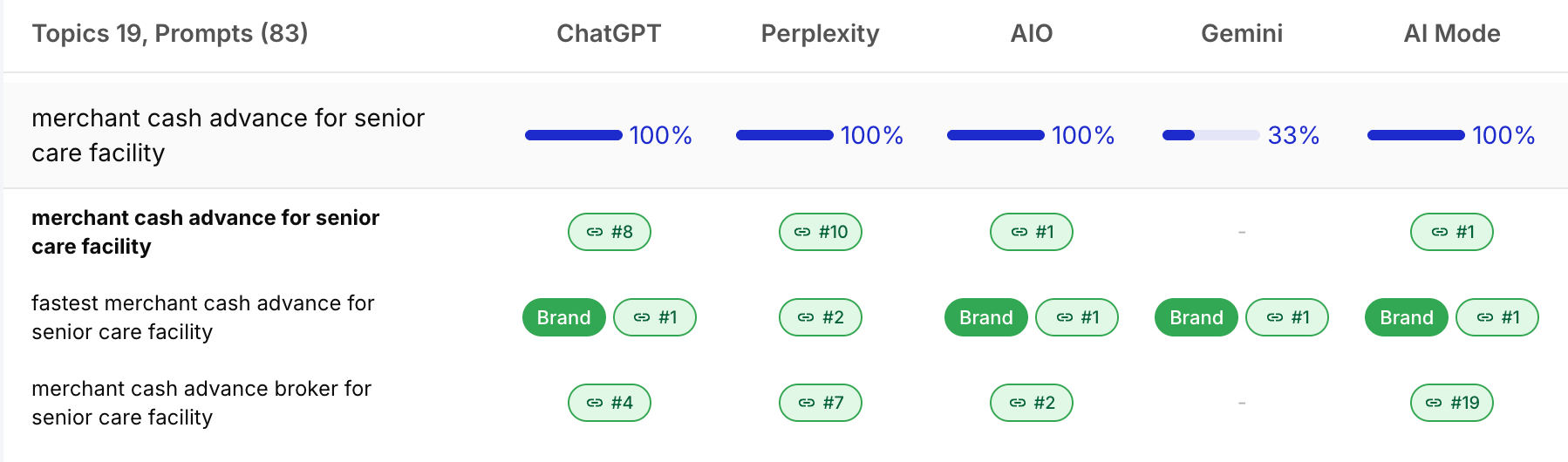
The Traqer data makes both cases visible. At a prompt-level analysis, “merchant cash advance same-day funding” is shown as being ninth in ChatGPT’s source list. The output text names no specific brands; it’s an informational response with no brand recommendation.
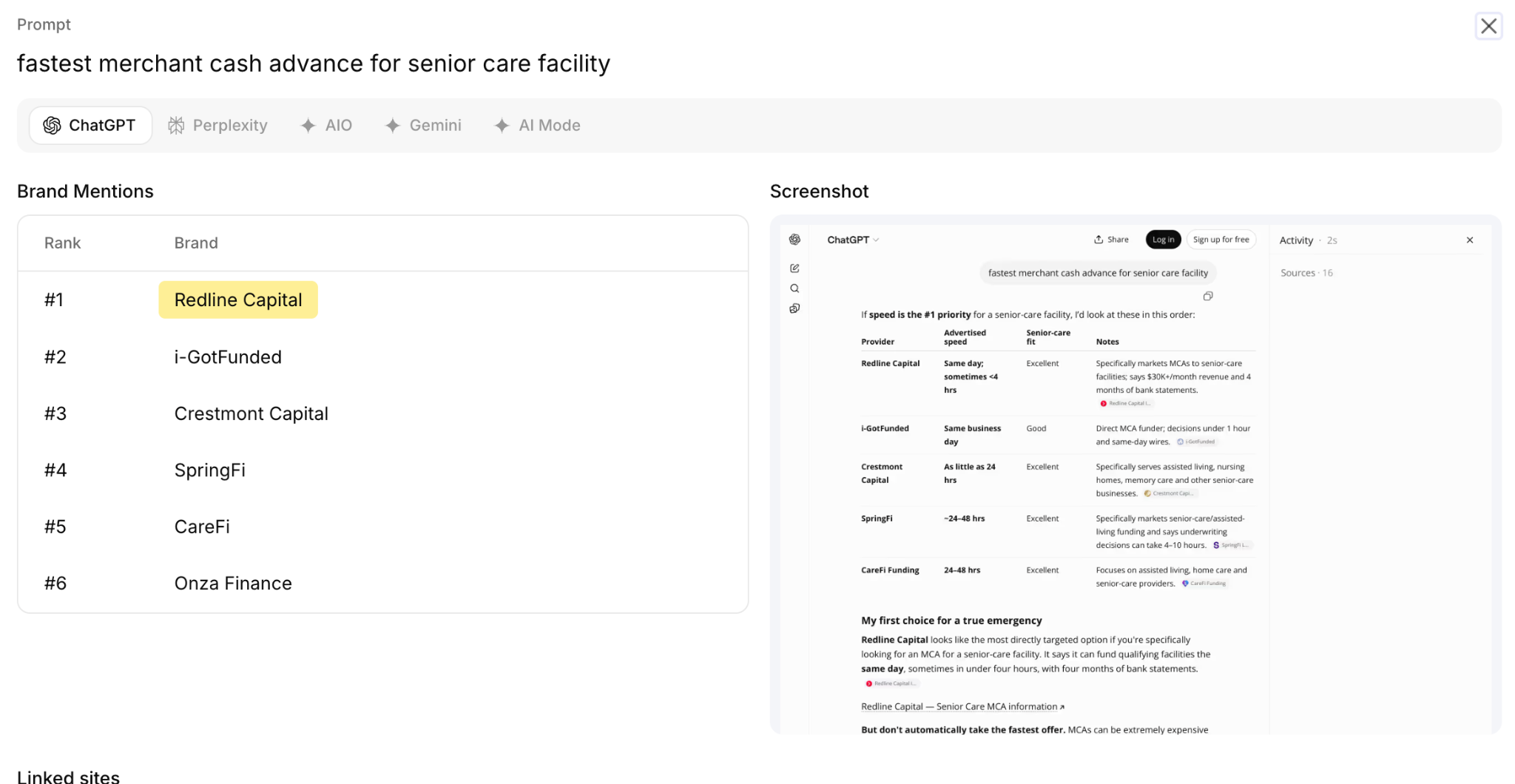
But for the prompt “fastest merchant cash advance for senior care facility” ChatGPT tends to name Redline very high in its brand recommendations, using language that closely mirrors Redline's own article: that it serves senior care facilities and can fund qualifying applicants the same day, based primarily on monthly revenue.
How Traqer's topic-based structure handles prompt variability
No AI visibility tool knows exactly how a real user will phrase their question. Users tend to have full conversations with LLMs, rather than entering isolated keyword queries like they do with Google searches.
The LLM draws on context from prior sessions and information the user has shared across multiple interactions. This is what Grow and Convert calls Invisible Prompts: the personalization layer that makes individual prompt results unreliable as a measurement basis, because no tracking tool can reproduce the context a real user brings to their session.
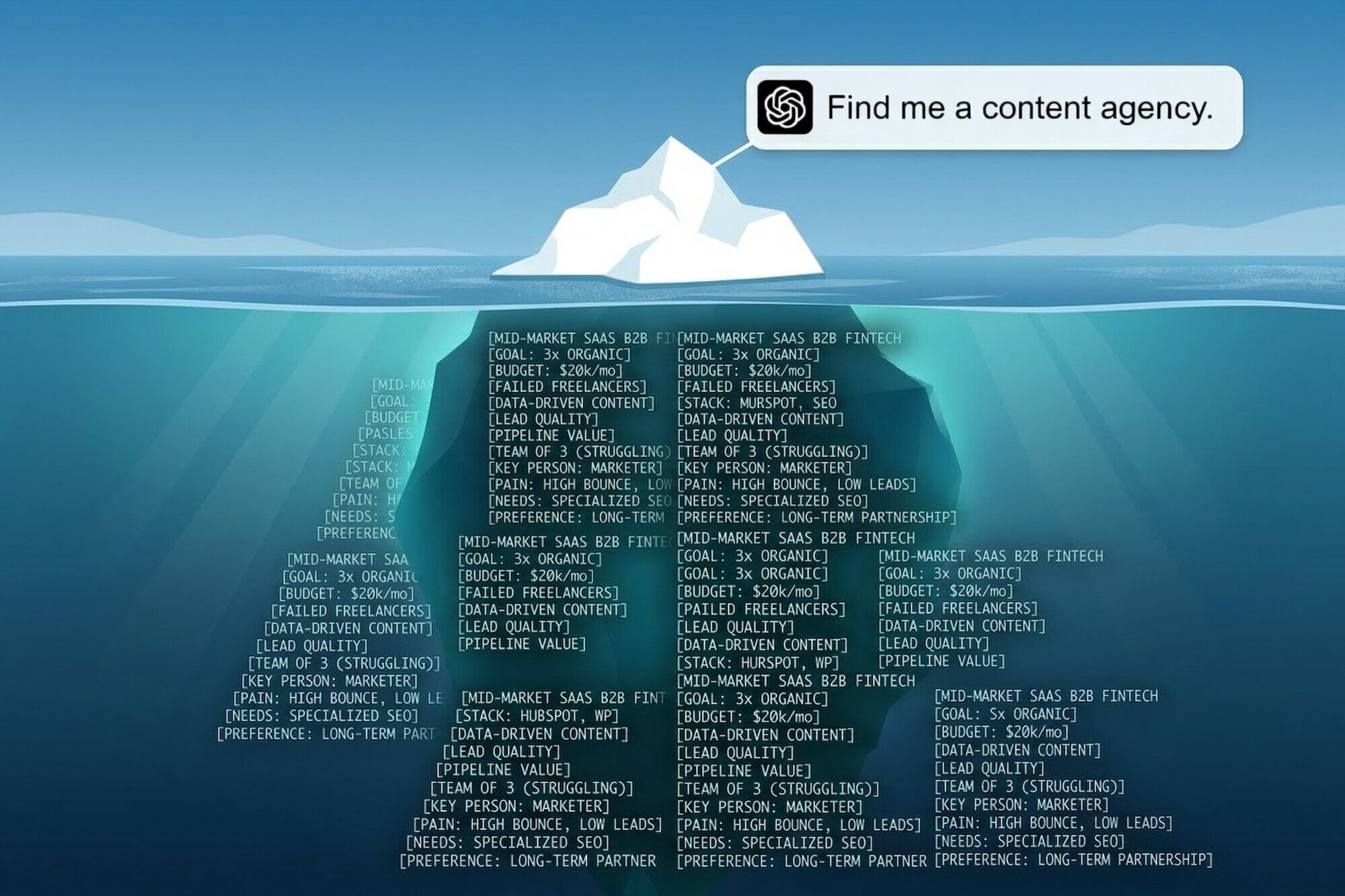
This is one reason why Traqer helps you monitor topics rather than relying on individual prompts. For a topic like “merchant cash advance for senior care facilities” multiple prompts are tracked that approach the subject from different angles. The measure isn't whether Redline appears for one specific phrasing. Rather, Redline measures whether they appear consistently across the range of ways someone might approach that topic. Consistent appearance across several prompt variations is a more reliable signal than a single result.
Put simply: aggregating visibility performance across multiple prompt variations within a topic reduces variability to a level where the results are meaningful.
How this data informs content strategy decisions
The niche, industry-specific topics (e.g., senior care, electricians, lawn care) are producing brand mentions, not just citations. That's the result that matters for a brand trying to build consideration with users who are actively looking for a provider. This is an encouraging sign, and something that can be replicated.
The generic topics (e.g., revenue-based financing, construction line of credit) show zero or near-zero visibility. Traqer reports those as they are rather than absorbing them into an aggregate. Whether to invest in those areas now or extend the niche topic coverage first is a content strategy decision, but it's a decision the team can make with accurate information in front of them rather than a figure that averages across both.
The citation-to-brand-mention gap is also something Traqer will track accurately over time. Redline is appearing as a cited source in some contexts where it isn’t yet being recommended as a brand. As content accumulates and rankings continue to strengthen, brand mentions often follow. The weekly Traqer data will show whether that's happening for Redline, and at what rate.
To track AI visibility across ChatGPT, Perplexity, Google AI Overviews, AI Mode, Gemini, and Claude, Traqer offers a free trial. It shows which topics a brand is visible for, how visibility breaks down per LLM, and the difference between being cited and being recommended.