
Toro TMS builds trucking management software for bulk haulers: dump trucks, fuel tankers, construction materials. It is a narrow slice of the trucking industry that most TMS platforms ignore because their products are built for general freight. Toro saw that gap and built specifically for it.
When Grow and Convert started working with Toro in early 2025, the content strategy was to publish bottom-of-funnel articles targeting the keywords a bulk hauler or fleet manager would search when evaluating software. Not generic trucking content, but specific articles covering the features Toro had built (dispatch, payroll, load management, compliance, ticket management) and the niche use cases where Toro had a clear advantage over broader competitors.
Eighteen months later, 43 of the 46 keywords targeted now rank on page one of Google.
But this piece is about what Traqer showed when Toro started measuring how that content was performing in AI search: which LLMs were recommending them, how visible the brand was across topics, and what the data suggested as next steps.
The starting assumption: SEO rankings lead to AI visibility
The content strategy for Toro was built on Pain Point SEO: identify the keywords people search when they are actively looking to buy, and write content that addresses those keywords in depth. The articles covered category keywords (trucking management software, bulk hauler TMS), feature-specific keywords (dispatch software for trucking, trucking payroll software), comparison keywords (Toro TMS vs. competitors, TMS alternatives), and template keywords that catch people one step before the software decision.
The connection between this kind of content and AI search visibility is direct, and it underpins how Grow and Convert approaches GEO work: LLMs search the web when users ask buying-intent questions. The pages they pull from tend to be the ones that rank in traditional search. If you have detailed, product-specific content that ranks on Google, there is a reasonable expectation it will also get cited by AI when users ask about the same topic.
Traqer is how Toro verifies whether that is happening, where it isn't, and what to do about the gaps. The structure maps directly onto the SEO keyword work: each keyword becomes a topic in Traqer, tracked across a cluster of prompts rather than a single one. That matters because the prompt a real user types into ChatGPT when they want trucking software recommendations is unlikely to be “trucking management software.” It's more likely to be something longer, more specific, and harder to predict.
Tracking a topic across multiple prompt variations is a more accurate reflection of how AI visibility actually works than picking one prompt and hoping it's representative.
What Traqer showed across 18 topics and 90 prompts
Toro TMS is tracked in Traqer across 18 topics and 90 prompts, covering the full range of buying-intent questions a trucking company owner or fleet manager might ask an LLM: what TMS software is best for bulk haulers, what are the best options for managing dump truck operations, how does trucking payroll software work, and so on. Across those 90 prompts, the numbers are pretty strong:
91% visibility on Google AI Overviews
81% visibility on AI Mode
59% visibility on Perplexity
50% visibility on Gemini
35% visibility on ChatGPT
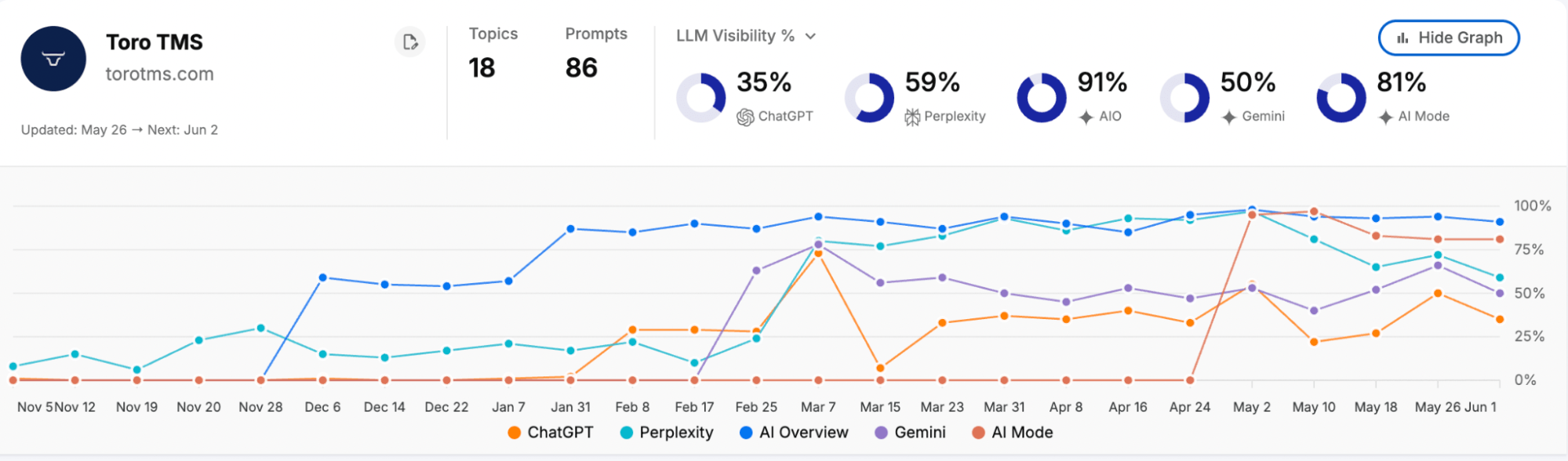
Of the 90 tracked topics, Toro has some visibility in 86 and high visibility (appearing in more than 50% of prompts) in 65. That’s consistent coverage across the topics that matter to the business.
These numbers also illustrate something Traqer is built to make visible: the variation across LLMs is significant, and a blended average across all five would obscure it. 91% on AIO and 35% on ChatGPT describe two meaningfully different situations. Seeing them separately is the point.
Brand-level data: Toro leads its category
Traqer's Brand Level Analysis, which shows brand and domain mentions across all AI responses, puts Toro's position in concrete terms.
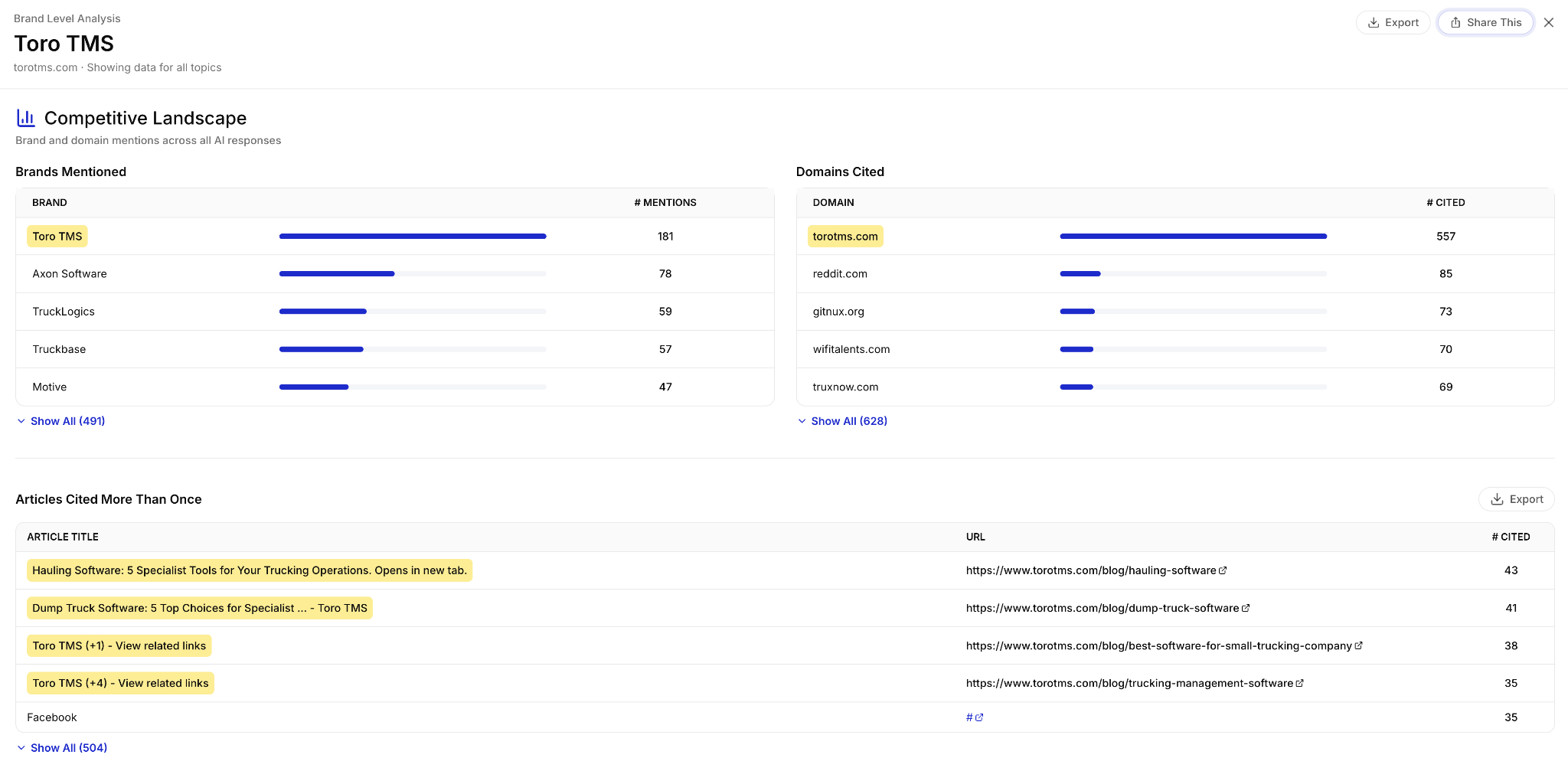
Across all topics and all LLMs, Toro TMS has 181 brand mentions, more than double the next most-mentioned brand in its competitive set (Axon Software at 78). Truckbase, Samsara, and Motive follow further behind. In a category with 525 brands appearing across AI responses, Toro is the most-mentioned.
On the domains cited side, torotms.com leads with 557 citations, far ahead of the next-highest domain. The gap between Toro's own domain and the leading third-party domain (reddit.com at 85) is significant. It confirms that Toro's owned, ranked content is the primary source LLMs are drawing from. The content strategy and the AI visibility are working from the same foundation.
This is the SEO-to-AI connection in measurable form. The detailed, specific content that ranks on Google is what LLMs cite when they recommend Toro to users.
The ChatGPT gap
The one notable gap in the data is ChatGPT. At 35%, Toro's ChatGPT visibility is substantially lower than on Google AI Overviews (91%), AI Mode (81%), Perplexity (59%), and Gemini (50%).
This pattern shows up consistently across different brands using Traqer, and it reflects a structural difference in how these LLMs work. Google AI Overviews and AI Mode behave as search summarisers: they pull from pages that rank in traditional search, so strong SEO rankings translate fairly directly into AI visibility. Perplexity operates similarly. ChatGPT relies more heavily on its training data and, by extension, appears to weight brand mentions across third-party sources more heavily than owned content alone.
Toro's content strategy has focused on owned content: 46 product-specific articles on the Toro site. That has been sufficient to drive strong visibility on the search-based LLMs. For ChatGPT, the gap suggests that third-party mentions (appearances on sites that ChatGPT already draws from) are the lever that still needs work.
Traqer's Analyze view for the trucking management software topic shows the relevant third-party domains: reddit.com (cited 89 times across all topics), youtube.com (83), truxnow.com (78), dumptruckdispatcher.com (67). These are sites LLMs are already pulling from. If Toro is not appearing on them, or appearing infrequently, that is where the ChatGPT gap likely originates.
Why topic-based tracking matters here
Before Traqer, the alternative for measuring AI visibility was manual spot-checking: open ChatGPT, type a prompt, see if Toro came up. This approach has two practical problems. LLM responses are variable enough that a single run of a single prompt tells you very little about actual visibility across that topic area. And one prompt phrasing does not reflect the range of ways a user might approach the same question.
Research from Rand Fishkin at SparkToro found that Claude would need to be asked the same question 1,429 times before producing two answers containing the same brands in the same order. Manual spot-checking against that level of variability is not a measurement methodology.
Traqer tracks each topic across multiple prompt variations, runs them weekly across all five LLMs, and aggregates the results into a visibility percentage per LLM per topic. That is a signal you can act on. For Toro, the 90-prompt tracking set covers the full range of buying-intent questions in the category, which means the visibility percentages reflect something real about how often trucking decision-makers asking AI tools for software recommendations will encounter Toro's name.
The weekly cadence also matters. SEO rankings take time to move, and AI visibility follows the same pattern. A single data point does not tell you whether visibility is building or stalling. Tracked over weeks and months, the trend does. For more on how topic-based tracking works in practice (and at scale), see Traqer's post on AI visibility tracking tools for agencies.
What the data suggests as next steps
The Toro data points to two priorities:
The first is citation outreach, targeting the ChatGPT gap. Traqer's Analyze view identifies which third-party domains LLMs cite most frequently for the trucking management software topic and across the full account. Reddit, YouTube, truxnow.com, and dumptruckdispatcher.com are the leading third-party sources. If existing content on those domains doesn’t mention Toro, getting included is a route to improving ChatGPT visibility.
The second is continuing to publish specific, product-centric content for any topic where visibility is still low. The correlation between SEO rankings and AI visibility is consistent enough across clients that content remains the primary lever. Toro's 91% AIO visibility exists because 43 keywords rank on page one. For any topic where that ranking foundation is not yet in place, AI visibility will follow once it is.
The content that has driven Toro's results to date is also the content that shapes how LLMs describe the product. When ChatGPT or Perplexity recommends Toro, the language it uses tends to mirror the specific details in the articles: what bulk hauler means, what makes Toro's dispatch different, which features matter to construction fleet owners. Generic content produces generic recommendations. The more specific the owned content, the more specific the AI recommendation.
A broader pattern in GEO performance
The Toro data is worth considering alongside a finding that recurs across brands using Traqer: the ChatGPT gap isn’t specific to Toro. Constitution Lending, a Connecticut-based private money lender that Grow and Convert also tracks with Traqer, shows the same pattern: strong visibility on Perplexity and Google AIO, noticeably lower visibility on ChatGPT. The common factor appears to be that both clients have invested primarily in owned content. That is enough for search-based LLMs. For ChatGPT, third-party mentions appear to be an additional requirement.
Traqer makes this pattern visible. Without per-LLM tracking, both clients would see a blended visibility number that looked reasonable, and the specific gap that points toward a specific action would be hidden.
To track how your brand appears across ChatGPT, Perplexity, Google AI Overviews, AI Mode, Gemini, and Claude, Traqer offers a free trial. For an overview of how topic-based AI visibility tracking works, see Traqer's AI visibility tool guide.