

Every good writer will do some version of SERP analysis before they start a bottom-of-funnel piece. They’ll look at what ranks, note which sections the top results cover, and work out what their article needs to compete. But the same applies when you’re trying to get your content to perform in the LLMs.
LLM analysis is something that’s worthwhile to incorporate into your content writing process, and this post explains how you can use our tool, Traqer, to do that. Note that this is still a working hypothesis. Nobody knows exactly how LLMs decide which brands to recommend, but this is the process we’ve started using with clients, and it's consistently surfaced details our content was missing.
How does Traqer help you do LLM analysis?
Before we write any article, we load the target topic into Traqer and add a few prompts that approach that topic from various different angles. These prompts get run via a logged-out browser, so the LLM knows nothing about the “person” who is asking the question. This gap in knowledge makes the analysis exercise useful, because with no personal context to lean on, the LLM indicates its baseline reasoning.
This process tells you how the LLM groups the options, what it would need to know to give a good answer, and which details it would use to decide.
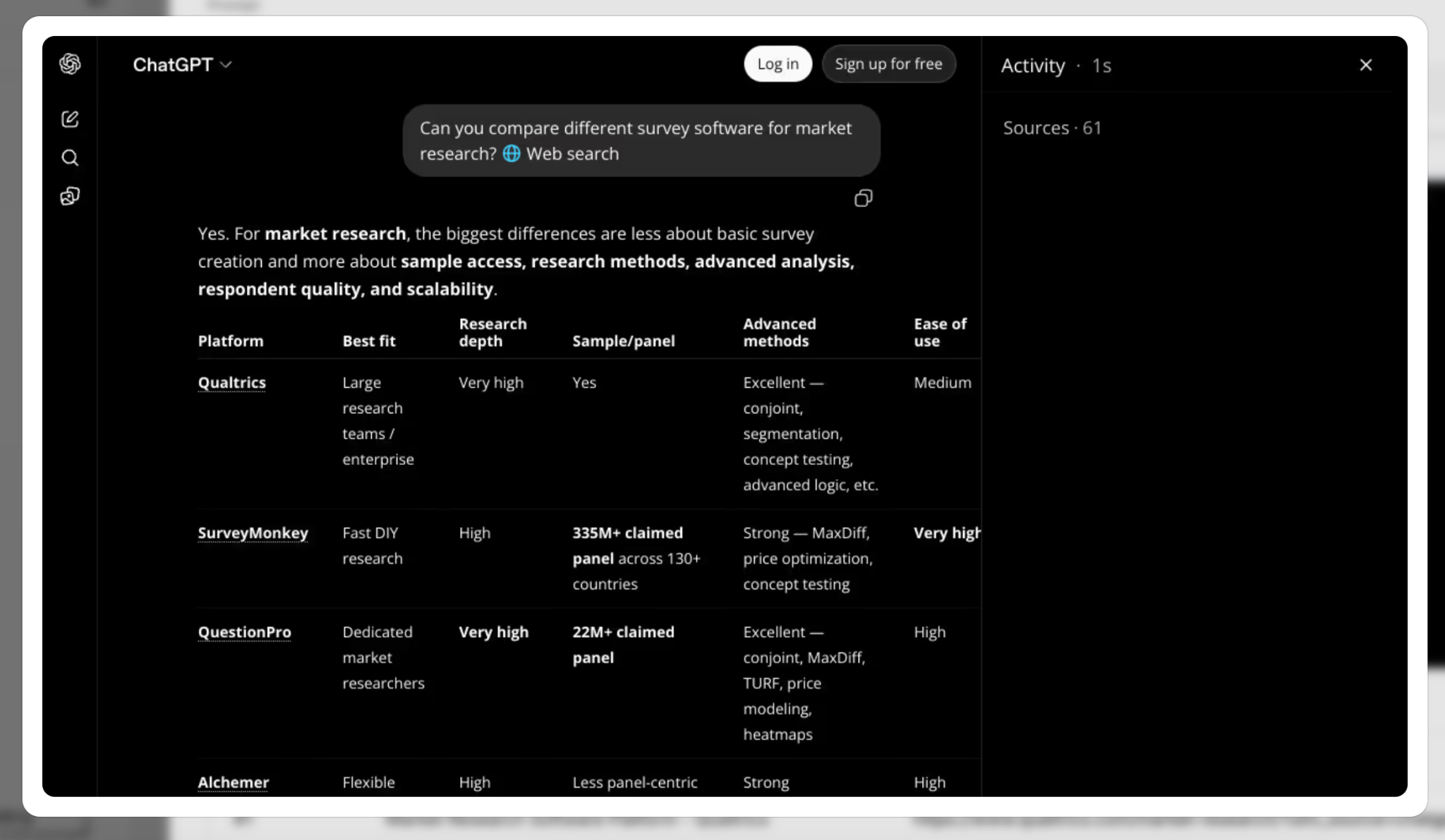
This starts to reflect a content brief, written by the system you’re trying to get recommended in.
The main idea is simple. Look for the attributes the LLM is trying to narrow down by, then make sure your writing addresses them using what you know about your best customer.
The rest of this post walks through how we run this kind of analysis, what we look for, and what we found on a few real accounts being tracked at our content agency, Grow and Convert.
Why logged-out responses tell you so much
When a logged-in user asks an LLM for a recommendation, it already knows a lot about them. It knows what their business does, their rough budget, and what they’ve tried before. We’ve written about this before as invisible prompts. The short prompt you can see is only a small part of what shapes the answer.
A logged-out session has none of that context, so the LLM tries to narrow things down by itself. When we ran our own topic (AEO and GEO agencies) through Traqer, ChatGPT asked the user four things.
It wanted to know the company and industry, whether the business is B2B or B2C, roughly how much they’re willing to spend per month, and whether they want visibility in the US only or globally.
Those questions are a list of the variables the LLM uses to personalize its recommendations. When a logged-in user asks the same thing, the model already has those answers and it matches them against what it knows about each agency. If your content never says if you work with B2B or B2C companies, what industries you serve, or whether your results were in the US or elsewhere, the LLM has nothing to match.
So if the LLM is narrowing by B2B or B2C, your post should say plainly which one the product is best for.
How to run an LLM analysis for your content marketing
1. Load the topic with several phrasings (prompts)
Start with the topic you’re about to write for, and look at how the LLMs answer it across multiple different prompts. In Traqer, every topic already has several prompts running across ChatGPT, Perplexity, Google AI Overviews, AI Mode and Gemini, so you can click straight into the responses. If you’re doing it manually, run four or five different phrasings in incognito windows in each LLM you care about.
One phrasing isn't enough. The responses change a lot between LLMs, and they change between phrasings of the same question. You’re looking for the patterns that repeat.
2. Read the responses for five things:
How the LLM categorizes the options. For one client (a school) we looked at prompts asking for alternative schools and their programs. The LLMs consistently grouped schools into types such as Montessori, Waldorf, expeditionary learning and democratic schools. For our own agency topic, ChatGPT sorted agencies by buyer, with separate groups for B2B SaaS companies, content-heavy production, and small to mid-sized businesses that want SEO bundled in. If the LLM puts options into categories, your content should make it obvious which category you belong in.
What the LLM says the user should compare. One response told parents that the most useful way to compare schools is to start with the child’s needs. It then laid out how to slice the options almost like a comparison table. If you're writing a comparison or a top-level list post, build your table around the same criteria. You'll be handing the LLM information in the structure it’s already using.
What details it offers to provide. After listing schools, one response offered to share each school’s programs, tuition and enrollment details. That's the LLM telling you what it considers important for this decision. A piece that leaves out tuition or enrollment information is probably missing something the model thinks the user needs.
What it says to look for. On the agency topic, ChatGPT explained how AEO works and then told the user to check whether an agency measures AI visibility, whether it has a real entity strategy, and whether it adapts content for AI retrieval. Each of those could be a section or an FAQ on a page that wants to show up for that topic.
The fan-out queries. Many responses show the searches the LLM ran behind the scenes. For the alternative schools prompt, one fan-out query combined “alternative schools” and “unique programs” with Montessori, Waldorf, expeditionary learning and democratic schools. Another combined alternative schools with New York City, charter, Montessori and private schools. Treat these like word associations. They show which concepts the model connects to your topic, and they're a good check on whether your piece covers them.
3. Look for what your content is missing
The most valuable output of the analysis is usually a gap. For a motion capture software client, we looked at how ChatGPT answered “best motion tracking software for sports” logged out. It split the category into four buckets: AI video tracking, biomechanics movement analysis, team performance tracking, and real-time 3D motion capture. The client’s content had mostly positioned the product around biomechanics. It had never really covered team performance tracking, even though the product handles it.
That gap probably warrants its own piece. From a pure SEO point of view, you might argue a separate team performance article risks cannibalizing the existing one. For AI search, it’s a different use case with a different buyer, and the product works differently in that context (processing multiple athletes at once, for example). An LLM trying to match a coach with the right tool needs content that addresses that situation directly.
We saw the same thing with a booking software client that serves food tour companies. The responses listed the features people care about in that category, including OTA reseller integrations and automated reminders. Real users don't type “booking software for food tour companies” into ChatGPT. They say they need something that integrates with Viator, or that their current tool doesn't send automated reminders.
If your content doesn't cover those details, your product won't be the match when someone asks.
4. Turn it into the outline
Once you’ve read through the responses, you should have the categories the LLM uses, the criteria it compares on, the details it expects, and the use cases or personas it splits the topic into.
Those can inform the sections of your piece, the columns in your comparison table, and the specifics you need to pull from the client, sales team or case studies before you start writing.
What this changes about how you write
Pain point SEO starts with the search intent behind a keyword. That still gets you ranking in Google, and ranking in Google is, in many cases, still how LLMs find you when they search the web. What LLM analysis adds is a view of the details the model uses to decide who to recommend. Those details are about personas, use cases and specifics, and they're more granular than search intent.
That applies to case studies as much as articles. If the LLM asks whether a business is B2B or B2C, what industry it’s in, and whether it needs US or global visibility, then a case study that states all three gives the model something concrete to match against a real user's situation. A case study that only says “we grew leads 3x” gives it much less to work with there.
A few caveats: what to be aware of in this approach
A logged-out response is not what your real buyer sees. Their answer is shaped by everything the LLM knows about them, which is exactly why you can't predict it.
The logged-out view is useful because it shows you the questions the model asks when it lacks that context, and those questions point to the details it uses when it has it.
Single responses are noisy. The same prompt can produce a different answer tomorrow, so base your outline on what shows up repeatedly across the different phrasings and platforms.
You also shouldn’t add everything the LLM mentions. Filter it through what the product actually does and who it’s actually for. The goal is to make sure the situations where your product is the best fit are written down clearly, in enough detail for an LLM to recognize them.
Try it on your next piece
The next time you're about to write a bottom-of-funnel article, spend a few minutes reading how the LLMs answer the topic before you outline. You’ll almost always find a category, criterion or use case you weren't planning to cover. Then match those attributes to what you know about your best customer, and write them into the piece.
If you want to run this across a set of client topics without doing it by hand in incognito windows, Traqer runs every prompt in a logged-out browser and keeps the full responses and fan-out queries for each topic.