
Between January and September 2026, brand visibility for one of Grow and Convert’s B2B SaaS clients rose from 23% to 64% across six LLMs, more than doubling over the period. This case study covers what Traqer made visible, how its topic-based structure reflects the content strategy, and how the data can be used to report accurately on the results of content work.
The client is a global B2B SaaS brand that works with a wide range of verticals and with businesses big and small. Grow and Convert started working with them in 2023 and built rankings for specific bottom-of-funnel keywords using Pain Point SEO. The question then was what else could be done to extend that visibility to AI engines and show up in more of those conversations. The content strategy is covered in Grow and Convert’s full case study.
How Traqer was set up around the content strategy
The strategy followed Grow and Convert’s Personalized GEO framework. It mapped every product angle, found long-tail keywords around each angle, and wrote specific, detailed content for each keyword, supported by case studies about the client’s existing customers.
Traqer tracks the client across 35 topics and 217 prompts on six LLMs: ChatGPT, Perplexity, Google AI Overviews, AI Mode, Gemini, and Claude. The topics were set up around the angles from that topic map: a vertical, a feature, a use case or pain point, and a core category keyword. Each topic has a set of related prompts. Some are short and keyword-style, and some are longer and conversational.
Because the topics follow the topic map, results can be read against the content that was written. Visibility in a vertical topic relates to the vertical-specific content, and visibility in a how-to topic relates to the use-case and pain-point content.
Visibility is tracked by topic area, not by single prompts, because that is more accurate. It measures how visible the client is when the subject comes up, regardless of the exact phrasing. Grow and Convert covers the reasoning in its posts on Invisible Prompts and topic-based visibility.
What Traqer showed overall
Combined brand visibility was 23% on January 5 and 64% on September 29. The same view shows per-LLM visibility of 43% on ChatGPT, 68% on Perplexity, 74% on Google AI Overviews, 63% on Gemini, 75% on AI Mode, and 70% on Claude.
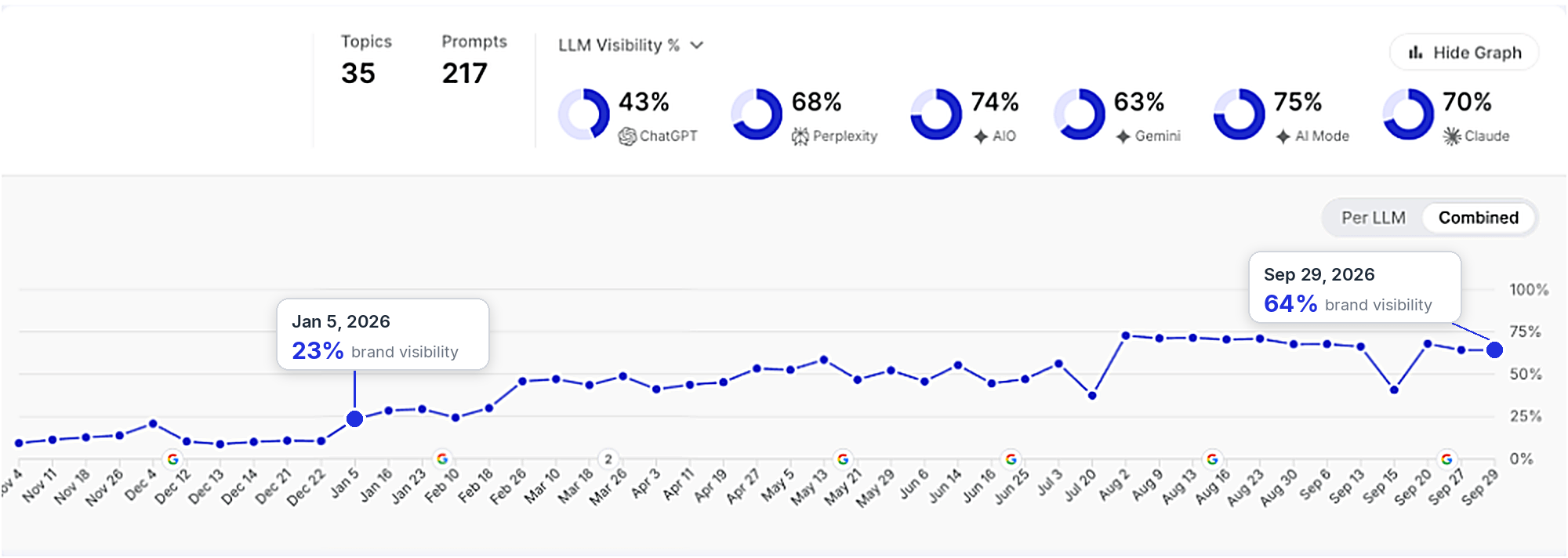
Traqer’s topic visibility chart counts the topics with visibility in each model. With 35 topics and six models, the maximum is 210. On January 5, 65 showed some visibility (above 0% of prompts) and 46 showed high visibility (50% or more of prompts). On September 29, those counts were 201 and 154, so the client had visibility in nearly every tracked topic.
Results by topic type
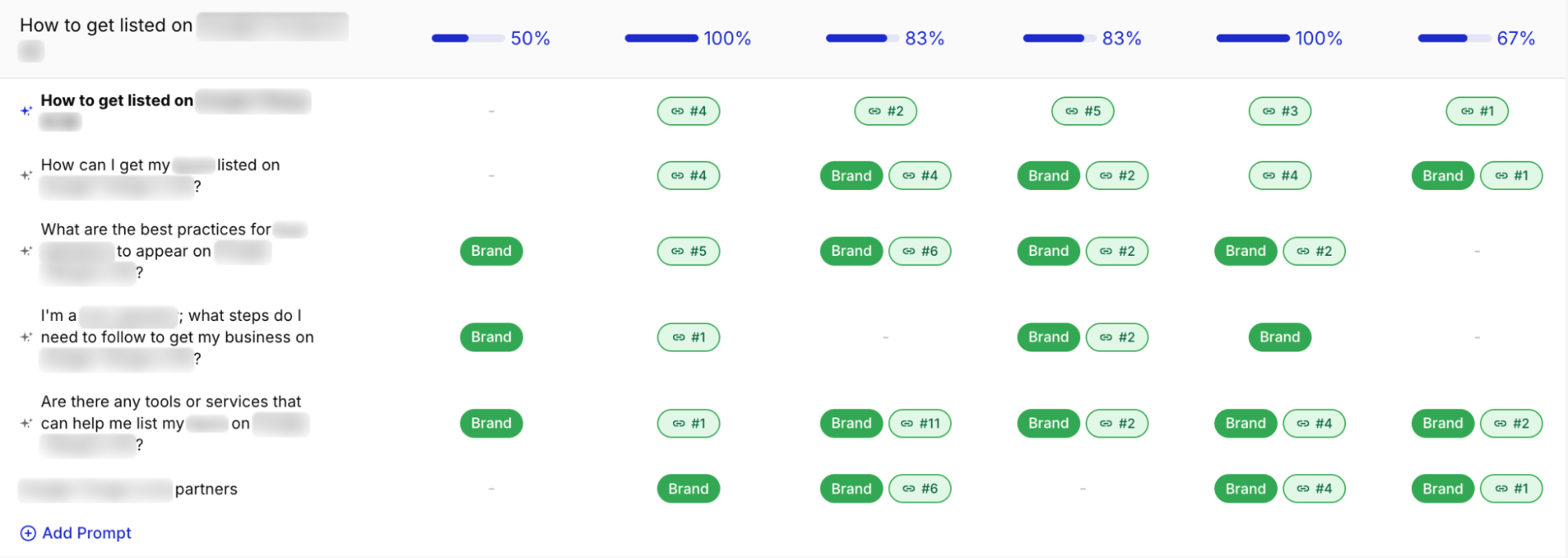
The topics below are representative examples. The figures are the share of weekly runs in which the client was mentioned or cited on the prompt in question.
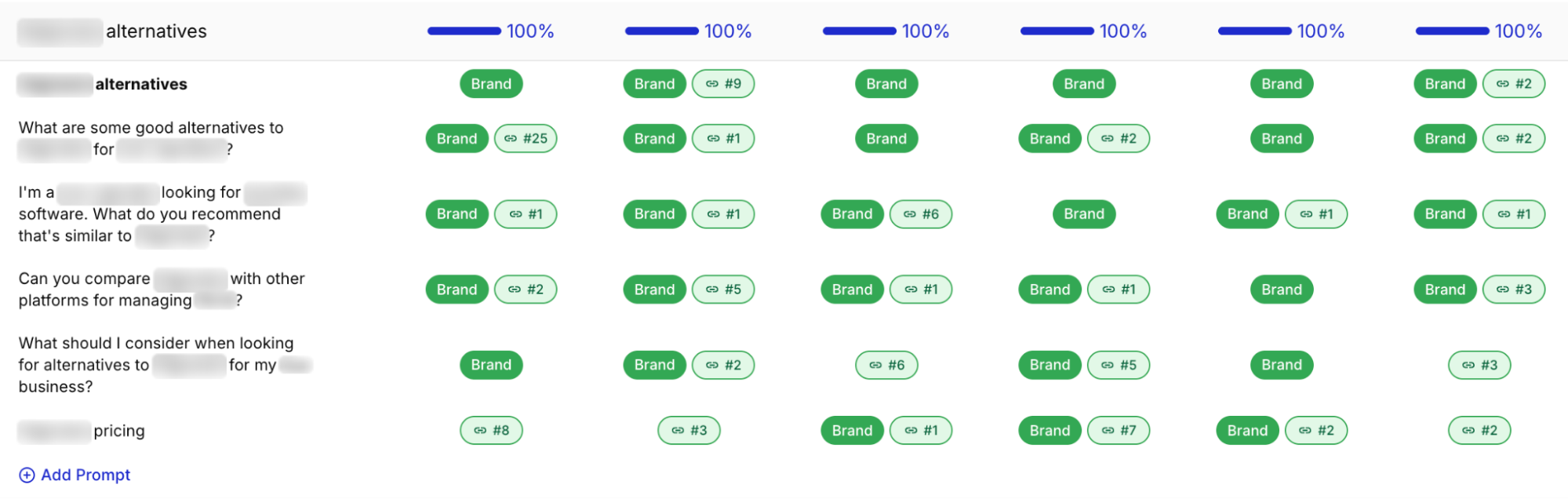
On a vertical-specific prompt, the client is mentioned in 91% of Perplexity runs, 90% of Google AI Overviews runs, 90% of Gemini runs, 91% of AI Mode runs, and 82% of Claude runs. ChatGPT is covered in the next section.
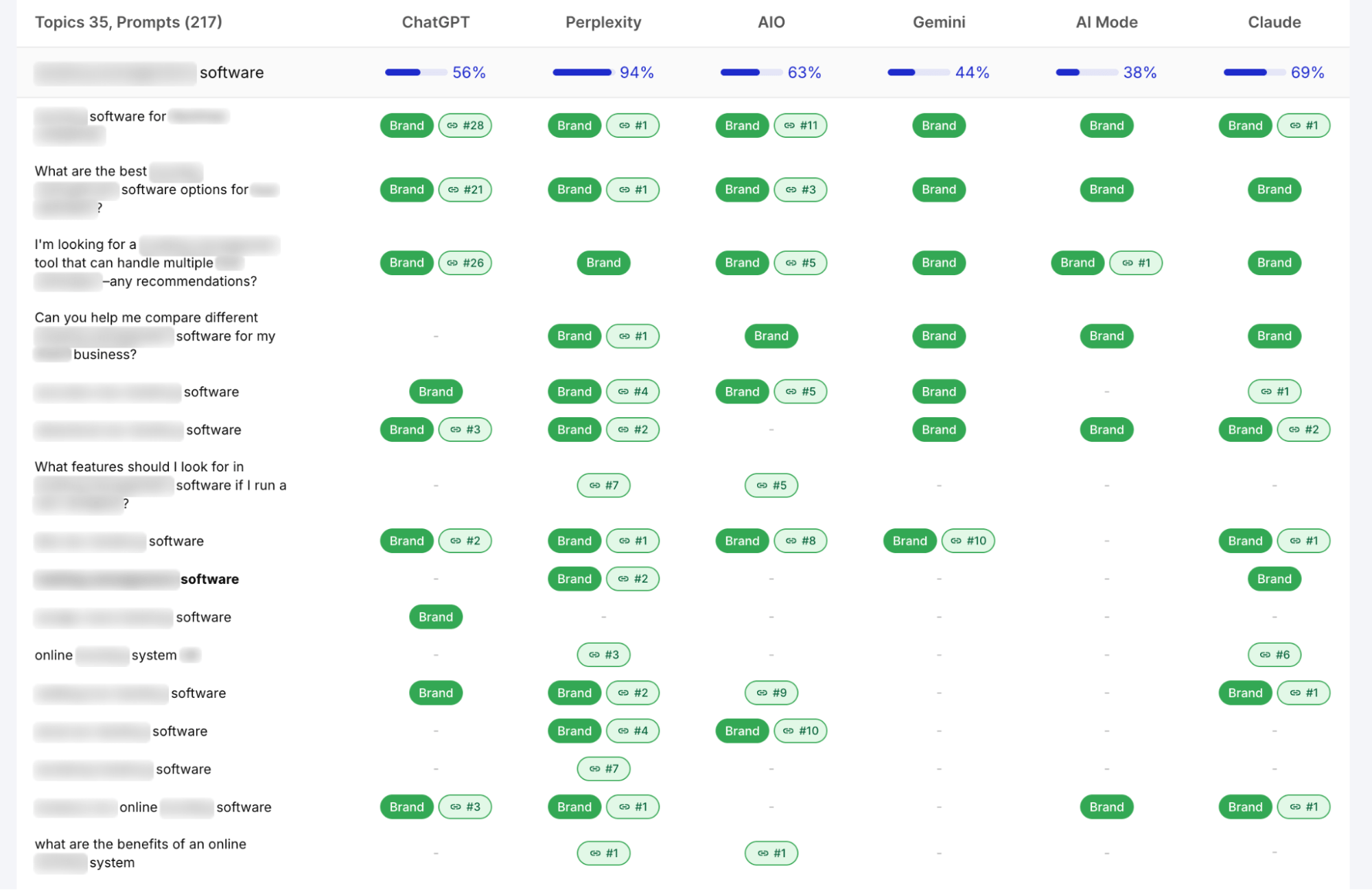
In a competitor alternatives topic, the client is mentioned on the main prompt in 76% of ChatGPT runs, 88% of Perplexity runs, 97% of Google AI Overviews runs, 82% of Gemini runs, 95% of AI Mode runs, and 100% of Claude runs. On a pricing prompt in that topic, the client’s content is cited in 93% of Perplexity runs and 100% of Google AI Overviews and AI Mode runs. When someone asks what a competitor costs, the client’s article is a go-to source.
In a jobs-to-be-done topic (i.e., a “how to…” topic) about becoming a supplier on a major third-party marketplace, the client is mentioned on the main prompt in 100% of Google AI Overviews runs, 83% of Gemini runs, 89% of AI Mode runs, and 91% of Claude runs. It is cited in 100% of Google AI Overviews and Claude runs and 94% of AI Mode runs.
Run history and stability
The overall figures show the direction of travel. Run history shows how consistently the client appears.
Traqer runs every prompt weekly and saves every result. LLMs can give different answers to the same prompt, so a single run might catch a good result or a bad one. Saving every run shows how often the client appears over weeks and months.
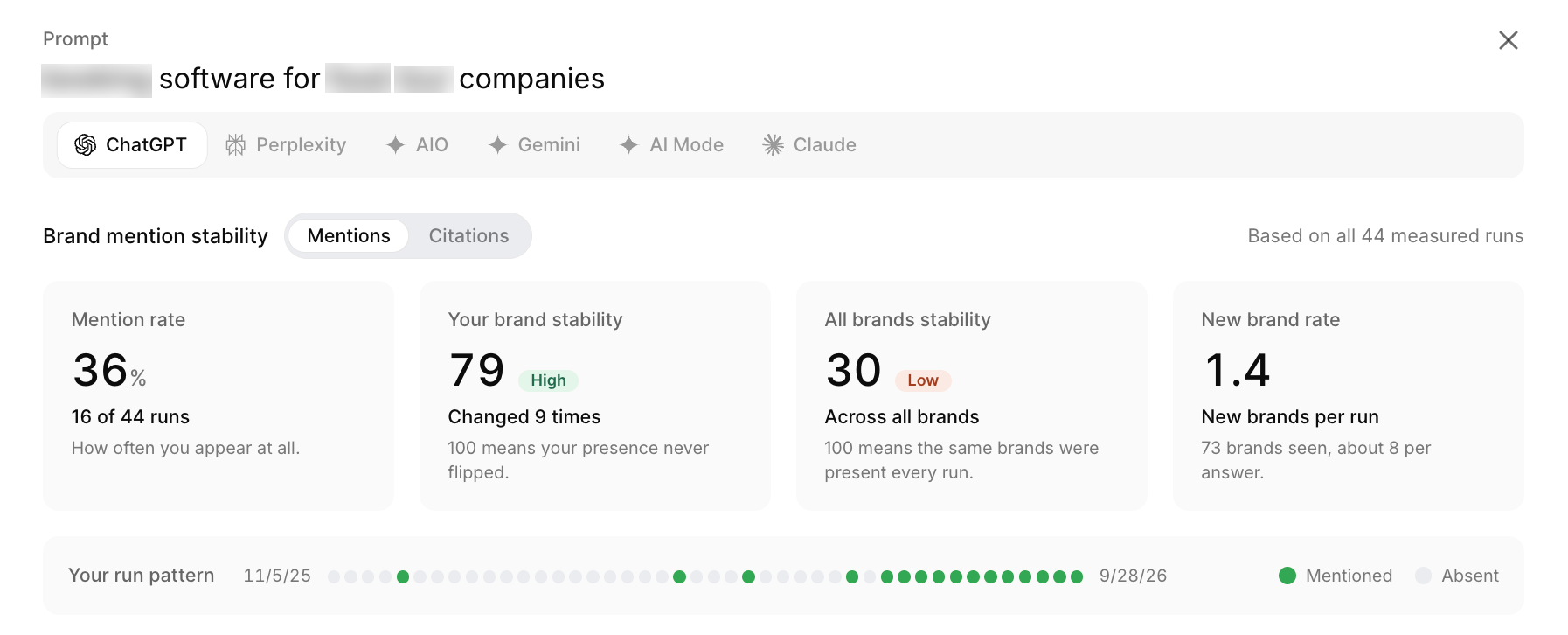
The ChatGPT run history for the vertical-specific prompt shows what this looks like. Tracking began in November 2025. The client showed up only occasionally in the early months, and it has been mentioned in every one of the last 12 runs. The overall mention rate is 36%, or 16 of 44 runs.
A single overall rate doesn’t show this momentum, because it includes the early history. The run pattern shows the client has been mentioned in every run for the last 12 weeks.
Traqer also reports stability scores for the prompt. Brand stability is 79, which Traqer rates as high, meaning the client’s presence rarely flips between runs. Once it started showing up, it stayed. All-brand stability is 30, rated low, with 1.4 new brands per run. ChatGPT has named 73 different brands across these runs, about eight per answer, with one to two new brands appearing every week. ChatGPT keeps reshuffling which brands it recommends for this prompt, and the client has held its spot.
Reporting the results to the client
The charts in Grow and Convert’s case study come from Traqer: overall visibility over time, topic visibility counts, per-LLM results by topic, and the run history for a single prompt. They show the same result at four levels, from the overall trend down to individual weekly runs.
The client has also seen this visibility show up as attributable traffic from AI sources. From January through September, overall AI traffic is up about 1,900% (roughly 20x), and AI traffic to articles is up about 750% (roughly 8.5x).
Free trials directly attributable to traffic from AI tools are up about 75% over the same period.
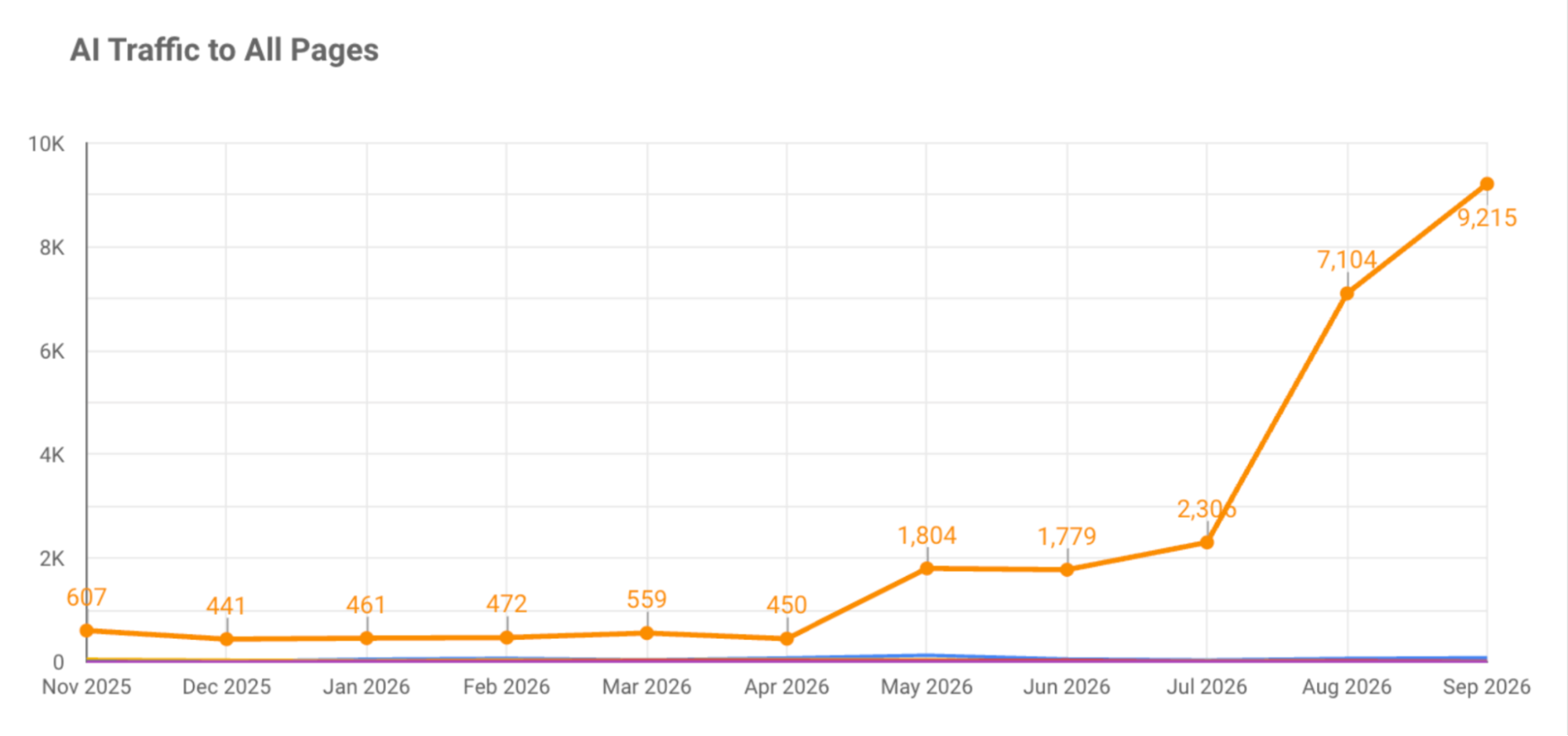
A lot of AI visibility doesn’t result in traffic that can be traced clearly to AI tools. Users often don’t click into a brand’s site from a source link in ChatGPT or Claude. They’ll see a product recommended in the LLM’s output, open a new tab, and search for the brand name. The figures above are therefore a lower-bound estimate, and the real number of trials from AI tools is almost certainly higher.
For an agency, attributable traffic on its own understates what content work has produced. Visibility data in Traqer gives a second measure to report alongside it, with a run history that shows how the result built up.
Using the data to help decide what to do next
Brand mentions show that the client is named in LLM answers. Citations show how much LLMs rely on its content, which ties the results back to the articles themselves. Together with the visibility percentages and run data, they show how reliably the client appears.That includes which topics the client owns and where its content is the source LLMs turn to. Grow and Convert also uses this data to decide where to build next.
For agencies reporting on AI visibility, Traqer tracks ChatGPT, Perplexity, Google AI Overviews, AI Mode, Gemini, and Claude by topic. Try Traqer, or see AI visibility tracking tools for agencies and the AI visibility tool overview for more.