

Working on AI search at our agency, Grow and Convert, has led us to the conclusion that GEO is far less predictable than SEO. With traditional SEO, you pick a keyword, create content, build links, and over time you rank. You know which keywords have volume, which pages rank, and where you stand. AI search is different, with uncertainty at several steps.
Prompts. You do not know exactly what users type, because they do not use short, repeatable keywords. They have long conversations unique to them.
Context. Even if you know the prompt, you or your tool will not get the same answer as a real user, because the model factors in that user’s history, memory, and context. We cover this in our piece on invisible prompts.
Repeatability. The same user asking the same prompt repeatedly will get different answers and citations each time.
So what do you do with that uncertainty? The answer rests on one fact. LLMs still run on content.
This is a Traqer version of a framework first published on the Grow and Convert blog. You can read the original article here. Traqer is the AI visibility tool built by the Grow and Convert team, and it is built around the topic-level measurement this framework depends on.
How search changes from SEO to AI search
In SEO, people search with short keywords and mostly see the same results. There is some personalization by location and history, but it’s relatively minor. If you and I search “project management software,” we see similar results. That seems fine until you consider that you might be at an enterprise moving off Jira with specific requirements, while I am a small business owner looking for my first tool.
Those details change what software fits each of us, but Google does not know them to such a level, so it serves the same ten links. SEO handled this by targeting longer-tail variants like “enterprise project management software,” which still does not capture the real nuance. There are effectively unlimited specific situations behind any search, and traditional search had no good way to handle that context.
AI search does. Each user has a personal conversation where they share a lot of context, and the model learns their company size, existing tools, and specific pain points from the current thread and from prior history. It can then recommend products tailored to their situation. In one test, asking Claude for the best project management software “for us” returned an answer that already knew what our company was and how big it is, without any of that being typed into the prompt. We call these invisible prompts.
The models aren’t only surfacing articles from high-authority domains. They work out what a user needs, search the web, read the results, combine that with what they already know, and recommend the product that best fits the user’s specific pain points. That is a different dynamic from SEO, and it changes the content you need to produce. Generic “what is project management” content will not do it. You need content that covers the kinds of customers you serve, the use cases and scenarios you handle, the pain points you solve and for whom, the features that matter and when they matter, the outcomes customers see, how you compare to competitors, and case studies that show results.
This content does not have to be SEO blog posts alone. The same answers can live on your homepage, product and solution pages, in case studies, and in off-site mentions, so each surface gives the models another way to connect your product to a specific need.
Your GEO topic map
Your GEO topic map is a collection of content that teaches LLMs what they need to know to recommend you in the right conversations. Here is how we build it for clients.
Map every product angle that matters. That means your categories, competitors, use cases, target personas, the jobs your product does, and the pain points it solves. This is the full set of conversations where a model could recommend you, and most companies are not producing this content.
Interview the people who know your customers best. We talk to sales, support, product, and founders, the customer-facing roles, about the pain points and use cases they hear, then extract the positioning, features, and differentiators that make the product the right choice in each scenario. Google research and default AI-generated copy will not surface these details. They come from the people who talk to customers every day.
Produce content at the depth of a sales conversation, not an intro guide. Content marketing has long defaulted to beginner-level “intro guide” material, a habit from chasing high-volume keywords. Beginner content will not help when a customer asks an LLM advanced, specific questions. The model wants to recommend brands that speak at the customer’s level, so the content needs the depth of a sales conversation, with detailed features, screenshots, specific scenarios, use cases, and case studies.
Target Google keywords when it makes sense. Where a pain point we find in interviews matches a real search term, we target it, so the content earns both traditional search and AI search. For most businesses there are plenty of these bottom-of-funnel queries, like “best [category] software,” “[competitor] alternatives,” and “how to [solve specific problem].”
Produce case studies. Models can connect a story of your product helping one customer to another user asking about a similar problem. Case studies carry the specificity and the pain-point-to-solution detail this approach depends on.
Do citation outreach to earn off-site mentions. We use Traqer to see which sites influence answers across each LLM for a topic, then run outreach to get the brand included in those articles. Because the data shows which pages the models cite, this is targeted outreach rather than general PR, and it gives the models another signal connecting the brand to the topic alongside your own content.
Track AI visibility at the topic level. Measuring the right way means tracking visibility by topic, not by individual prompt. Many tools, including Peec, Profound, and Scrunch, default to per-prompt measurement. We built Traqer to measure at the topic level, which is how we track whether a client’s visibility on a topic is growing.
Three case studies
Constitution Lending competes with firms that have 80-plus domain authority, thousands of backlinks, and decades in the market. We built their topic map by interviewing their lending experts and producing content for each specific scenario their customers face, such as LLC mortgages, DSCR loans for particular property types, and bridge loans for particular situations. They now appear in AI search for more than 50 bottom-of-funnel prompts across ChatGPT, Perplexity, and Google AI Overviews, often ahead of lenders that have been in the market for decades. This did not come from an llms.txt file or restructured headings, which do not help a model connect a brand to a user’s pain points. It happened because the models found detailed, specific content and could match it to queries. Read the full case study.
InnovationCast makes innovation management software for enterprises, with use cases that run from crowdsourcing ideas across a large workforce to validating ideas to scouting new technology. They began with a limited content and SEO presence. By publishing across their topic areas, they built both an SEO presence that generates qualified leads and AI visibility. Their topic-based coverage for “innovation portfolio management software” and for a different phrasing, “technology scouting software,” both show up in tracking, which is the point of mapping topics rather than chasing a single prompt.
Redline Capital is a business funding company that started with almost no prior web presence. When we began tracking them, they had no citations and no brand mentions across 83 prompts and five LLMs. The one lever they pulled was owned content, publishing articles for the specific scenarios their customers search. The topic-level view shows exactly where it worked. On niche topics like merchant cash advances for senior care facilities, electricians, and lawn care businesses, the models now cite Redline and name it in their recommendations. On generic topics like revenue-based financing, where they have not published and established brands dominate, they stay invisible. The AI visibility gap maps directly onto the content gap, which is why we track at the topic level rather than as one blended score. Read the full case study.
Why topic-level measurement matters
A single-prompt view is misleading, because the same topic phrased differently returns different brands and citations, and because no tool sees the personalized prompts real users enter.
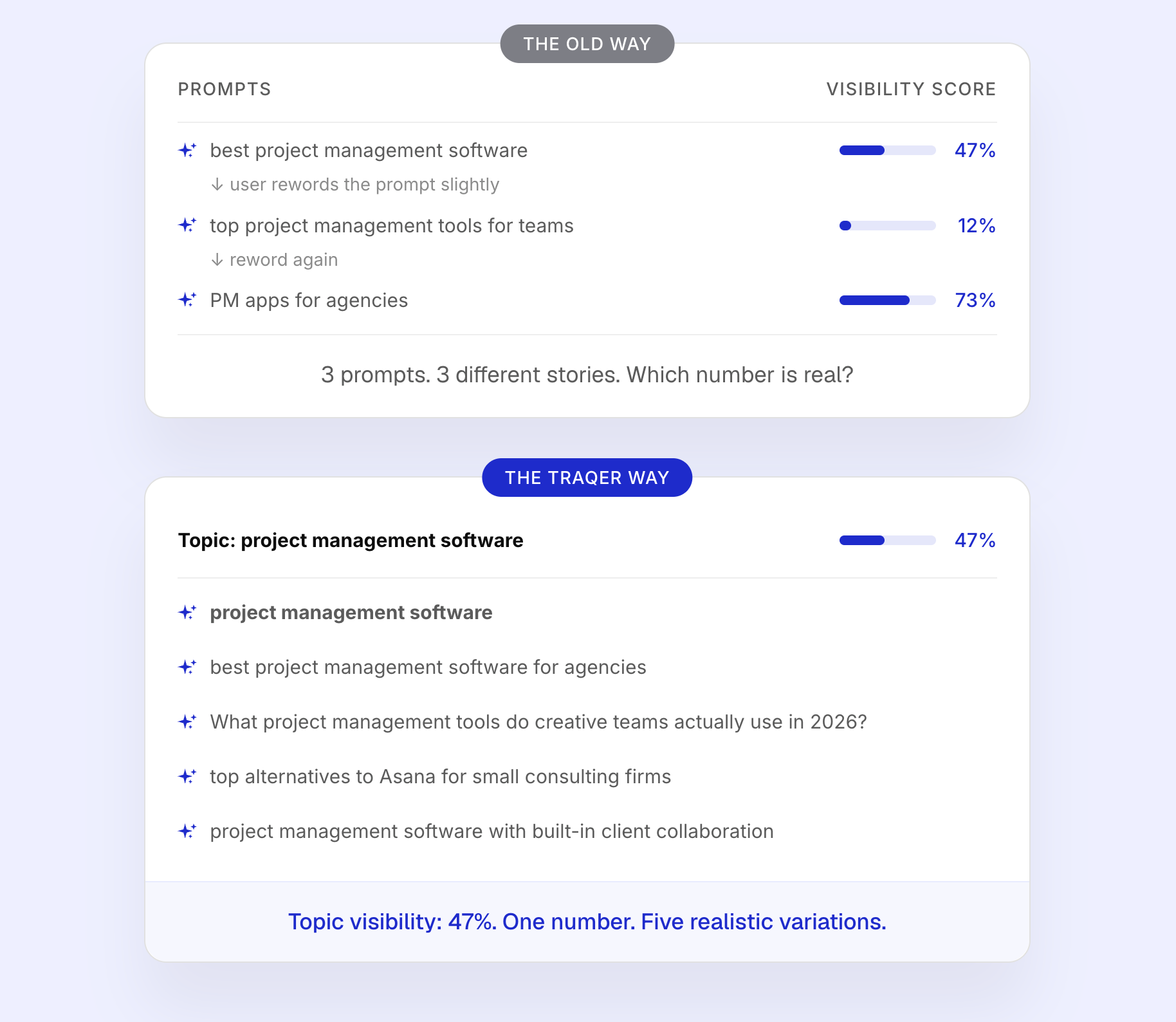
Topic-level tracking, per model, smooths over that noise and shows whether your presence on a buying topic is rising or falling. This is the measurement approach Traqer is built around.
What this means for agencies and consultants doing GEO/AEO
For agencies, the topic map is both the content plan and the reporting structure for each client. Build the map from interviews with the client’s customer-facing teams, produce sales-depth content for each angle, and target the Google terms that overlap. Then report progress by topic, per model, so a client sees movement on the buying conversations that matter rather than a single prompt that may not reflect real usage. Traqer tracks unlimited brands per account, so each client’s topic map can be tracked separately without per-brand fees.
You can read the original, longer version of this framework on the Grow and Convert blog. For the related thinking behind it, see invisible prompts and Prioritized GEO.