
Marketing teams naturally want their brands to show up in ChatGPT, Claude, Google AI Overviews and AI Mode, and the other LLMs. The field is unsettled. Most weeks bring a new tactic described as essential: add llms.txt, add FAQs, add key takeaways, word headings as questions. People do not even agree on a name for the field, whether GEO, LLMO, AEO, or AIO, let alone the best practices.
The real problem is priorities. Teams don’t know what to do first, especially with limited budget and time. We’ve spent months testing these tactics, and we built Traqer to track client visibility because existing tools had too many issues. We don’t have every answer, but we do have results. Clients at our agency, Grow and Convert, are consistently mentioned, and our articles are cited across ChatGPT, Perplexity, and Google AI Overviews. We organize the tactics into clear tiers of priority and call it Prioritized GEO.
This is a Traqer version of a framework first published on the Grow and Convert blog. You can read the original article here. Traqer is the AI visibility tool built by the Grow and Convert team, and this framework is how we decide where clients should spend their time.
The GEO priorities pyramid
Every tactic we have seen fits one of three buckets. Owned content is what you write and publish on your own site. Off-site brand mentions are getting publications, industry sites, or communities like Reddit or Wikipedia to mention you, which is digital PR. On-site tactics cover changes to your own pages that help LLMs interpret them, such as llms.txt, “key takeaways” intros, FAQs, and question-worded headings.
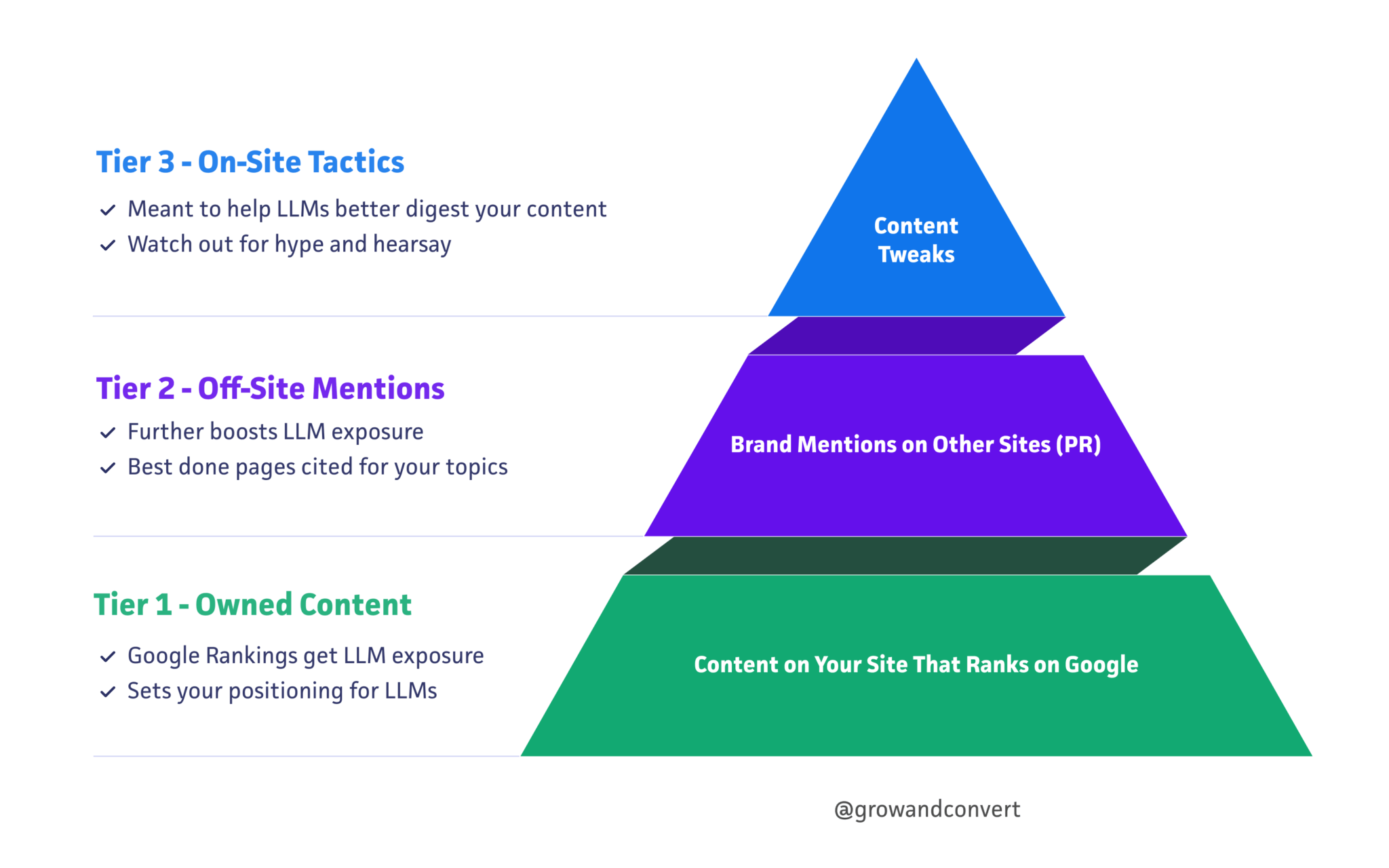
The order of priority is owned content first, off-site mentions second, and on-site tactics last. Owned content that ranks in Google is the foundation. Off-site mentions add to it. On-site tactics are a final layer and should not be expected to carry results on their own.
To see why that order makes sense, it helps to look at how LLMs gather information and how your brand can influence them.
How GEO works
Every tactic works through one of two mechanisms: exposing your brand to LLMs, or helping LLMs understand your content once they reach it. Owned content and off-site mentions both expose your brand. On-site tactics help with understanding.
Web search is the foundation
Both owned content and off-site mentions raise AI visibility through the same intermediate step, which is showing up in traditional search on Google or Bing. LLMs encounter your brand when they search or crawl the web to produce an answer. GEO is therefore tied to traditional SEO, especially for product-recommendation answers, which are the ones most marketing teams care about.
LLMs do draw on training data, but the AI companies reveal little about what is in it or how often it updates, so it is hard to influence. What is clear is that these tools search the web to supplement answers, a process Google calls grounding. OpenAI’s own help documentation notes that ChatGPT runs a search whenever it thinks an answer would benefit, not only when a user clicks search.
It does not search every time, but it usually does for product recommendations. You can tell an answer was grounded when the tool shows a “searching the web” step or includes citations. Google AI Overviews and Perplexity are web-search summarizers by design.
Since LLMs can be influenced through their web searches, the next question is which prompts to rank for.
Prioritize bottom-of-funnel topics
Bottom-of-funnel topics deserve the top focus for two reasons. They give your brand a real chance of being named, and they are more likely to trigger a web search.
In traditional SEO, top-of-funnel keywords drove traffic that rarely converted, but at least it was traffic. In GEO, top-of-funnel topics tend not to drive traffic at all, because users get their answer inside the LLM and do not need to leave. Top-of-funnel queries may include sources, but the click-through rate on them is very low. OpenAI does not release ChatGPT click data, though the pattern is visible in Google AI Overviews data, which shows a sharp drop in organic clicks when an AI summary appears.
Bottom-of-funnel product topics are different. For prompts like “what are the best accounting tools for a small business?” or “who are the top SaaS content marketing agencies?” the model lists brands, and your goal is to be one of them. No click is required, since the answer is recommending you.
For these product topics the models are very likely to search the web, because they know their training data may not hold the current best options. If your brand appears, and is discussed positively, in those searches, you have a chance of being recommended.
Prioritizing the three categories
1. Owned content is the foundation
If both owned content and off-site mentions expose your brand through web search, why put owned content first? Several reasons.
It gives you control of the narrative. On your own site you can go into depth on your features, the pain points you solve, who your ideal and non-ideal customers are, and how you differ from competitors. That depth matters in AI search, where users have conversations rather than typing short keywords, and where a model is trying to match a product to a specific problem rather than counting backlinks. This is the long tail of GEO, where recommendations are too personalized for any tool to fully capture.
It also serves two channels from one effort. SEO still drives far more traffic than ChatGPT today, it underpins Google AI Overviews, and it produces leads month over month. Owned content earns both SEO and GEO results, which a short Reddit mention does not.
It carries less algorithm-update risk. If your visibility depends heavily on one site, that site can be de-weighted overnight. In September 2025, multiple people reported that ChatGPT had started using Reddit as a source far less than before, which would have undercut money spent on Reddit mentions. The chance of the models de-weighting the entire web, including your site, is very low. Your site is one of billions that make up the content these tools rely on.
It is easier to execute. Most companies could produce a strong article for each of their top bottom-of-funnel keywords this month, since they know who would write it and what it should look like. Far fewer know how to earn Reddit mentions or land a feature in a major publication, or how to vet a PR agency and tell whether it is working. That know-how can take a year to build, a year better spent publishing and ranking. Digital PR is not a bad strategy. It just belongs second.
We have watched this play out with a brand starting from zero. When we began tracking Redline Capital, a business funding company with almost no prior web presence, it had no citations and no brand mentions across 83 prompts and five LLMs. For a new brand like that, the only route into AI visibility is live web search, which means content that ranks in Google. The one lever Redline pulled was owned content, publishing articles for the specific scenarios its customers search.
Where that content now ranks, such as merchant cash advances for senior care facilities, electricians, and lawn care businesses, the models cite Redline and name it in their recommendations. Where it has not published yet, like revenue-based financing, it stays invisible, with results dominated by established brands. The AI visibility gap maps directly onto the content gap, which is the clearest case we have for owned content as the foundation. Read the full Redline Capital case study.
2. Off-site brand mentions help boost visibility
Off-site mentions work through the same mechanism as owned content, which is getting you to show up in Google first. So Reddit, Wikipedia, and other sites said to be “special” for LLMs really come down to appearing in traditional search when the models look things up.
That leads to our main advice for this category, which is to pursue mentions on the sites that appear for the queries you care about, not the sites claimed to be most cited overall. The widely shared charts showing “Reddit is the most cited source” add up citations across many unrelated queries. One such chart was based on a set of randomly selected keywords from a large database. Those keywords may have nothing to do with your brand. What matters is which sites show up for your prompts.
For many of our clients, especially B2B, the most cited domains are industry publications rather than Reddit or Wikipedia. For our client Toro TMS, which makes software for trucking and bulk-hauling companies, the domains cited most for “trucking management software” prompts across ChatGPT, Perplexity, and Google AI Overviews were PCS Software, TruckingOffice, Connecteam, Wise Systems, and Toro TMS itself. All trucking or dispatching sites. For the far more competitive “best project management software,” the most cited domains were all project management software sites, again none of them general community sites.
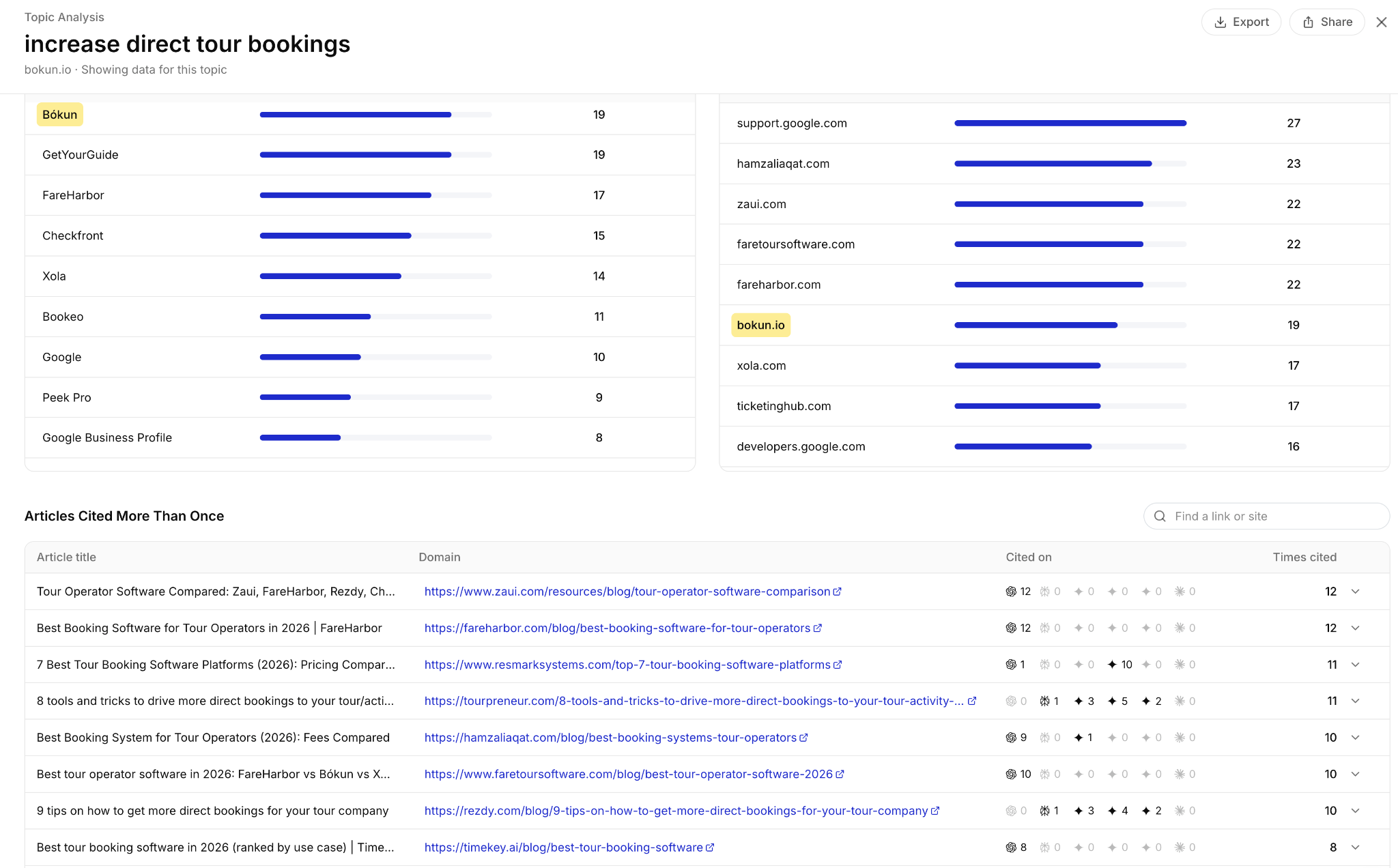
So the better move for most brands is citation outreach, which means identifying the domains and pages cited around your target queries and then making the case for being included in their lists. That puts your brand on the pages the models are finding and citing. The starting point is seeing which domains and pages get cited for a topic (which you can do in Traqer, see below).
3. Why on-site tactics aren’t the highest priority
The third category is on-site tactics, such as llms.txt, “key takeaways” intros, FAQs, and question-worded headings. These differ from the first two because they do not help you get discovered. They aim to help a model interpret your site after it has already found you. Discovery matters more than interpretation. If the models aren’t finding your content when they generate answers, interpretation aids do nothing. And these tools already understand natural language, so reasonably well-written content will be understood.
On whether to use them, llms.txt does not appear to help. It is a proposal from Jeremy Howard of fast.ai about how sites could help LLMs crawl them, there is no evidence the major tools use it, and our tests show no difference, so we do not recommend spending time on it. For key takeaways and FAQs we do not have clear data yet and are still testing, but multiple clients show up in LLMs with content that uses none of these, which is evidence they are not necessary.
How Grow and Convert executes GEO for clients
Identify bottom-of-funnel topics. We start with topic ideation using our Pain Point SEO framework, then find traditional SEO keywords that align. Ranking well for a head term naturally captures many long-tail variations, which matters because models phrase their searches many ways, a behavior known as query fan-out.
Produce high-quality owned content as the foundation. This content needs to rank for the keywords humans and models search when looking for products like yours, so it has to be written well. The models summarize and pitch your product through it, so the content is the pitch. We do not recommend AI-generated foundational content, or writing by someone who does not know the product. We interview the people who know it best, in sales, product, and leadership, to capture positioning, features, and differentiators.
Link building and citation outreach, optional. After publishing, we earn backlinks from relevant domains and, where it helps, run citation outreach to the domains most cited for the topic.
On-site tactics, optional. Once the foundational content exists, you can test key takeaways or FAQs. Our results do not show much effect, though they appear harmless. The rule is not to let any tactic get in the way of content that convinces real customers.
Results from client work
For InnovationCast, which makes innovation management software for large companies, a single well-ranked piece on “innovation management software” picked up a range of related SEO keywords through query fan-out, and we monitored visibility across ChatGPT, Perplexity, and Google AI Overviews.
Different phrasings of the same topic produced very different results, which is why we track multiple prompts per topic rather than one.
For Constitution Lending, a private lender for real estate investors, we wrote their differentiators, fast closings and high loan-to-value ratios, into every article. When we ask for fast-closing, high-LTV DSCR lenders in the US, ChatGPT recommends them, cites our article, and repeats the exact value props from it, such as loans up to 80% LTV, quick pre-approval letters, and closings in as little as four days. How you position the product in the foundational content is how the models position it to users.
We see the same in Google AI Overviews, which named our client Insider among the best customer data platforms and cited and linked the article we published on their site. In Perplexity, an article we wrote for Axial, which helps business owners find a broker when selling, appeared as the first source for a detailed prompt about selling a healthcare business. That article also ranks first on Google for “how to sell my healthcare business.”
What this means for agencies & consultants and AI search
For agencies, Prioritized GEO is a way to set client expectations and sequence the work. Lead with owned content built on each client’s bottom-of-funnel topics, since it produces both SEO and AI results and is the most defensible to report on. Add citation outreach to the domains cited for that client’s topics once the content is in place. Treat on-site tactics as optional. Tracking each client’s visibility per topic and per model shows which part of the pyramid is working. Traqer puts no cap on brands or users per account, so a full client portfolio fits without per-brand pricing.
You can read the original, longer version of this framework, with full screenshots, on the Grow and Convert blog. For the related thinking behind it, see invisible prompts and topic-based GEO.