
Many guides to optimizing content for LLMs start with on-page tasks like schema markup, llms.txt files, and question-formatted headings. Those tactics are worth knowing, but they’re not where AI visibility is won, and leading with them misreads how LLMs choose which brands to name.
When someone asks an LLM for a product recommendation, it answers from what it finds when it searches the web as well as from what it already learned about your space during training. Getting recommended is mostly about being present in both, and on-page formatting does little to change that. This makes the work closer to bottom-of-funnel SEO and digital PR than to a new set of AI-specific tricks.
With Traqer you can monitor brand visibility across ChatGPT, Google AI Overviews, Google AI Mode, Perplexity, Gemini, and Claude, and the frameworks for tracking results come from our AEO/GEO work at our agency, Grow and Convert. This article covers:
How LLMs decide which brands to recommend
Why the LLMs are not equally easy to influence
The order to work in, using our Prioritized GEO framework
How to measure results without overstating them
How LLMs decide which brands to recommend
Two sources feed an LLM's answer to a product question. The first is its training data, the large body of text it learned from when it was built. Researchers call this parametric memory, and it includes a rough model of your product space, which is why a model can name well-known brands in a category without looking anything up. The second is live web search. Modern LLMs retrieve pages relevant to the question and use them to ground their answer, a process usually called retrieval.
OpenAI's documentation notes that ChatGPT runs a search whenever it judges that an answer would benefit from one, not only when a user asks it to.
For the queries that matter most to marketers, the balance tips heavily toward search. When a user asks for the best software in a particular category, or for alternatives to a competitor product or service, the model knows its training data may be out of date on current products, so it nearly always searches the web and reads what is ranking. That’s the opening. If your content, or content on other sites that mention you, is among what the LLM retrieves, you have a chance of being named in the answer.
This is also one reason why top-of-funnel content earns almost nothing in AI search. If you ask, for instance, what a transportation management system is, an LLM is likely to explain the concept without naming a vendor because of the information-seeking intent of the user.
We have written before about how these informational answers don’t provide a brand mention and, increasingly, no click either. This is because the user's question is answered within the chat itself. The queries worth optimizing for are the ones where the model has to name products.
The LLMs are not equally easy to influence: what the data shows
Lots of GEO advice out there treats “LLMs” as one monolithic thing. Our tracking data shows they operate very differently. Across companies using Traqer, brand visibility for the same bottom-of-funnel prompts falls into three consistent tiers. The most likely explanation, and the one we argue in our own research, is that these tiers follow how much each LLM relies on live web search versus its own training data.
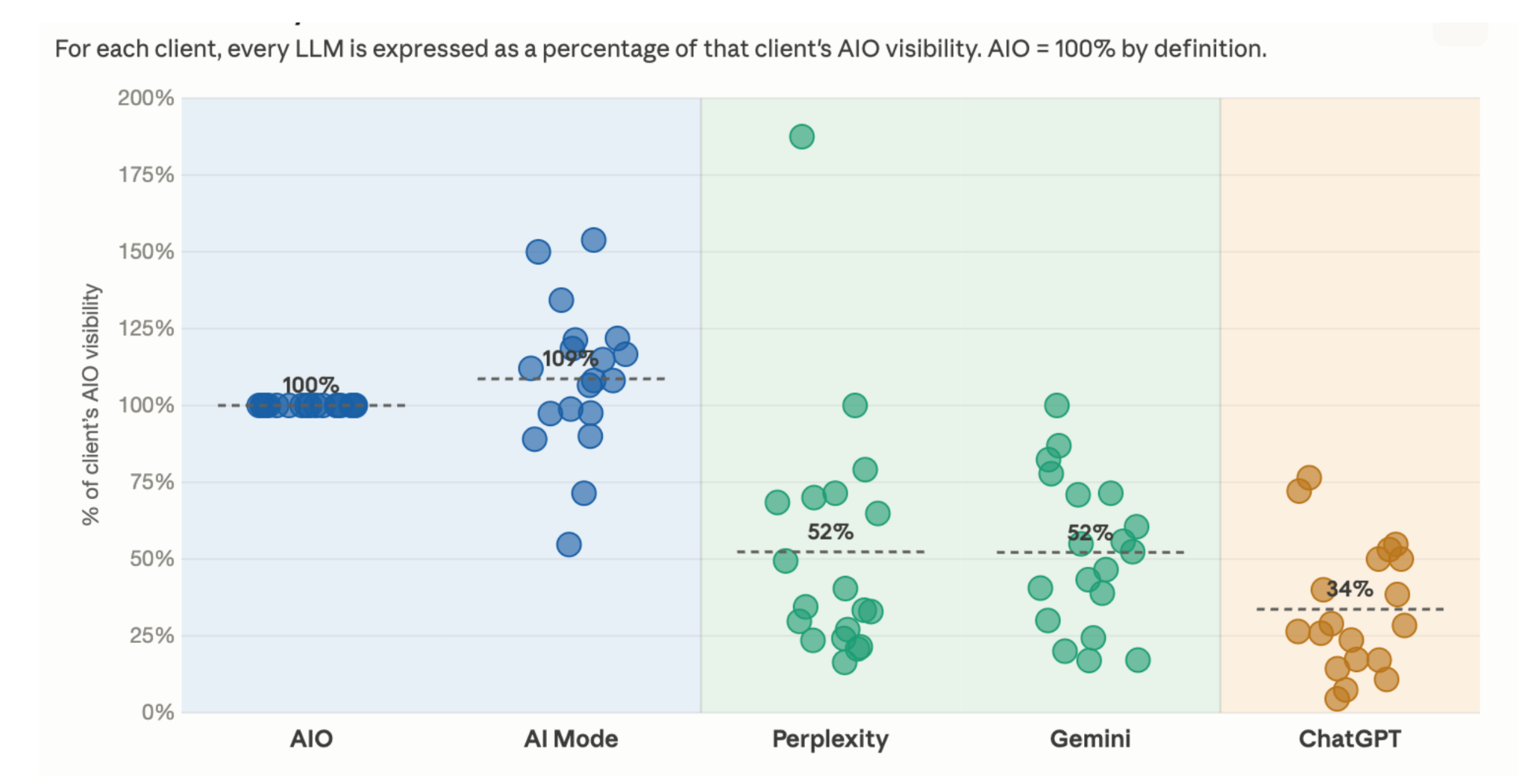
At the top are Google AI Overviews and AI Mode. Google’s own documentation explains that these features are built on its core search ranking systems and generate answers by retrieving pages from Google's search index. They behave, in effect, as summarizers of what ranks on Google. Companies ranking for lots of bottom-of-funnel keywords show in AI Overviews and AI Mode more than elsewhere.
In the middle sit Perplexity and Gemini, at roughly 40-50% of the visibility achieved in Google tools. Perplexity is also a search summarizer, but it runs on its own crawler and index rather than Google's, so its results don’t always line up with Google's. Gemini is a general-purpose model rather than a pure search summarizer, but our data suggests it leans on live search more than ChatGPT does, and it searches more often, which is why brands visible in Google search tend to do better in Gemini than in ChatGPT.
At the bottom is ChatGPT, at roughly a third of the visibility compared to Google features. ChatGPT can and usually does search for product queries, but it appears to weigh its training data more heavily than the search-based systems do. SparkToro’s research points to why this matters. The brands a model has absorbed as category leaders during training tend to get recommended regardless of what any single search turns up. For an incumbent, that is an advantage. For a smaller brand, it means ChatGPT tends to be the slowest and hardest platform to move (though not impossible).
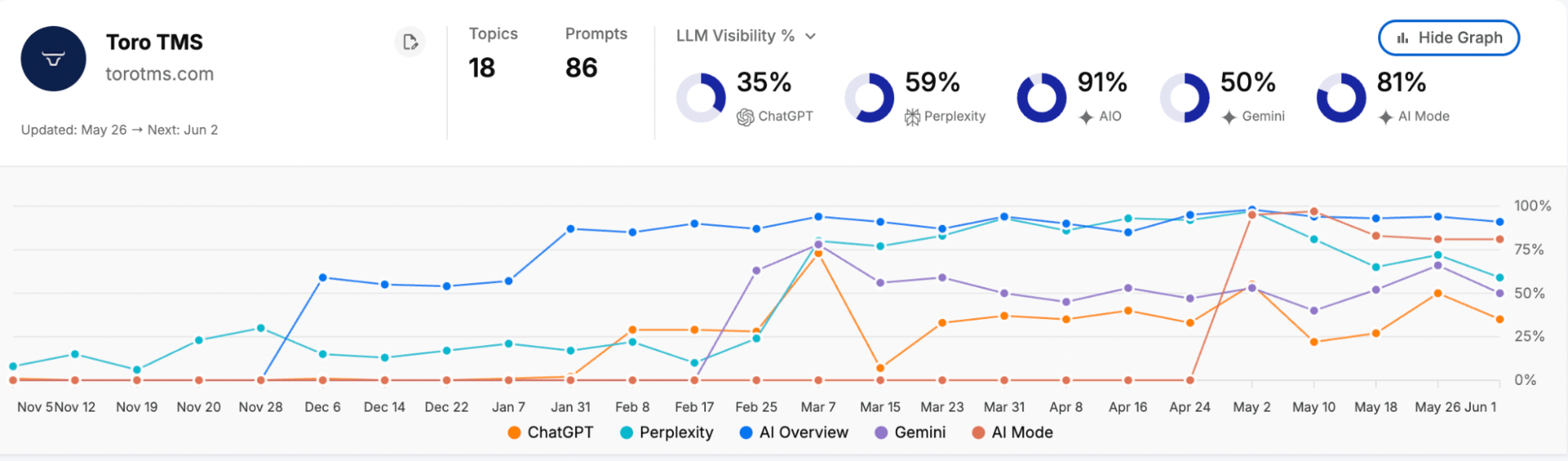
These tiers show up clearly within a single account. Toro TMS, a client of Grow and Convert we track in Traqer, appears in 91% of its tracked buying-intent prompts on AI Overviews, 81% on AI Mode, 59% on Perplexity, 50%t on Gemini, and 35% on ChatGPT. That’s one brand and one body of content, with visibility ranging from 91% down to 35% depending on which LLM is answering.
One more distinction is important if your goal is to gain an LLM recommendation rather than a citation. When we look at brand mentions only, rather than mentions and citations combined, Perplexity tends to drop down alongside ChatGPT, because it cites many sources but names comparatively few brands. We cover the full data behind these tiers in this article on the G&C blog: Not all LLMs are the same.
The main point here is that GEO involves several related jobs running at once rather than one. The same content work raises your visibility across all of these platforms, but it lands fastest on the search-based ones and slowest on ChatGPT. It helps to set these expectations in advance for clients and/or the senior management who you’re reporting to.
Step-by-step process: optimizing content strategy for LLMs
The process outlined below (and in the video above) is Prioritized GEO. It organizes the scattered GEO tactics you see online into three tiers, from the ones that do the most to the ones that do the least.
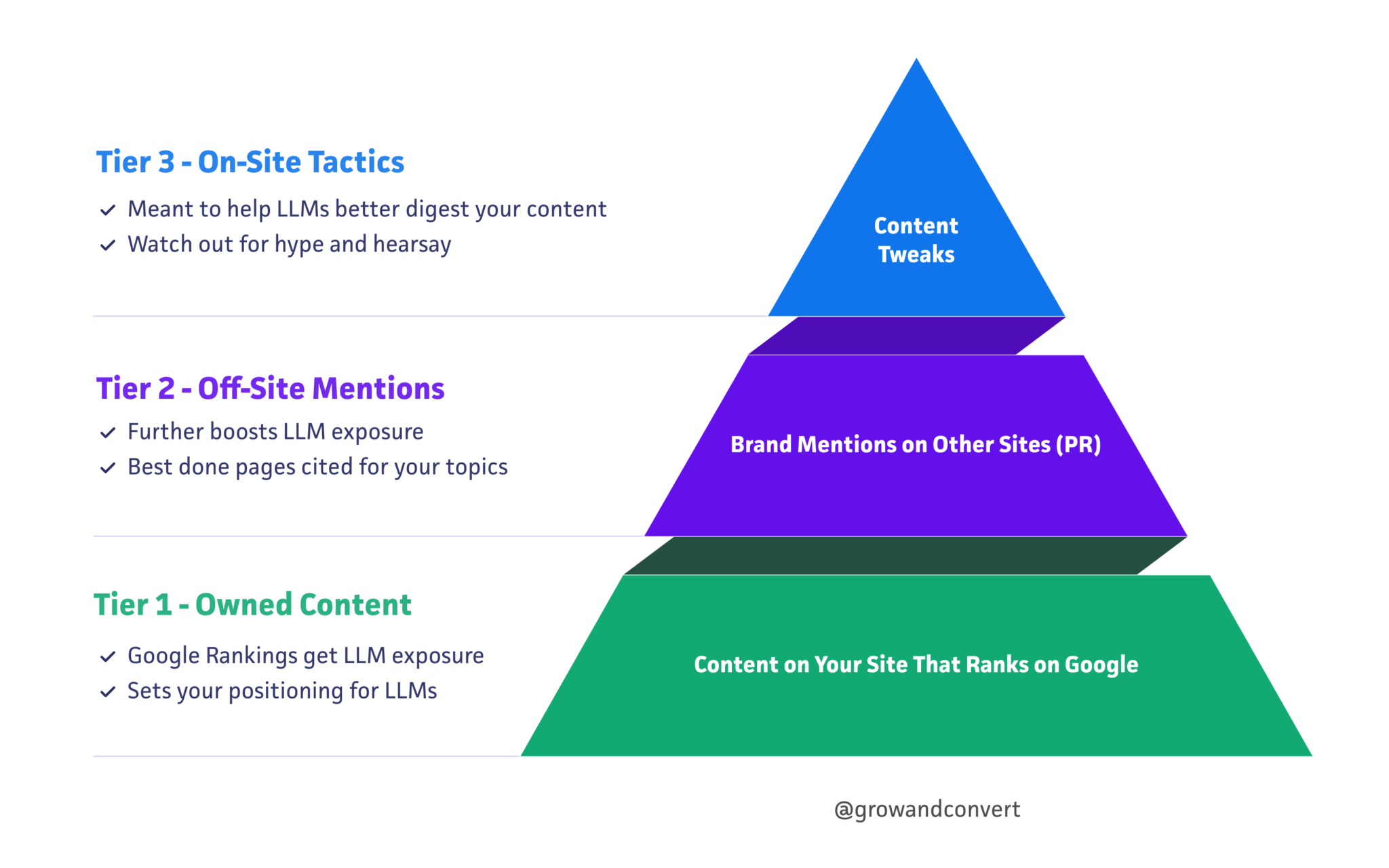
Tier 1: bottom-of-funnel content on your own site
The foundation is content you publish and rank for on your own site, targeting the queries where you want to be recommended. It comes first because when an LLM searches for a product query, content that ranks for it is what it reads, and your own site is the one place you fully control what is said about you.
That search is rarely a single lookup of the exact phrase. Google’s AI features do this through what Google calls query fan-out, breaking a question into several related sub-queries and reading what ranks across all of them, and ChatGPT runs a lighter version of the same thing. Our study of ChatGPT's citations found that each searching prompt spun off two to four sub-queries, most of them long, specific, and effectively invisible to keyword tools, so there is little point chasing the exact strings.
What gets you into those results is ranking for the relevant bottom-of-funnel keywords with detailed, product-centric content. The link between ranking and being named is strong. Across 400 or more bottom-of-funnel keywords for 16 companies we tracked, those ranking on Google’s first page showed up in ChatGPT and Perplexity answers for that keyword 77% of the time, rising to 82% for a top-three ranking. That is a combined figure for ChatGPT and Perplexity, and the payoff differs sharply between them. Ranking helps on every platform, since ChatGPT does search for product queries, but it converts into visibility least reliably on ChatGPT because that model weighs its training data more heavily. It is why the same rankings that put Toro in 91% of AI Overviews answers put it in only 35% on ChatGPT. Ranking is the foundation everywhere; on ChatGPT it is necessary but does less of the work on its own.
The pattern runs in both directions. Toro TMS, for instance, has 43 of its 46 target keywords on Google’s first page, and its own domain is the single most-cited source across the AI answers in its category, ahead of every third-party site. For Constitution Lending, a private lender company we also track, the business areas where its content has not yet ranked are the same ones where it does not appear in AI answers, so the visibility gap mirrors the ranking gap.
This does not require being an established name. Redline Capital, an accounts receivable financing company, began with almost no SEO footprint (an Ahrefs domain rating of 15, since risen to 26) and little brand presence. By publishing detailed bottom-of-funnel content on its own site, covering who its financing suits, the problems it solves, and how it compares to alternatives, it came to rank for high-intent terms like accounts receivable financing companies and built growing visibility across every platform we track, ChatGPT and Gemini included. That came from owned content alone, with no third-party outreach.
Two things make this content work. The first is intent. Bottom-of-funnel, product-centric topics are the ones where an LLM names brands at all, so those are the topics to build for, rather than high-volume informational keywords. These are queries like best software in a category, competitor alternatives, and how to accomplish a specific job your product does. The second is specificity. In traditional search your page ranks and then sells the visitor once they arrive. In AI search the model reads your content and does the selling itself, in its own words, before the visitor ever reaches you. If your content only says the generic things every competitor says, the model has nothing distinctive to recommend you for.
Content that states plainly who your product is for, the specific problems it solves, and why it is different gives the model something to name you for. This is also why thin, AI-generated content performs poorly here, since it reflects the average of what already exists and gives the model nothing specific to hold onto.
We’ve made the case for this kind of bottom-of-funnel content for years under the name Pain Point SEO, and it applies more sharply in AI search than it did in traditional SEO. We see it in the outputs. When ChatGPT recommends Constitution Lending, its wording mirrors the specific differentiators in their articles, such as faster funding timelines and lower down payments.
And for Level AI, a conversational intelligence platform, writing owned content around its exact value propositions earned brand mentions across more than 100 product-centric prompts. Generic content produces generic recommendations. Specific content gives the model something specific to say about you.
Tier 2: mentions on other sites that rank
The second lever for Prioritized GEO is getting your brand mentioned on other sites, through digital PR, citation outreach, guest posts, and similar off-site work. It operates through the same mechanism as owned content, because when an LLM searches a query it reads more than your site. If the sites it reads regularly mention you, you are logically more likely to appear in the LLM’s answer.
The common advice is to chase Reddit, Wikipedia, and a short list of domains said to dominate AI citations. That misreads how retrieval works, since an LLM cites whatever is relevant to the specific query rather than a fixed list of popular sites. Our research on which sites LLMs cite found that for product queries, industry-specific sites are cited about 86% of the time and general sites like Reddit around 16%. The useful approach is to look at the sources an LLM cites for your topics and target those. This sits second rather than first because you control your own content fully and other people's only partly.
ChatGPT deserves a specific note here. It is the slowest platform to move, and in some accounts its visibility lags the search-based platforms even after owned content ranks, which is where mentions on the sites it already draws from can help. Those mentions are an amplifier, though, not a prerequisite.
Redline, the lender we mentioned earlier, built visibility across every platform, ChatGPT included, on owned content alone, so we would be cautious with the common claim that owned content isn’t enough for AI search and that citation outreach is essential. It is a useful second lever, not a substitute for the first.
Tier 3: on-page tactics
At the bottom of the priority list are the on-page tactics most GEO guides lead with, such as llms.txt files, schema markup aimed at AI, headings rewritten as questions, FAQ blocks, and key-takeaway summaries.
These aim to help an LLM navigate content it has already found. In our testing over the past year or so, they’ve made little measurable difference to whether a brand gets named by LLMs; which is why they come last. They’re not harmful, and there’s no reason to avoid a format that suits your content, but they will not put you in front of an LLM that never retrieved your page in the first place.
One on-page requirement does matter, and it belongs to a different category. An LLM cannot cite a page it cannot reach. If AI crawlers are blocked in your robots.txt, or if your important content only appears after client-side rendering, your pages can be invisible to the systems you are trying to reach, no matter how well they rank. Making sure content is crawlable and present in the initial HTML is a real requirement rather than a formatting preference, and it’s worth checking before you spend time on anything else in this tier.
Work at the topic level, and measure a rate (rather than a “ranking”)
Two features of AI search change how you should design your content strategy and read your results.
LLMs do not answer with a fixed ranking, and they do not answer the same way twice. Recommendation lists almost never repeat exactly, while how often a brand appears across many runs is far more stable. On top of that, a real user’s answer is shaped by their history and context, so the answer a tool records in a neutral session is not the one a given buyer sees. We call this the invisible prompts problem.
Both point to the same approach:
Rather than optimizing for a single prompt or chasing a ranking position that doesn’t really exist, build content across the full set of topics and angles where you want to be recommended.
We describe this in topic-based GEO as building a topic map, a set of content covering your categories, use cases, competitor comparisons, and the specific jobs your product does, so that whatever angle a buyer's question takes, the LLM has been taught enough about your product to recommend you.
Then measure your visibility as a rate, the share of prompts in a topic where you are named or cited, tracked per platform rather than blended into one score.
Tracking per platform matters because of the tiers above.
A single combined visibility number hides the fact that you may be strong in Google’s AI features and weak in ChatGPT, which is exactly the sort of gap that tells you where to focus. This is how Traqer reports visibility, by topic and per platform, with brand mentions tracked separately from citations.
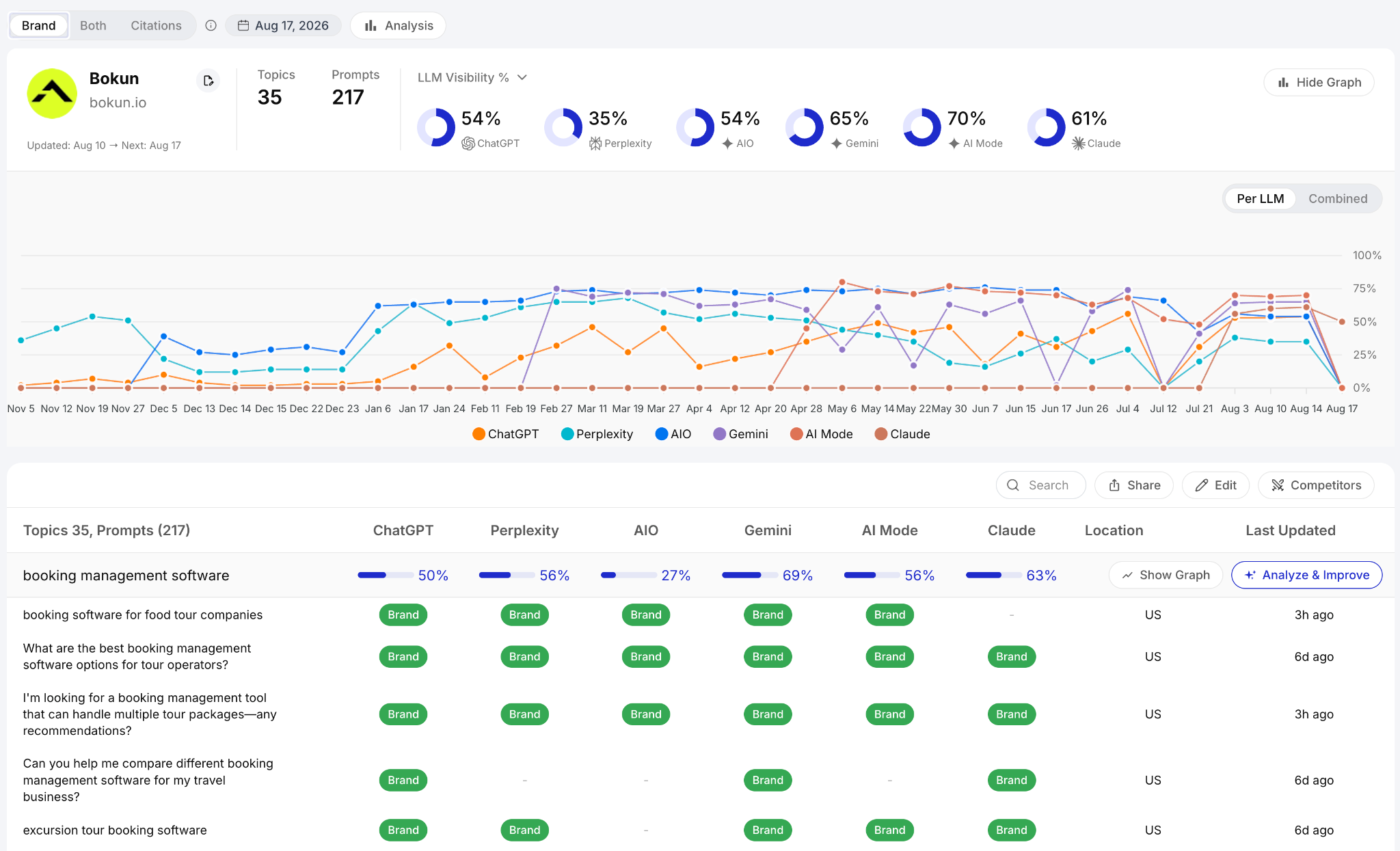
It is more accurate than single-prompt tracking, though it is not complete, since no tool can see the personalized answers real users receive, and it is worth being honest about that limit rather than presenting any number as the whole truth.
Where to start with optimizing content for LLMs: the key points
The work that raises your visibility across LLMs is consistent, even though the platforms differ. Start with the bottom-of-funnel topics where your buyers are choosing between products, and publish content that ranks for them and describes your product specifically enough to be worth recommending.
Then, get your brand onto the third-party sites that LLMs already cite for those topics. Confirm the models can crawl your pages, and leave the schema and llms.txt work for last. Expect the search-based platforms, meaning Google’s AI products and Perplexity, to move first, and ChatGPT to take longest.
Then measure it by topic and per platform, so you can see where you are being recommended and where you’re only being cited (or missed altogether). You can track your AI visibility across ChatGPT, Google’s AI platforms, Perplexity, Gemini, and Claude in Traqer.