

If you’re working on improving AI visibility for your clients, adding Claude into the mix is more difficult than it might seem. Several tools for measuring LLM visibility either lock Claude behind an enterprise contract or charge you with a per brand pricing. Both scenarios get expensive the moment you start tracking a roster of companies rather than a single account.
This article covers:
What to look for in a Claude tracker built for agency use
How the main options compare for the agency use case
What to look for in a Claude tracker for agencies
Five things separate a tool that works for an agency from one that only works better for a single brand:
Claude coverage without an expensive contract. Claude is a special case, because the other LLMs offer public logged-out interfaces that can be read and scraped. Claude doesn’t, which means visibility is measured through Anthropic’s API. All visibility tools need to handle Claude this way, which is why many keep it locked behind the pricier plans.
Pricing that works when you have a roster of clients. Even if Claude is included in a plan, enterprise or otherwise, you need to have a tracker that doesn’t bump up the price every time you add a new client. This means you need per-prompt pricing (or packages that provide a certain number of tracked prompts), rather than a per-brand or per-seat pricing structure that climbs.
Measurement that fits how Claude behaves. Claude tends to lean more on its training data than some of the other LLMs that summarize live search results. This means that brands with strong traditional SEO might appear in Perplexity or Google’s platforms, but be absent from Claude. This makes a single blended visibility score useless, because it hides the gap between LLMs. You need a tracker that offers per-model reporting as a default, rather than guiding you to an overall average.
Like the other LLMs, Claude also varies a lot from run to run. What’s useful to know isn’t a single position at a single moment in time, but how often a client’s brand appears across many runs put together. In practice, this means two things to look for: measurement at a topic level, where a group of related prompts gives a visibility rate across a buying area, and a stability view that looks across all of a prompt’s history of runs rather than only the latest.
You also need to be able to keep brand mentions and citations separated, because being named in a recommendation for a bottom-of-funnel query is way more valuable than having a URL cited as a source. Clients need to know where they stand on each, independently.
Direction and strategic guidance, not just reporting. Tracking LLM visibility improvements tells a client where they stand, and you can highlight the outcomes of your activity to justify their investment. But a Claude tracker should also help you do better work. It should surface the pages and publications that Claude draws on when answering questions on a topic, and show where competitors are being recommended but your client is not. This gives you outreach targets and priority content ideas to take forward.
Where the AI visibility tools differ on measuring demand
All of the tools out there track how a brand is mentioned and cited across the LLMs. They differ in coverage and method, which the sections below get into in more detail. But one secondary feature is worth understanding before that, because it’s where they diverge and the industry is still debating.
Several tools try to estimate demand, the AI-search equivalent of keyword search volume. Profound, for example, promotes a feature called “Prompt Volumes” that puts an absolute number on how often a given prompt is asked, drawn from large panels of real user conversations. Peec has access to similar data but does not publish absolute figures, showing a relative one-to-five demand score instead, on the view that real user prompts are close to unique and so a true “prompt volume” doesn’t actually exist.
For the same reason the variability in responses matters, we land closer to Peec here, although we go a step further. Rather than score individual prompts at all, we measure by default at the topic level across many runs, since if the same prompt rarely returns the same answer and a single question fans out into several machine queries before it is answered, there is no stable volume to count. We go into the fan-out side of this in our piece on fan-out queries.
Put simply: there is an unresolved disagreement about how much demand you can honestly measure in AI search, and it's probably worth knowing where a tool stands before you weigh the options featured below.
How the main Claude tracking tools compare for agencies
Traqer
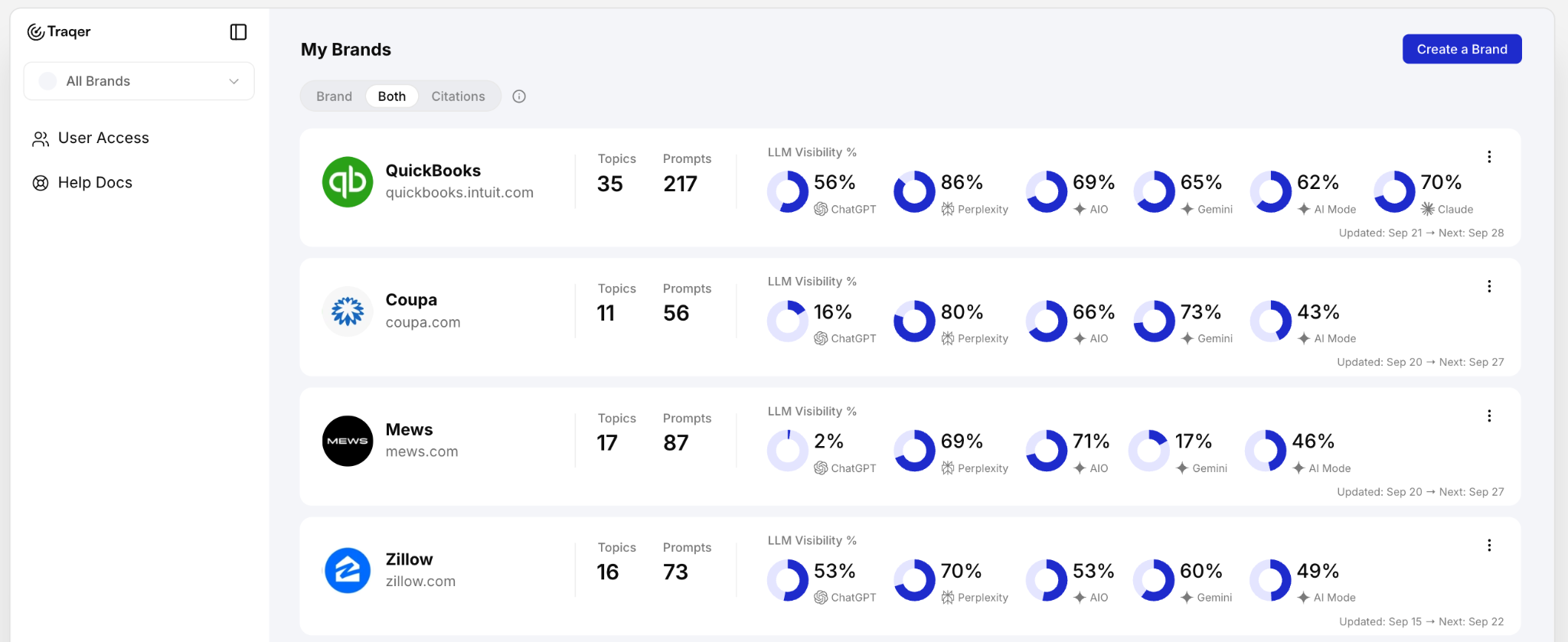
Traqer is our tool, built at our content marketing agency, Grow and Convert. It is designed for agencies to monitor LLM visibility across multiple client brands in a way that means they can identify what works and how they can show real wins to clients. We built it ourselves after trying a range of different tools and finding that they were inaccurate and extremely expensive. Traqer is built specifically for agencies and consultants, not for large companies who only need to track their own brand.
Traqer is priced at just $25 a month for 50 prompts, with ChatGPT, Perplexity, Google AI Overviews, and Gemini all included. Claude is a $20 add-on to that $25 monthly plan. As we noted above, Claude is usually extra (or hidden behind enterprise plans) because tools are forced to use the Anthropic API to access its data. Our $20 charge is an at-cost addition (i.e., we don’t make profit on it.)
Every Traqer plan includes unlimited brands and unlimited users, and each client can have a Viewer login to their own data while your team keeps editing rights. Reports can go out white-labeled under your own agency brand, too.
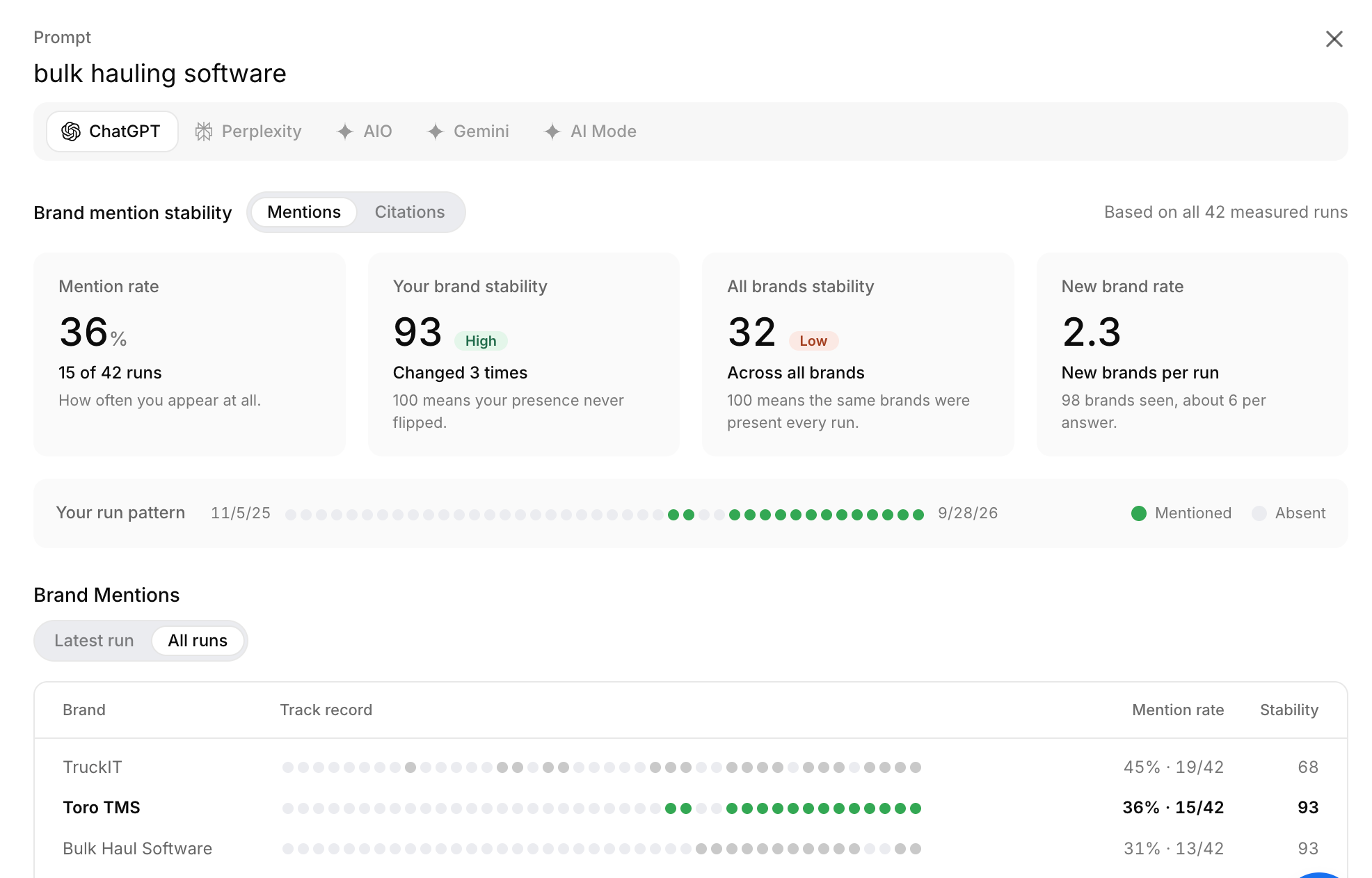
Measurement is at the topic level and per model, brand mentions and citations are kept apart, and the stability view shows each prompt’s full run history.
If you give Traqer a topic area where a client wants visibility (e.g., “project management software” or “kitchen repair service”) it’ll generate a set of realistic prompt variations that cover various ways that a real searcher will ask an LLM about that topic. These can be edited and removed as needed.
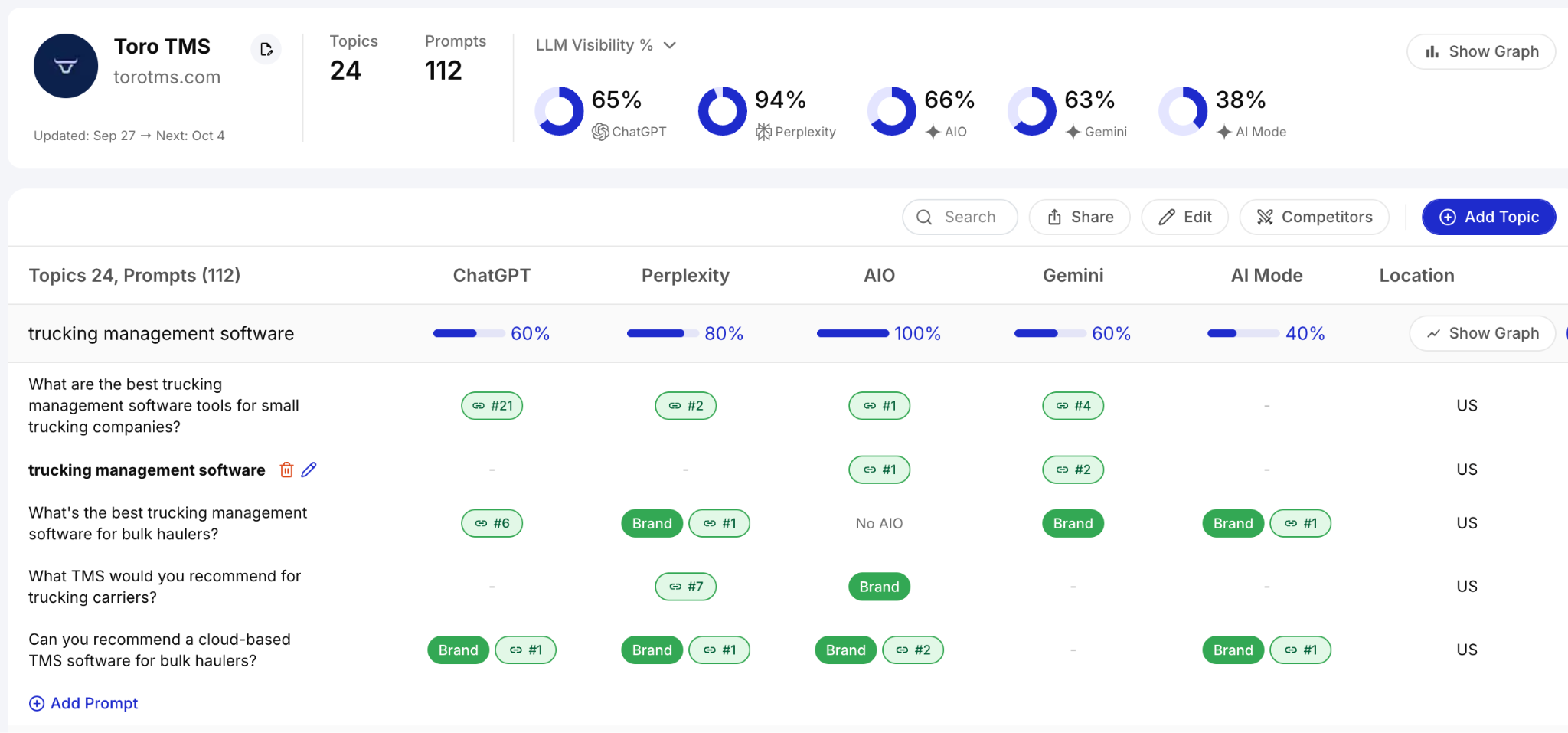
We do it this way because unlike SEO keywords, AI prompts are unique. People have long conversations with Claude that nobody can predict, and they have their own personalized context contained within Claude that we cannot know. So we believe that the only true way to get useful insight is to ask about a topic in various ways and measure how often a particular brand is mentioned or cited.
If you want to start tracking Claude visibility at a fraction of the cost of other tools, and in a way that helps you show genuine wins to your clients, try Traqer for free today. No credit card required.
Profound
Profound is the category’s most enterprise-focused platform, built for large in-house teams that need depth on one brand, which it does well. For an agency planning to use Profound for tracking Claude, two things are worth knowing. Claude sits on Profound’s custom Enterprise tier, so it is not available on the lower plans at all. The standard agency plan tracks only ChatGPT, Perplexity, and Google AI Overviews, with the full engine set, Claude included, reserved for the custom agency tier.
White-label reporting is not part of the standard plan either, and any rebranded client reporting sits under Enterprise terms, which matters when you present visibility to clients under your own brand.
For a large agency serving enterprise clients with budgets to match, Profound is a capable choice. Its engine coverage is among the broadest in the category, and it is built with the depth and enterprise-grade security that large in-house buyers need. The mismatch is with smaller rosters and budgets.
Peec
Peec was founded in 2025 and backed by about $29 million in funding, built for marketing teams who want a read on AI visibility without an enterprise contract. It runs dedicated agency plans with unlimited client projects, consolidated billing, and pitch workspaces for new business, and every paid plan includes unlimited seats. Pricing works on credits, where one prompt tracked against one model for one day is one credit, so the bill rises with the number of prompts, the number of models, and how often you run them.
The agency plans run from roughly $245 to $795 a month, with a custom tier above that. Peec renders pricing by region and changes it often, so confirm the current figures on its pricing page.
Entry plans let you pick three engines from a menu of six or seven, among them ChatGPT, Perplexity, Google AI Overviews, Gemini, Google AI Mode, and Copilot. Claude is not one of those included. As we’ve mentioned already, it is delivered through an API connection and sits only on Peec’s top agency tier, so reaching Claude across a client roster means a custom contract.
If Claude isn’t central to what you track, Peec is relatively agency-friendly. It is quick to get going with, separates brand mentions from the sources behind them, and adds competitor detection and gap analysis. Cost is an issue, however. The agency plans start at $245 a month, and the credit model charges for every model and every daily run, which is a lot for a lean agency to commit to.
Scrunch
Scrunch, now owned by Sitecore, is a mid-market and enterprise platform with strong on-page audits and detailed reporting on which AI crawlers (the bots behind ChatGPT, Claude, Perplexity, and Google’s AI) are fetching a site. It is the exception to the gated enterprise plans that Peec and Profound have: Claude is included on every plan, along with ChatGPT, Perplexity, Gemini, Google’s AI Mode and AI Overviews, and Meta, though not Microsoft Copilot. The challenge with Scrunch for agencies is that it costs a lot.
Plans start at $250 a month on annual billing with a set prompt allowance and three to five seats, and multi-brand coverage for a roster runs through its agency partner program on quote-based pricing. This means the bill grows with each client you add. Scrunch’s strength is the depth on the delivery side, and the audits and crawler reporting are among the best in the category. Including Claude on every plan is an advantage over Profound and Peec. For clients with the budget and the people to act on audits, and existing Sitecore customers in particular, it is a good option to consider.
Otterly
Otterly starts out cheaper than Scrunch, Peec, or Profound. Plans start at $29 a month for 15 prompts, and it is structured for multiple clients in a way that the enterprise tools aren’t; with unlimited users on every plan and unlimited workspaces from the Standard tier up.
It does offer Claude without an enterprise step, but as a paid add-on rather than part of the base price, and the cost climbs sharply up the tiers. On the $29 Lite plan the Claude add-on is about $29 a month, which roughly doubles the bill. On the $189 Standard plan it is around $109, and on the $489 Premium plan it reaches about $439, so a Premium plan with Claude runs close to $930 a month before any other engine add-ons.
Base plans cover four engines (ChatGPT, Perplexity, Google AI Overviews, and Microsoft Copilot), with Gemini and Google AI Mode as further add-ons, and prompt allowances are tight enough (15, then 100, then 400) that a real client roster moves you up the tiers pretty quickly. White-label reporting runs through a Looker Studio connector and its agency program rather than natively.
How to choose the right Claude tracker for your agency
Two questions are most important when you’re choosing a Claude visibility tool:
What does the tool cost at your actual client count and prompt volume?
Can you get Claude tracking without an enterprise contract?
Traqer is built for the agencies that need to track Claude (and the other LLMs) without breaking the bank.
You can add Claude on any plan, track client performance beside the other main LLMs, and show progress to clients in a white label report. If it helps to run the cost question against your own roster of clients first, our pricing lays out the per-prompt model in full.
Traqer is built by Grow and Convert. For more about the measurement thinking behind it, the articles about topic-based GEO and prioritized GEO explain the approach in more depth.