
Search for the best LLM SEO tools and you’ll find the same article over and over: a numbered list of platforms, each with a feature grid, presented as if they all do the same job and you only need to pick one. For an agency, that framing isn’t particularly helpful because the tools in these roundups do different jobs. The phrase gets stretched across a spread of jobs, from writing content through to tracking how a brand appears in AI answers, and it travels under several names, LLM SEO, GEO, AEO, and AI visibility.
We run SEO and GEO for dozens of clients at Grow and Convert, and we built our own AI visibility tracker, Traqer, because the tools we tried were either too expensive to run across a roster or measure in ways we couldn’t defend. So take this guide as a perspective from inside an agency that does the work.
This article is focused mostly on one of those jobs. Content production and technical optimization are problems with a mature range of tools, and if you work at an agency you already know them. The part that’s harder to get right, and the part clients keep asking about now, is measuring how a brand shows up in AI answers and knowing whether your work is changing it. Most of what follows is aimed there. First, though, let’s clear the adjacent tools out of the way.
The tools for the other jobs, in brief
Content production remains important, because the pages that rank in Google are largely the ones LLMs draw from when they answer a product question (more on that below). Wave Writer, our own tool, is an AI assistant for drafting articles. It works by taking search intent and company context into account, as well as a deep assessment of current ranking articles to produce briefs and drafts shaped around your positioning.
Clearscope sits alongside Wave Writer as an editorial coverage check, grading a draft against what already ranks before it ships. Both are useful, and neither tells you anything about AI answers.
The fundamentals are the SEO tools you already know about: Ahrefs and Semrush, for instance. They help you find bottom-of-funnel keywords to target, tell you whether a client ranks for them, and show which third-party pages hold the rankings in a topic, and those pages are the ones an LLM is most likely to read when it builds an answer. When a new category appears, it’s tempting to assume the incumbents have been superseded by GEO-specific tools, but this isn’t necessarily true. SEO rankings are still one of the leading indicators of whether a client appears in AI answers at all.
Both jobs help AI visibility, but don’t measure it; and measurement is what the rest of this piece is about.
LLM visibility measurement (the hard part for agencies)
The core issue with AI visibility measurement is that LLM outputs are unstable in a way search results are not. Ask the same product question in ChatGPT several times and you’ll get different answers, with different brands named and in a different order. There’s no fixed position to track the way there is in traditional search, so a tool that reports a fixed position for a prompt is showing you a single snapshot that will look different next time.
In our experience running this across clients, the signal that matters is how often a brand shows up across many variations of the same question, rather than where it lands in any single response. A brand can be absent from one answer and present in the next, while a stable set of brands appears in most responses for a topic. Presence across a topic (over time) holds even when the exact ordering has volatility.
A few questions to any vendor separate the tools that measure this well from the ones that don’t:
Does the tool track topics or single prompts? A topic is a cluster of related prompts pointing at the same buying question from different angles. Because you cannot know the exact wording a buyer will use, tracking one prompt tells you very little, and tracking a topic tells you how often a brand shows up however the question is asked.
Does it break visibility out per LLM, or blend everything into one number? A client can be strong on Perplexity and near invisible on ChatGPT for the same topic. A single blended percentage hides the difference you most need to report on.
Does it separate brand mentions from citations? A brand mention means the LLM named the client in its answer. A citation means the client's URL appeared as a source. A client cited but not mentioned has a different problem to solve than one that is not appearing at all, and combining the two into one score hides which it is.
Where does the data come from, the web interface or an API? API responses differ from what a user sees, because the web products layer system prompts and interface tuning on top of the base model. A brand that appears in an API response may not appear in the interface a buyer is using.
This last question decides most agency purchases:
What does it cost across your whole client roster? Tools that charge per brand look affordable for one client and become unworkable across twenty. Per-seat charges do the same when you want to give each client login access. This was one of the key reasons why we developed Traqer ourselves.
How the main LLM visibility trackers compare
Traqer
We built Traqer for our own use before it was something anyone could buy. As an agency tracking dozens of client brands, we needed a tracker that measured visibility the way we thought it should be measured and that we could afford to run across a roster.
Traqer is topic-based rather than prompt-based. You set up a topic and it generates a set of prompts that approach that topic from different angles, then reports the percentage of those prompts where a brand appears, broken out for each LLM. This handles the variability problem. You cannot ever know the exact prompt a buyer will type, so you track the topic and measure how often the brand shows up across it. The reasoning behind topic-based tracking is the approach that shaped the whole product.
A few product specifics make a difference for agency work.
In the default view, visibility is shown per LLM, rather than blended into one number. ChatGPT, Perplexity, Google AI Overviews and Gemini are covered on every plan, AI Mode is included, and Claude is a low-cost add-on you can switch on yourself, where most tools reserve it for enterprise plans. (A single blended score would hide what needs to be reported; a client's position varies from one model to the next.)
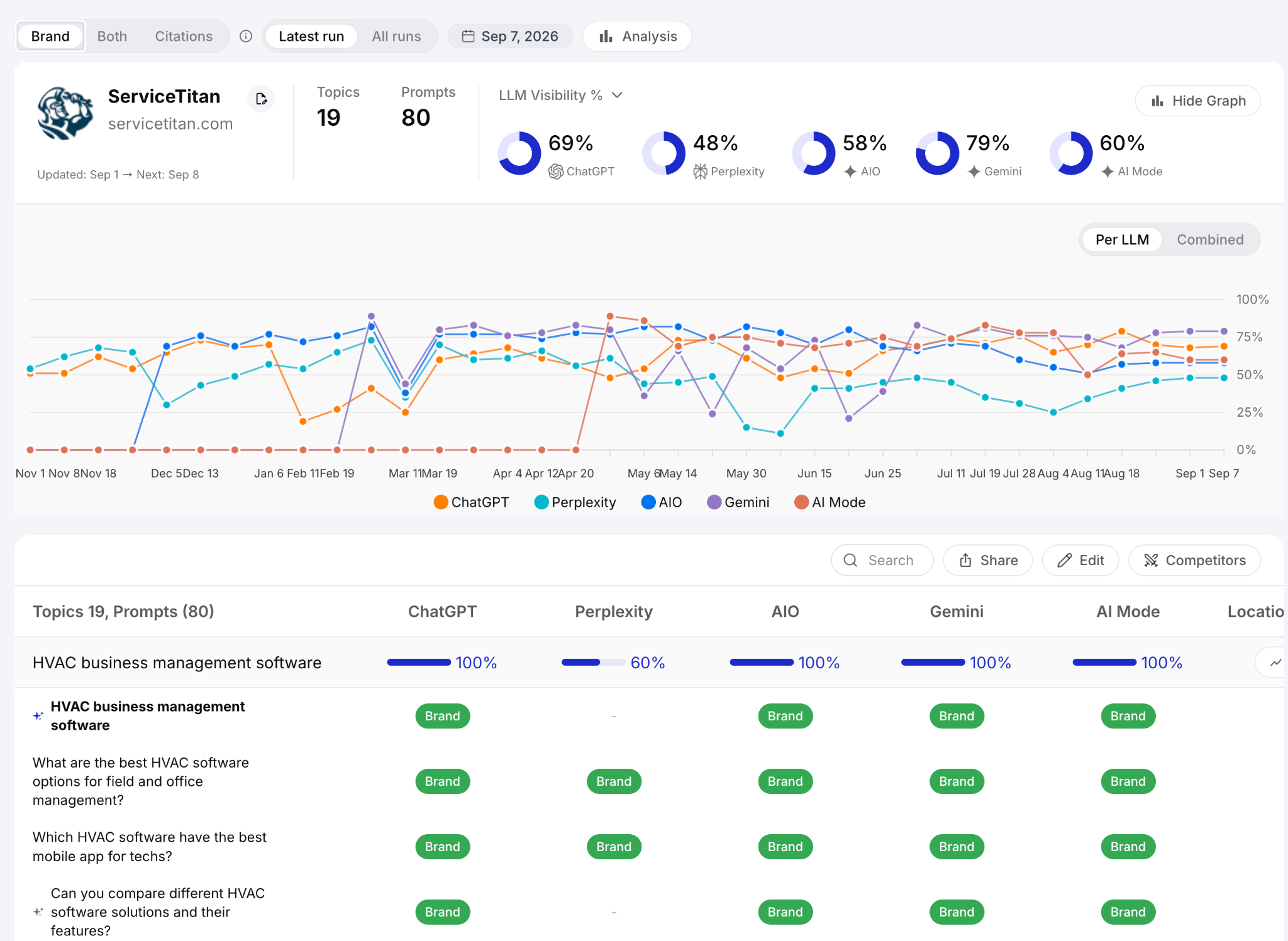
Brand mentions and citations are tracked separately, with a toggle at the brand level. Many AI visibility tools combine them into one number, even though they mean different things. Traqer's citation tracking shows which content the model draws from, which helps you plan your outreach. Our mention tracking shows whether your client is being recommended by name (i.e., the thing that turns into leads).
The metrics are built so they can’t be gamed by changing what you track. Alongside the visibility percentage, Traqer shows a raw count of prompts where a brand appears and a topic-level view of where visibility is high, medium or low. A standard percentage goes up if you simply stop tracking topics you are not yet visible for, which quietly discourages teams from being ambitious. The count and the topic view only move when something changes.
Multi-brand tracking is priced in from the start, which is why it works for agencies. Traqer starts at $25 a month for 10 topics and 50 prompts, with unlimited brands and unlimited users on every plan. Cost scales with prompt volume, not with how many clients you add, so a new client doesn’t change your bill unless you need more prompts. Unlimited users also means you can give each client a read-only login without a per-seat charge. At the entry tier, that works out to around $0.50 per tracked prompt.
For deciding what to do next, each topic has an Analyze and Improve view showing (among other things) which brands appear most for that topic, and which specific pages the LLMs are citing.
We go further into how the trackers compare, including how each one handles Claude, in our breakdown of AI visibility tracking tools for agencies.
Profound
Profound is one of the more established trackers and is built for enterprise in-house teams. The reporting is polished and the LLM coverage is broad. The constraint for agencies is the pricing model, which scales per brand and gets expensive across a client list, and it relies on API-based querying instead of web data. For a single enterprise brand with the budget for it, Profound is a serious option. For a roster of small and mid-sized clients, the economics are the issue, and Claude tracking is gated to its higher enterprise tiers.
Peec AI
Peec is a newer, VC-backed tracker aimed at enterprise marketing teams, and it uses web scraping (as does Traqer) rather than APIs, so the data-fidelity question applies less here. It covers the main engines natively with some models available as paid add-ons. As with Profound, the cost structure is the agency constraint once you are tracking more than a couple of brands, and Claude is not part of the base offering. Peec makes more sense for an in-house team going deep on one brand than for an agency spread across many.
Scrunch
Scrunch leans toward content and SEO teams, and its strength is in discovering which sources LLMs cite and where the gaps are, more than in visibility tracking and per-LLM reporting. If content discovery is the job you most need help with, it is a reasonable fit. It was acquired by Sitecore and sits in the mid-market. For agencies whose main job is tracking brand mention rates across clients, its focus is a little different from what you will spend most of your time doing.
What actually moves the number on AI visibility
A visibility tracker tells you where a client stands. Two things move the number, both well supported in our client data and both with clear limits.
The most significant lever is owned content that ranks. When we analyzed more than 400 bottom-of-funnel keywords across 16 clients, we found that a client ranking on Google’s first page for a term showed up in ChatGPT and Perplexity answers for that same term about 77% of the time, rising to 82% in the top three positions. The mechanism is straightforward. When an LLM answers a product question it searches the web, because training data doesn’t hold current product information, and it pulls from what ranks.
Redline Capital is the clearest example we have. The company came to us with almost no brand presence and an Ahrefs domain rating of 15 (relatively low). We didn’t run a citation outreach campaign or add schema. We published detailed bottom-of-funnel content on their own site, covering the specific industries and use cases where they could win, and it ranked for high-intent terms like “accounts receivable financing companies”. Across 100 prompts grouped into 19 topics, they went from almost no visibility to consistent visibility across ChatGPT, Gemini, Perplexity and Google's AI surfaces.
Owned content, on its own, was enough to get an unknown brand recommended. We have seen the same pattern in our published financial services case study.
The other lever is off-site mentions on pages LLMs already cite. When a model searches the web for a recommendation, it pulls from review sites, comparison articles and industry roundups as well as company sites. A brand that keeps appearing in those third-party sources reaches the model through more routes.
The practical version is to find the pages an LLM cites for a topic, which Traqer’s citation data gives you, then pursue mentions on them through outreach or contributions. This mirrors link building, though the goal is exposure to the model rather than domain authority. There’s no guarantee at the end of it. You’re influencing what the model reads, not controlling what it says.
A third set of tactics gets more attention than it deserves. On-page optimization aimed at making a page more citable, structured data, FAQ blocks, llms.txt files, headings rewritten as questions, is reasonable to experiment with and does no harm. We’ve tested changes like these across clients and have not been able to attribute visibility gains to them. Tools like Surfer and Writesonic’s GEO features can produce a tidier page, but a page that doesn’t rank for anything its buyers search is unlikely to earn AI visibility on markup alone. It operates alongside the two levers above. On its own, without content that ranks, it does very little.
Building an LLM SEO tool stack for your agency
For most agencies, the LLM SEO stack doesn’t need to be large. You need something for the content job, which for us is Wave Writer for briefs and drafts, Clearscope for an editorial coverage check, and the SEO suite you already run to find the keywords and watch the rankings. You need one measurement tool that tracks the right things, and the case we’ve made for Traqer relies on our view of topic-based tracking, per-LLM breakdowns, mentions separated from citations, and pricing that doesn’t punish agencies.
Traqer starts at $25 a month with unlimited brands and users, and you can set up a single topic and see a client's visibility across every major LLM in a few minutes. Start at traqer.ai, and if you want help with the content production side, Wave Writer is at wavewriter.ai.