
People asking about ChatGPT brand mentions usually want two things. The first is a way to see whether ChatGPT is naming their brand when people ask about their product/service category. The second is a way to get named more often. Both are more challenging than they first appear.
Much of the confusion comes from a common assumption that ChatGPT works like a search engine, with a stable ranking you can hold and check. It doesn't work that way, and that has direct consequences for how you measure mentions and how you try to earn them. A brand can appear near the top of one answer, halfway down the next, and not at all in a third; all from the same question asked minutes apart.
This guide covers what a brand mention in ChatGPT actually is, how it differs from a citation, why a single check tells you very little, and what we've seen move the needle across the clients we track with Traqer.
What counts as a brand mention in ChatGPT
There are two distinct ways your brand can show up in a ChatGPT answer, and it's worth being precise about them because they mean different things for your business.
A brand mention is when ChatGPT names your company or product in the answer text. If someone asks for the best options in your category and ChatGPT writes your name into its response, that's a mention. This is the version most marketers care about, because a named recommendation is what puts you into a buyer's consideration set.
A citation is when a URL connected to your brand appears as a source for the answer, whether or not your brand name shows up in the text. ChatGPT might pull from your comparison page or a blog post to help construct its reply and reference the source, while still recommending a competitor by name.
You can be cited as a source without being mentioned as a recommendation, and you can be mentioned as a recommendation without your own pages being cited at all. They point to different things. Mentions tell you whether ChatGPT is recommending you, and citations tell you which content it's drawing on. Lots of LLM visibility tracking tools collapse both into a single visibility score, which hides the difference.
(In Traqer there's a toggle at the top of every page to view brand mentions only, citations only, or both, so you can separate the two. We go deeper on the distinction in our guide to tracking brand mentions in AI search and, for the sourcing side, tracking AI search citations.)
Why ChatGPT mentions are harder to pin down than Google rankings
Two things make ChatGPT visibility behave differently from a Google ranking.
The first is where ChatGPT gets its answers. Search-based tools such as Perplexity and Google's AI Mode and AI Overviews get almost all of their information from the search results, not training data (meaning they largely just summarize live web results), so a brand with strong traditional SEO presence tends to have good visibility on those platforms. But ChatGPT leans more heavily on its training data to generate its answers, which means strong search rankings translate into ChatGPT visibility less regularly.
It does still search the web, and for product-recommendation questions it usually does; but how much weight it puts on that search versus its training data varies from one answer to the next.
We see this directly in our own client data. We track Toro, a trucking software company, across 18 topics and 86 buying-intent prompts. Their visibility sits at 91% on Google AI Overviews and 59% on Perplexity, both surfaces that summarize live search results, so their strong Google rankings carry over.
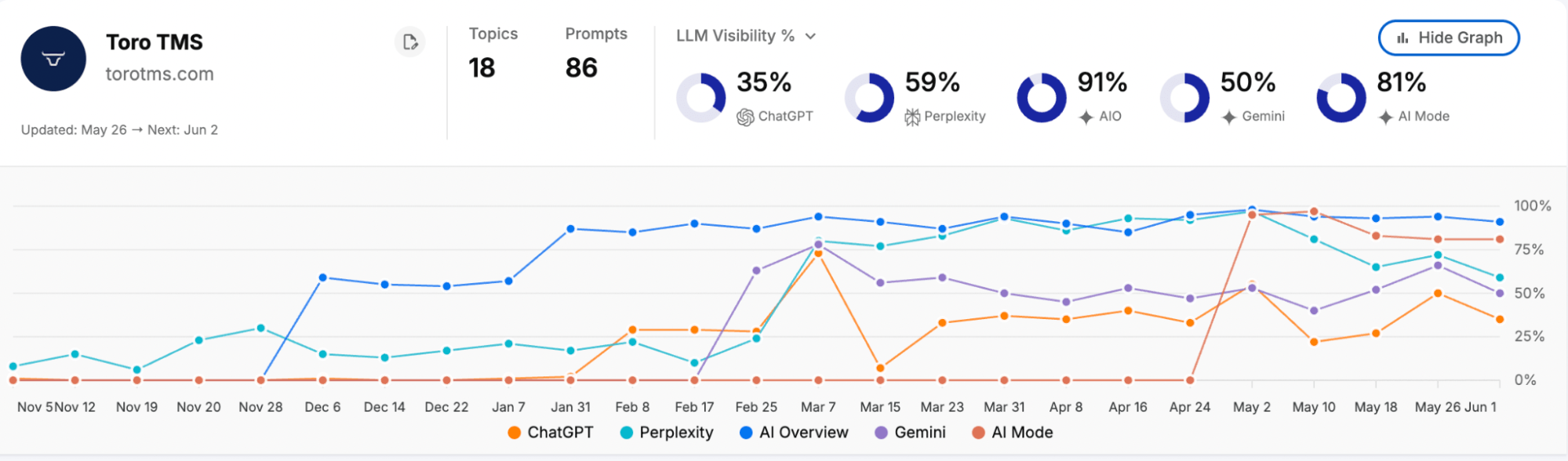
On ChatGPT the same brand, measured across the same topics with the same content behind it, comes in at 35%. That gap between the search-based platforms and ChatGPT is consistent across other clients we track too, so it's worth designing your measurement around rather than treating it as a quirk of one account.
The second thing is personalization. Two people asking a near-identical question can get materially different answers, because ChatGPT heavily factors in the context of the conversation, the account, and earlier messages into generating its response.
For example, if ChatGPT knows you run a 100 person business, it will recommend a different accounting software to you than someone who it knows is a solopreneur. Extend that to basically every answer it generates. The same prompt run again in a fresh session with no history or context often returns something different again. We've written about this at length in our article about Invisible Prompts, and it's the main reason a single check of "did ChatGPT mention us?" actually tells you so little.
Research backs this up. Rand Fishkin and Patrick O'Donnell had 600 volunteers run 12 recommendation prompts across ChatGPT, Claude, and Google's AI a combined 2,961 times. The odds of getting the same list of brands twice from the same prompt came in under 1 in 100, and the odds of the same list in the same order were closer to 1 in 1,000. This indicated that any tool claiming to report a fixed "ranking position in AI" is misrepresenting how these systems work.
The same research pointed to what does hold steady. Across the study, the leading brands in each category still appeared in roughly 55 to 77 percent of responses regardless of how the prompt was phrased. Individual position is close to random, but how often a brand shows up across many runs of similar questions is stable and measurable.
How to track brand mentions in ChatGPT
Because there's no reliable rank to capture, tracking one prompt and reading a lot into the result doesn't work. A better approach measures how often you appear across a group of related prompts.
Track topics rather than single prompts. Group the questions a buyer might ask about a given need into a topic, then measure the share of prompts within that topic where ChatGPT mentions your brand. That share, calculated per LLM, is a far more stable signal than any single answer. It reframes the question from "did we appear for this exact wording" to "how often do we appear when people ask about this area." This is the core of Traqer's approach, and we explain the measurement thinking behind it in Topic-Based GEO.
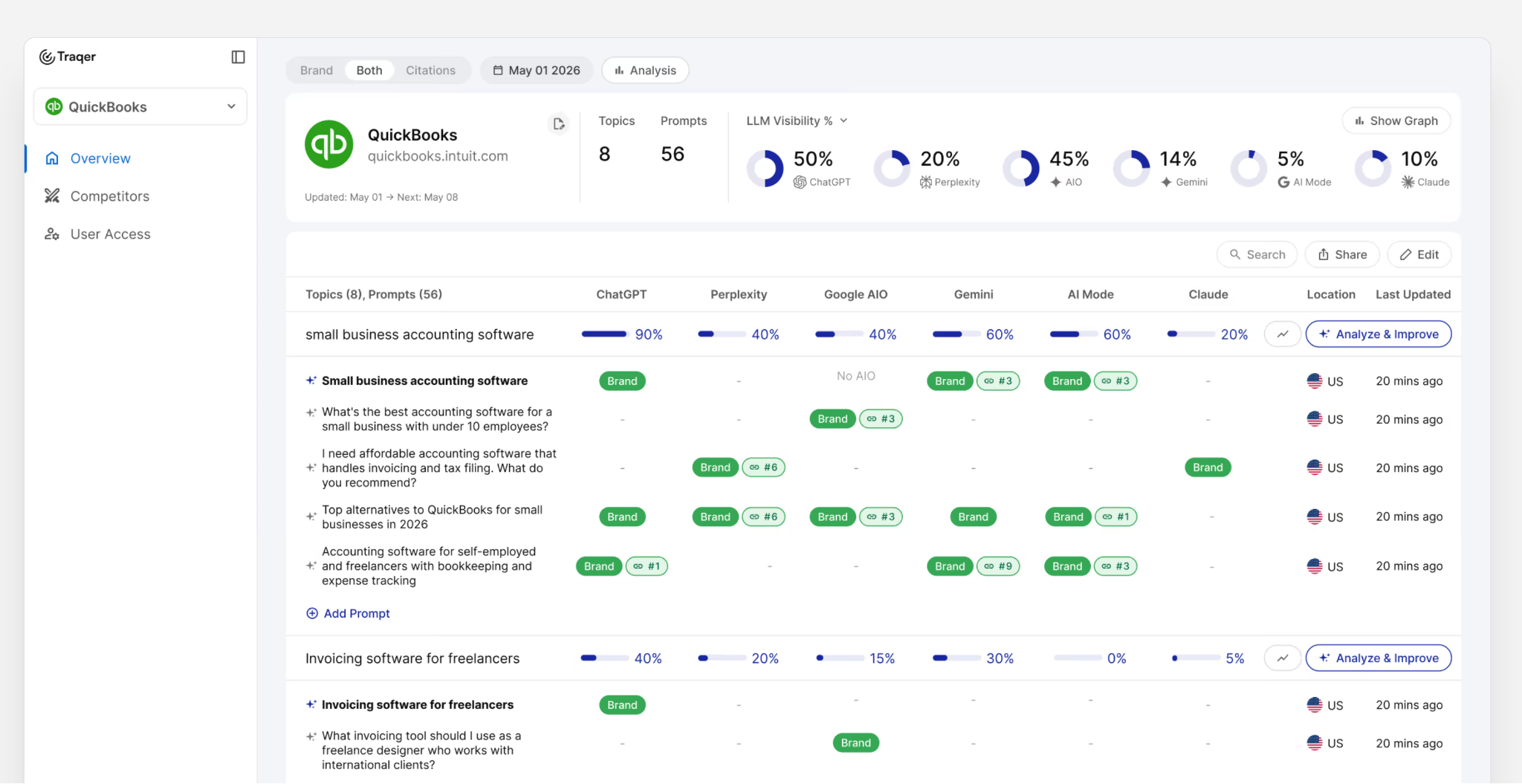
Read from the real interface rather than the API. Many tools query ChatGPT through its API and report what comes back. Those responses differ from what a logged-in user sees in the product, because the consumer interface layers on its own system prompts and tuning. Traqer captures the actual response from a web session and attaches a screenshot to every prompt, so you're looking at something close to a real user's experience rather than a stripped-down API reply. At the same time, those sessions are run logged out and neutral, so they reflect a baseline rather than any one person's personalized answer. That's precisely why the topic-level pattern matters more than a single result.
Use metrics that only move when something real changes. A single brand-wide visibility percentage is easy to flatter. Stop tracking the prompts you don't yet appear in and the number goes up, even though nothing improved. (Traqer reports a raw count of prompts where you appear and a topic-level view alongside the percentage. Both only rise when you genuinely gain ground.)
If your priority is watching ChatGPT specifically over time, we cover the workflow in more detail in tracking ChatGPT rankings over time and in our breakdown of rank tracking tools for ChatGPT. The same logic applies to other LLMs; the mechanics differ on each, which we cover for Perplexity brand mentions.
How to earn more ChatGPT brand mentions
Tracking tells you where you stand. But what can you do about it?
Across the clients we work with, a clear order of priority has emerged, and it starts a long way from the tactics that get the most attention online.
Publish owned content that ranks for buying-intent queries. When ChatGPT searches the web to answer a product question, it tends to pull from pages that rank well in traditional search. Content on your own site that ranks for a relevant bottom-of-funnel keyword has a reasonable chance of being encountered and drawn on when ChatGPT builds a recommendation.
This is the same bottom-of-funnel content strategy that has always driven conversions from organic search, which is part of why the overlap between good SEO and AI visibility is so large. Top-of-funnel explainer content does little here, because questions like "what is project management software" rarely produce brand recommendations at all. The effect is measurable. Across the topics we track for Toro (the trucking software company we mentioned earlier), their detailed, product-specific articles have made them the most-mentioned brand in their category in AI responses, with more than double the brand mentions of the next competitor, and their own domain is cited far more often than any third-party site.
For Constitution Lending, a private lender competing against incumbents that have far higher website domain authority, the same approach earned top-three recommendations for more than 50 bottom-of-funnel prompts across Perplexity and Google AI Overviews. The correlation occurs in the negative, too. When they expanded into a newer service line whose content hadn't ranked yet, they barely appeared in AI answers for those prompts. One thing this makes clear is that when ChatGPT does recommend a brand, it tends to reuse the positioning from that brand's own pages. Specific differentiators only surface if the content states them plainly, so the way you describe your product on your site is close to how ChatGPT ends up describing it to buyers.
Get mentioned on the sites ChatGPT already draws from. Beyond your own pages, ChatGPT pulls from review sites, comparison articles, and industry roundups. A brand that appears across several of those third-party sources is exposed to the model through more routes. The practical version of this is identifying which pages are cited for the topics you care about, then pursuing a mention on them, through a guest contribution, an expert quote, or being added to an existing roundup. Traqer's per-topic view surfaces the domains and specific pages being cited, which gives you the target list. This maps to the middle tier of the framework we describe in Prioritized GEO.
Consider on-site AI tactics as a lower priority. A lot of published GEO advice concentrates on adding an llms.txt file, restructuring headings as questions, or adding FAQ and schema markup aimed at AI crawlers. In our own testing across clients, these haven’t made a measurable difference to AI visibility. They're designed to help a model parse your content once it arrives, not to expose your brand to the model in the first place.
None of this is a guaranteed success. Ranking a page in Google doesn't force ChatGPT to cite it, and earning a mention on a frequently-cited page doesn't mean ChatGPT will recommend you. You're influencing the inputs rather than controlling the output. The logic is sound, though, and we've seen it work. But anyone promising a fixed cause-and-effect between one action and a ChatGPT mention is overstating their abilities.
Where to start with ChatGPT brand mentions
If you want a single takeaway, it's that ChatGPT brand mentions are best measured by frequency rather than position, and earned through the same web presence that has always underpinned search visibility. Set up the topics your buyers ask about, measure how often you're mentioned across them, keep mentions and citations separate, and produce expert-informed content that targets bottom-of-funnel topics.
Traqer tracks brand mentions and citations across ChatGPT, Claude, Perplexity, Google AI Overviews, AI Mode, and Gemini, with topic-level visibility and screenshots of the real responses, starting at $25 per month with unlimited brands. Start tracking your ChatGPT brand mentions with Traqer
Traqer is built by Grow and Convert. For more on the strategy behind improving AI visibility, Topic-Based GEO and Prioritized GEO explain the thinking behind how Traqer was built.