
A Gemini visibility tracker should show you how often Gemini recommends your brand by name when people ask about your category. Most serious AI visibility tools list Gemini as an LLM they offer, but they differ in how they measure the data and how much it costs to add to your plan.
This article covers what a good Gemini visibility tracker needs to do, where some tools fall short, and how we built Traqer to handle it. If you want the underlying method rather than the tool comparison, our guide on how to track brand mentions in Gemini gives you a deeper look.
What matters when choosing a Gemini tracker
What you need to know is how often Gemini names your brand as an answer to the questions your customers ask, and whether that is rising or falling over time. But Gemini’s responses change from one run to the next, even when the question stays the same. This means that one prompt, checked once, doesn’t give you much of an insight into whether you’re doing well or not in Gemini.
So here’s what you need:
A tool that tracks topics rather than individual prompts. People type long, specific, conversational questions into LLMs, and responses are highly personalized. This means you’re better off tracking a cluster of related prompts within a topic area over time to get a visibility rate. If you’re getting regularly mentioned for 7 out of 10 prompts within that area, you’re getting stable visibility and it can be reported as a legitimate signal.
A tool that measures stability across repeated runs. Because you might be mentioned in one run and not in the next, a tracker should tell you how consistent your presence is. A good Gemini tracker runs each prompt repeatedly and reports a mention rate across all runs; a pattern of where you showed up over time, and a measure of how much the answer churns. A brand that appears in almost every run is in a stronger position than one that appears in half of them. And seeing a pattern over time gives you a good idea of how you’re progressing.
A tool that covers all of Google’s AI products. The same technology also powers Google AI Overviews and AI Mode, and your customers may find your brand through those as well. That said, they behave differently, meaning you might be prominent in one and not in another. If appearing across the Google ecosystem as a whole matters to you, it’s worth tracking each.
(Traqer covers everything: read more about it in our articles about AI Overviews and AI Mode.)
A tool that’s affordable, especially if you’re tracking multiple brands in Gemini and across the other LLMs. Several AI visibility tools charge per brand and per model, which turns tracking a full client list into a bill of several thousand a month.
Two categories of Gemini trackers compared
Most tools that track Gemini fall into two groups:
The enterprise platforms, Profound being the most established, are built for large brands and priced for them. Their self-serve tiers tend to start with ChatGPT only, add Perplexity and AI Overviews a tier up, and hold Gemini, AI Mode, and Claude for a custom Enterprise contract.
Profound does not publish a price for that tier, and routes you to a demo, with third-party estimates putting real multi-engine use in the hundreds to low thousands a month. If Gemini is central to what you want to measure, check that early, because with this kind of tool it’s only available after a sales call.
The self-serve trackers, Peec being a widely-used example, are generally cheaper and quicker to start, and several do include Gemini in their engine list rather than gating it.
The catch tends to be a cap on how many engines a plan covers. Peec’s self-serve plans let you pick three LLMs to track, so tracking the Gemini app alongside AI Overviews, AI Mode, and ChatGPT already pushes you past the base allowance and into per-model add-ons or a higher tier. The headline price and the price for the coverage you actually want can be some distance apart.
Pricing and tiers in this category change often, so treat any specific figure here as a nudge to check the vendor’s current page rather than a fixed quote. With most tools, however, tracking Gemini properly (i.e., the app plus the other Google search products) costs more than the entry price suggests, either through an Enterprise gating or through engine caps and add-ons.
Traqer includes all of Google’s AI products on every plan and does not meter engines separately, which is the main way it differs from both groups when Gemini is the priority.
(You can get a 14-day free trial with no credit card required)
How to track Gemini accurately and report on progress
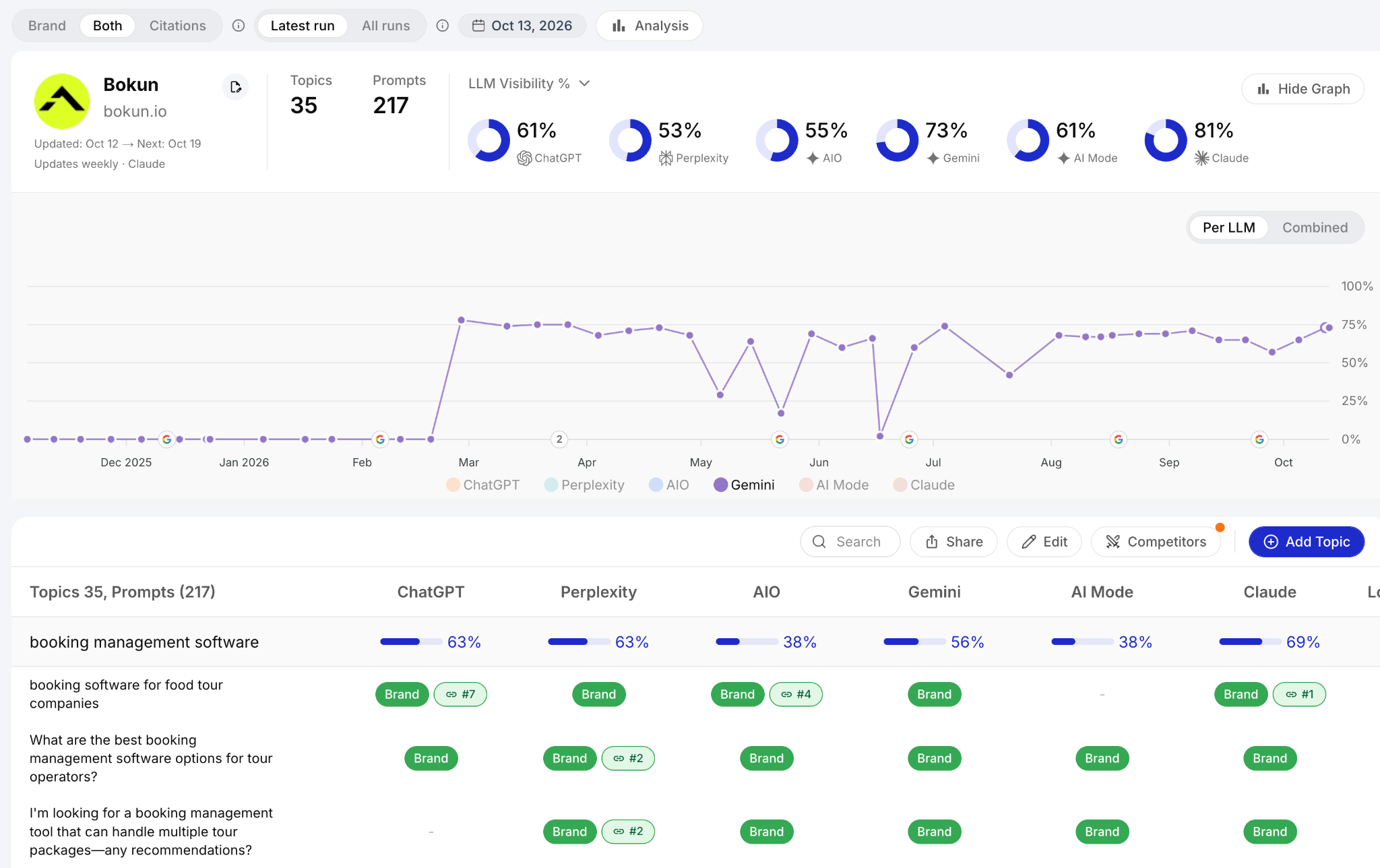
An accurate Gemini number depends mostly on which prompts you track. The habit carried from SEO is to reach for terms with search volume, but people rarely phrase things to Gemini the way they type them into a search box, so visibility measured on prompts your customers never use won’t tell you much useful.
Instead, track the questions and topics that contain buying intent; the ones you hear on sales calls, read in support tickets, and see in your own site search. Group each one as a topic category rather than monitoring a single exact phrase in isolation, so that one reworded version doesn’t swing the result. And run it often enough that you’re reading a pattern over time rather than a single answer.
Reporting on AI visibility is the part many teams struggle with. A bare percentage invites the wrong conversation, because management who are told they sit at “30% in Gemini” can’t tell whether that’s good, whether it moved, or whether your work helped. What makes a report land is comparison and direction.
Put this month next to last, show the trend across repeated runs, and show where the company sits against the competitors appearing alongside them. Measured that way, the number is something stakeholders can see progress in, which is what tends to matter when the retainer comes up for renewal.
A good example here is the “all runs” feature we have in Traqer, which shows stability for every brand in the answer, not only yours. It lays out each competitor’s record across all the runs, the share of runs it appeared in and how stable that presence was, ordered by mention rate with your own brand marked.
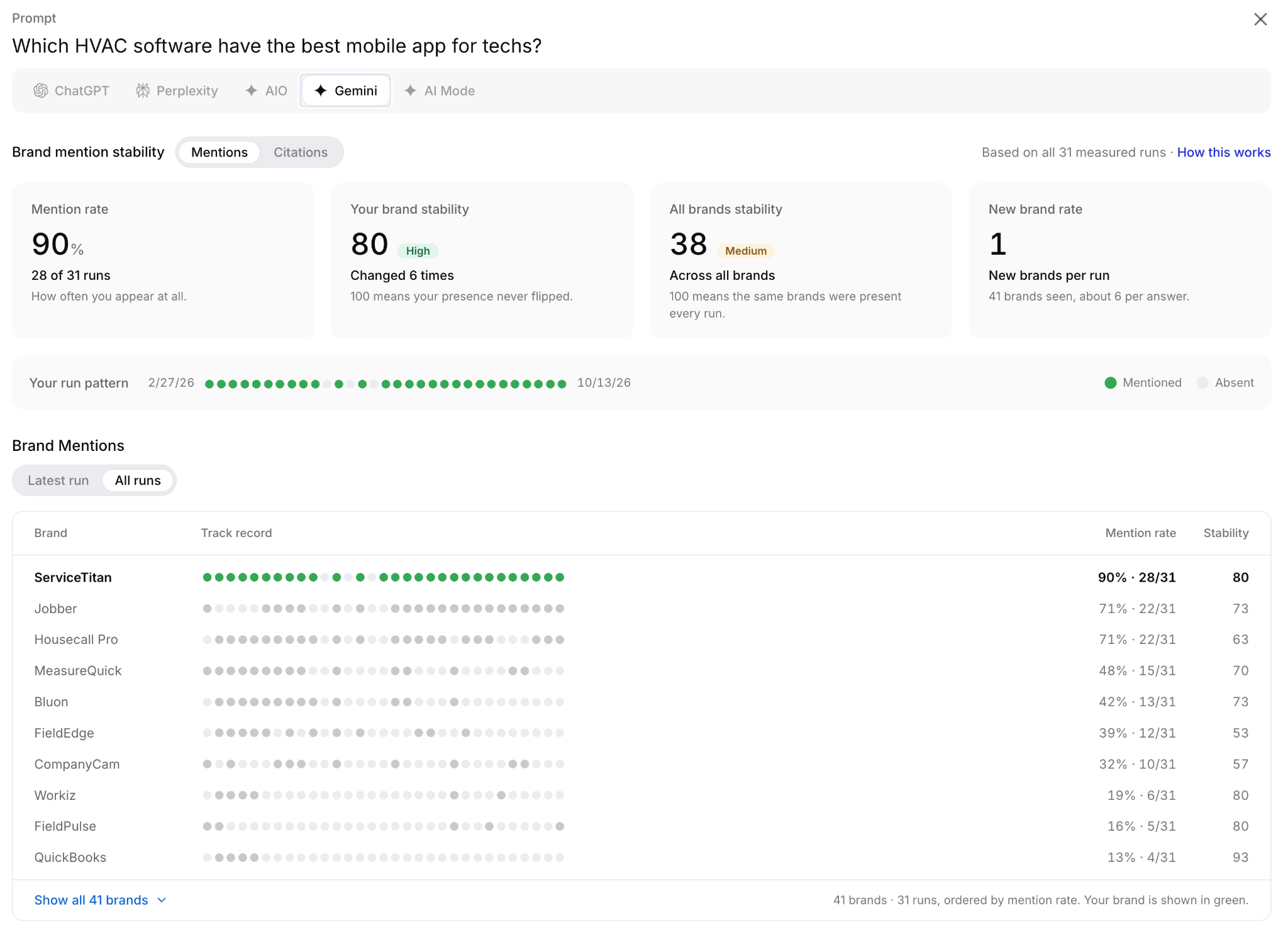
This means you can tell stakeholders that Gemini names them in almost every run, rather than one that happened to appear the day you looked. In a report, that lets you show how firmly the company holds its position over time, which carries more weight with management than a figure from a single day.
Why we designed Traqer differently
We didn’t set out to build an AI visibility tracking tool at first. We run an agency, Grow and Convert, and we needed to measure AI performance for our own clients. The existing tools were prohibitively expensive and we had big reservations about their methods for measuring visibility. So we built our own.
Traqer is different because of how it measures. It tracks how often an AI names your brand across the various questions your customers ask, runs those questions repeatedly so the number is reliable, and reads the web answers people see (rather than an API response). It reports each model separately and keeps brand mentions apart from citations, so nothing is averaged into one figure that hides what is going on.
Importantly, it’s available at a fraction of the cost of other reputable tools. Start your 14-day free trial here.