
Manually tracking Gemini isn’t realistic because the thing that makes LLM visibility tracking meaningful is exactly what a person can’t do by hand: run enough prompts across separate platforms, repeatedly, on a fixed schedule, and record it consistently.
This means you need a dedicated tool to track brand mentions (and citations) on Gemini; one that also separates out all of Google’s AI platforms so you can gauge performance across Gemini, AI Mode, and AI Overviews individually. In this article I’ll explain how you can use our tool (Traqer) to monitor your brand’s visibility on Gemini, and I’ll outline why we think topic-based tracking is the right approach.
The best way to track brand mentions in Gemini
Here’s what tracking Gemini looks like in practice (using our tool, Traqer):
Set up a topic (i.e., a buying intent question your customers ask), and Traqer will generate a spread of prompts that approach that topic from different angles, which you can edit as you need. It then reports the percentage of those prompts where Gemini mentions your brand, split per product.
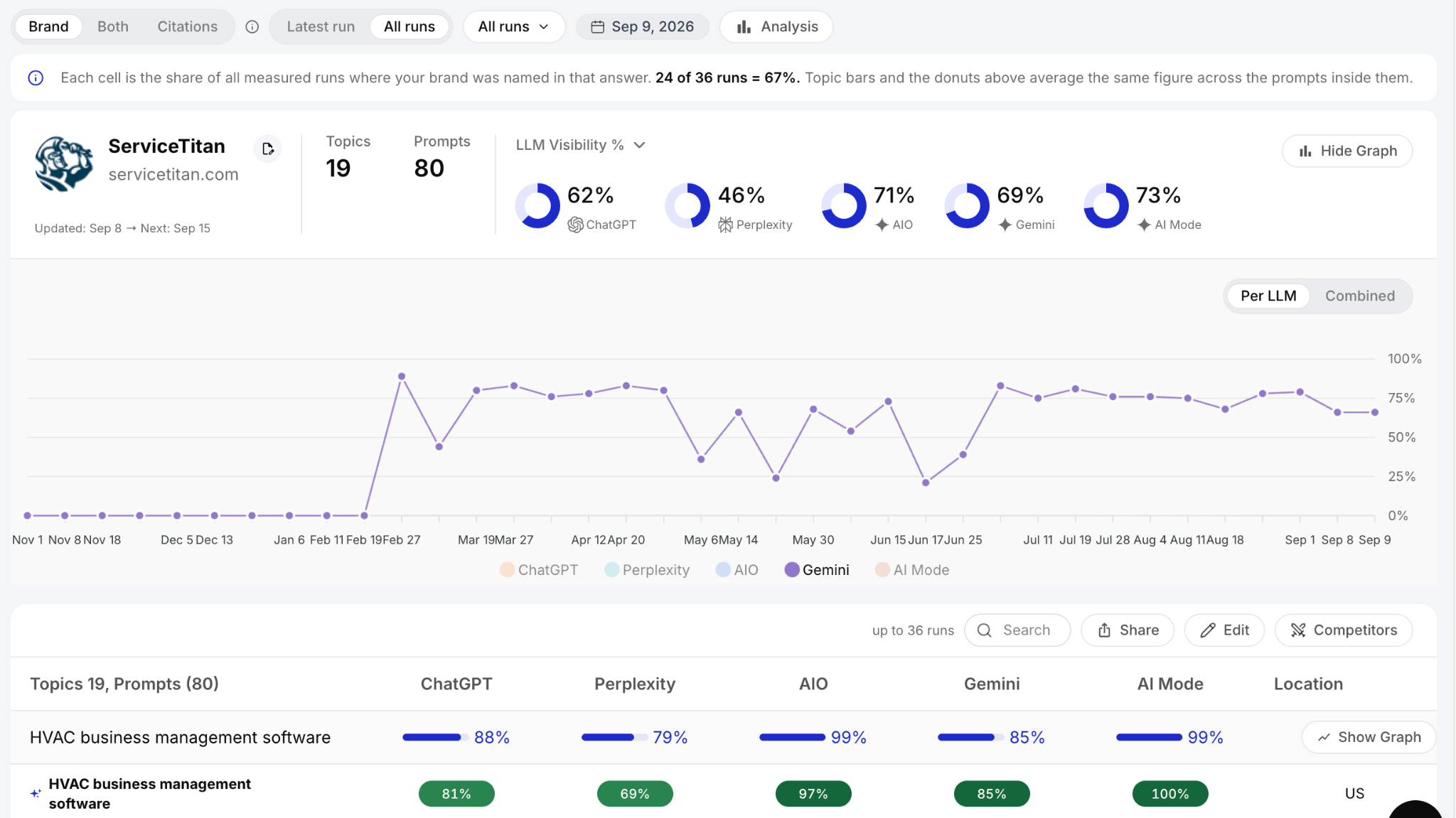
By default you’ll see the Gemini app, Google AI Overviews, and AI Mode as separate lines rather than a single averaged figure, alongside ChatGPT, Claude, and Perplexity if you track those too.
Traqer also keeps brand mentions and citations separate by default, with a toggle for brand mentions, citations, or both at the top of every view, and refreshes weekly so you can compare any two dates and show a client exactly what moved.
Each topic also has an Analyze & Improve view that shows a number of things:
An analysis of how likely the topic is to generate a brand mention (Brand Mention Probability)
Which brands Gemini names most for that topic
Which domains and specific pages it cites
Observed patterns and content ideas that arise
Citation data gives you a practical map of where to earn coverage, since the pages Gemini already pulls from are the pages you’ll want to target for mentions.
You can start tracking with Traqer right now. Pricing starts at $25 a month with unlimited brands and unlimited users.
What counts as a brand mention in Gemini?
A brand mention is when Gemini names your brand in its answer; someone asks Gemini for the best tools in your category, and your product appears in the response by name. That’s the type of outcome that’ll drive leads, because being recommended by name is what puts you on a buyer’s shortlist.
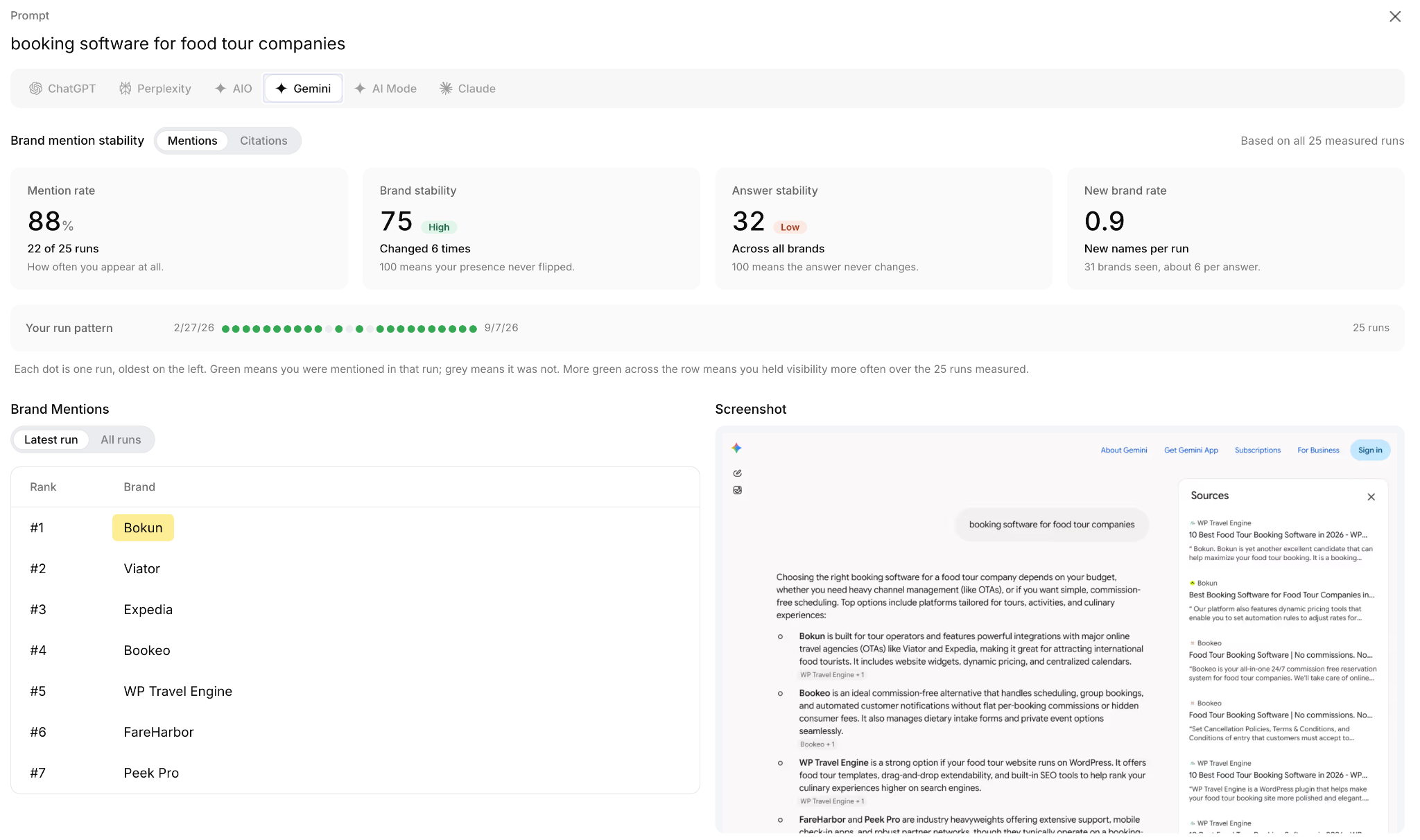
A citation is different. It’s when Gemini links to one of your pages as a source it drew from. Citations matter as they help shape the model’s understanding of what solutions exist for the user's problem (and thus allow you to position yourself as one), and on Gemini they matter more than on most LLMs because the system is grounded in Google’s index. Being a cited source is a step toward being mentioned. But a citation isn’t a recommendation.
You can be cited without Gemini mentioning you, and you can appear in an answer that cites none of your pages at all. Some tracking tools blend these two things into one visibility percentage by default, which inflates the number and hides which issue you actually need to tackle.
This is why it’s important to keep the two metrics apart, and why Traqer defaults to reporting them separately. We discuss this approach in more detail in our guide to LLM citation tracking.
Why tracking a single Gemini prompt doesn’t make sense
The instinct carried over from traditional SEO is to pick a query, run it, and record where you land. In AI search, that doesn’t work in the same way. Real Gemini users don’t type short, repeatable keywords into the chat box. They have long, specific, conversational exchanges shaped by their earlier messages, their account context, and their location. No tracking tool can see that context, so no tool can reproduce the answer a real user gets. The instability is measurable even before you get to personalization.
Generative search is less consistent than traditional search across two runs of the same query, and more easily thrown by cosmetic edits. A change as small as “what is” to “what’s,” or an added question mark, was enough to shift the sources retrieved (even though the intent was identical) in a study by Grossman and colleagues at NJIT (available to read here). Run one prompt once and you’re sampling a single draw from a distribution, which tells you little about whether you show up when people ask about your category.
The best question to ask is how often Gemini mentions you (or your client) across a range of different ways people ask about a relevant topic. It’s this shift, from prompt (i.e., keyword) to topic, which is the foundation of how we think AI visibility measurement should work.
(You can read more about this in our article about AI search visibility metrics).
Monitoring buying-intent topics in Gemini (not individual prompts)
A topic, in our view, is a cluster of related prompts that circle the same buying-intent question from different angles. Instead of tracking “best AI visibility tools” as a single query, you track a group of prompts that a real buyer might use to get at that same need, then measure the percentage of those prompts where Gemini mentions your brand over multiple runs.
That percentage is a far more stable signal than any single result. If Gemini names you in 70% of prompts within a topic, that tells you something important about your standing when people ask about that area, in a way that one prompt run once never could. It also survives the variability problem. One prompt swinging between runs barely moves a topic-level rate, so you’re reading a pattern rather than reacting to noise.
Also, a spread of prompts across a topic gives you fuller coverage of the intent rather than a bet on one phrasing. The same query fan-out logic that Google itself applies, breaking a search into multiple sub-queries behind the scenes, is part of why single-prompt tracking underrepresents how often you actually surface in Gemini. We dug into that in our article about fan-out queries.
It’s important to state that topic-based tracking is more accurate than the alternative approaches, but it’s not complete. No AI visibility tracker can capture every real conversation with its underlying user context.
How stable is your Gemini presence?
Monitoring a spread of prompts across a topic gives you coverage. But a mention can appear in one run and be gone in the next, so a single check only tells you where you stood at one particular moment.
Traqer measures each prompt across repeated runs and reports that consistency directly. A mention rate shows how often you appeared across every run rather than in one snapshot. A mention rate of 85% across 26 runs (22 appearances out of 29), tells you something a single check never could:
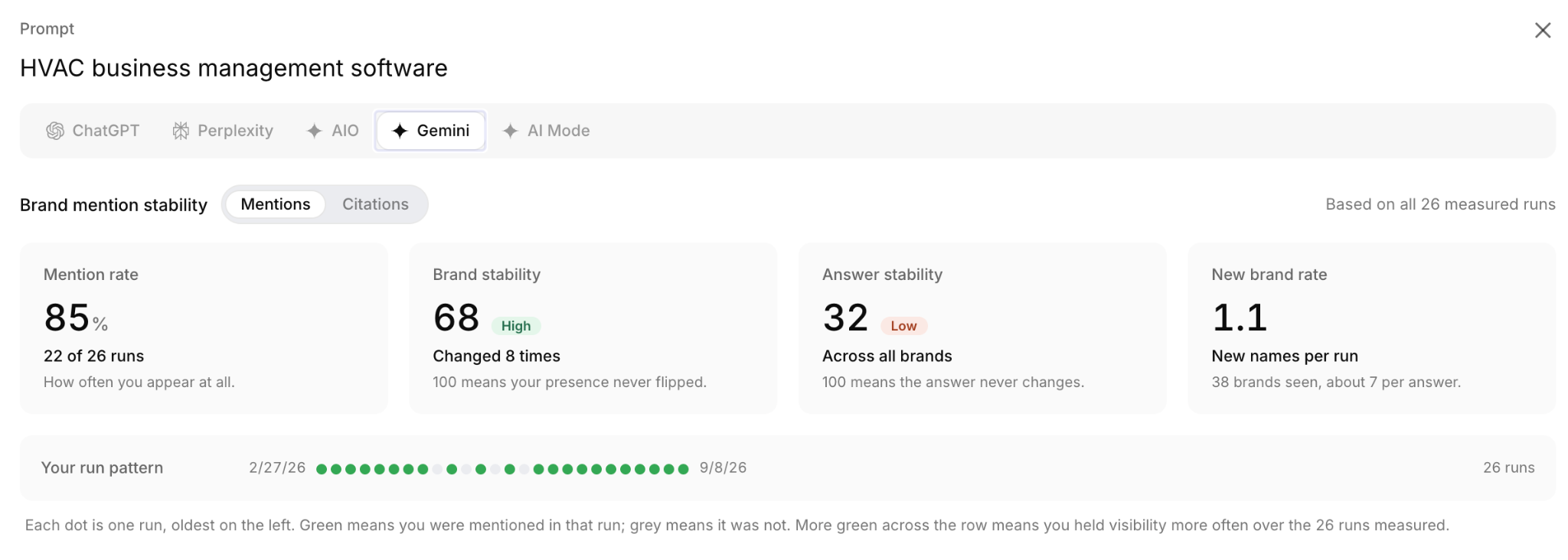
Alongside it, a run pattern strip plots each run in sequence, mentioned or not, oldest to newest, so you can see whether your presence is steady, patchy, or drifting in one direction over the weeks measured.
Two other scores help here:
Brand stability measures how often your presence flipped between appearing and not appearing across runs. A high score means you held your place and a low one means you’re on the edge.
Answer stability measures how much the whole set of recommended brands churned from run to run, which tells you how settled or contested the topic is regardless of where you sit, and a
New brand rate shows how many new names Gemini introduces per run.
These stability metrics show how variable the answer is in general, how firmly your brand is visible within answers, and whether your presence has been climbing or declining over a number of weeks/months. The same view is available within Traqer for the other LLMs, so you can monitor or compare stability for each.
Why it makes sense to track each Gemini product separately
Another instinct might be to treat the three overlapping Google products as one, since they share a model family and an index. Yet ask the Gemini app, Google AI Overviews, and Google AI Mode the same buying-intent question and you’ll often get three different sets of recommended brands back.
The study mentioned earlier (Grossman and colleagues) tested this across 14,212 queries, comparing the sources Google Search, AI Overviews, and Gemini returned for each one.
The three overlapped surprisingly little. Measured by Jaccard similarity, the source lists shared somewhere between 11% and 18% of their entries depending on the pairing, and the most counterintuitive result was that AI Overviews and Gemini, the two products closest in underlying model, produced the least similar source lists of any pairing. The three products returned roughly the same number of sources per query, so this isn’t a counting difference. They’re filling the same slots with different content.
This divergence is consistent in our data at Traqer.
Mean visibility runs highest on AI Overviews at 33%, then the Gemini app at 30%, then AI Mode at 24%, and AI Mode is the weakest of the three products for more than half the brands we track. A brand that looks fine on AI Overviews but thin on AI Mode is the most common pattern we see.
Across the dozens of clients being tracked at our agency (Grow and Convert), a brand’s visibility differs by an average of 16 percentage points between its strongest and weakest Google platform, and two-thirds of them show a brand visibility gap of at least 10 percentage points across the three.
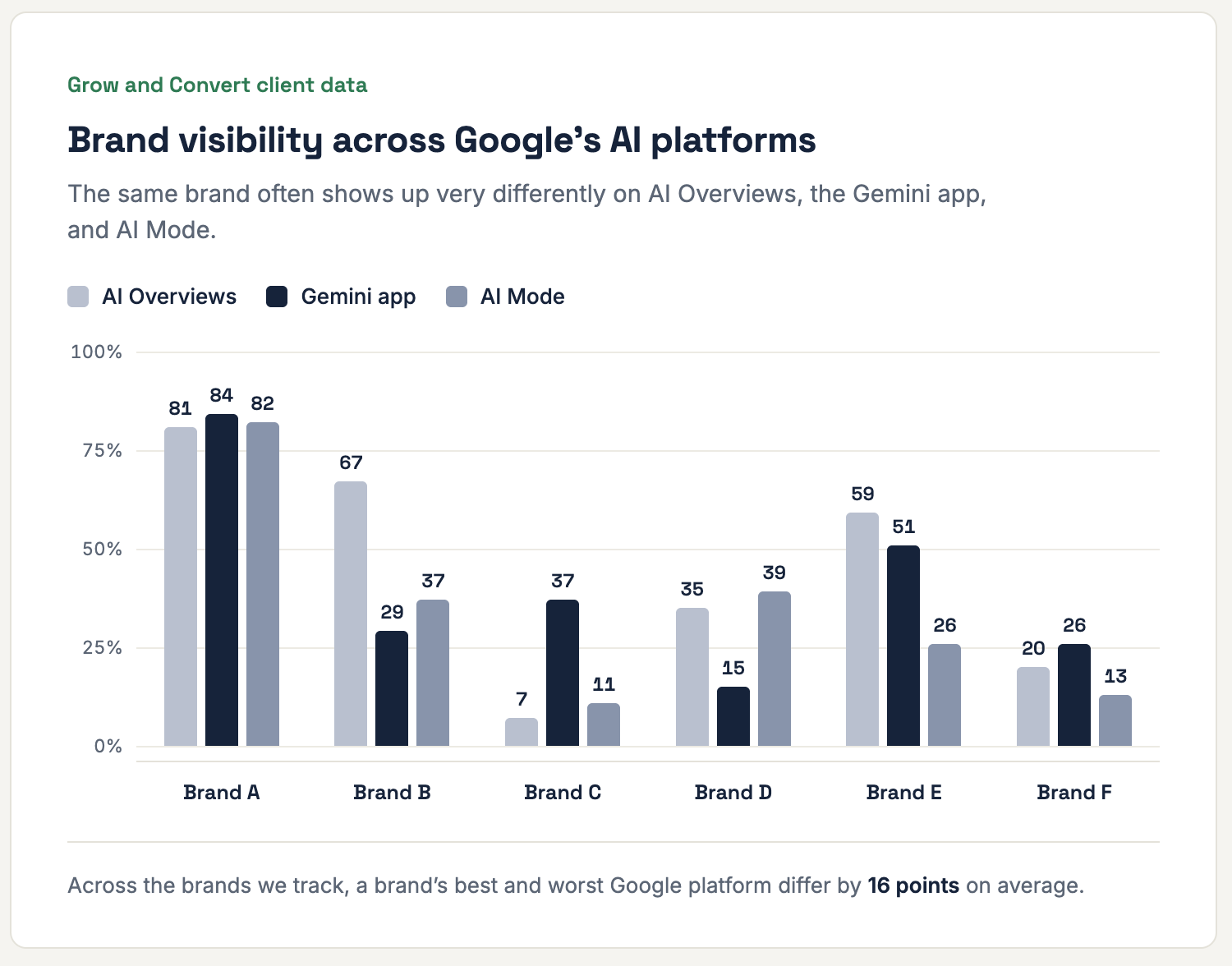
This is why we don’t blend across products in Traqer by default, and why we track AI Overviews and AI Mode as their own lines alongside the Gemini app. If those two are your priority, we cover them directly in our guides to the AI Overviews tracker and the AI Mode tracker.
A working example:
Say you track the topic “best accounting software for small businesses” with ten prompts, and your brand shows up in eight of ten prompts on AI Overviews, six of ten in the Gemini app, and three of ten in AI Mode. A blended tracker reports 57% and you file it away as a middling result.
The per-product view tells a different story. You’re strong where AI Overviews rewards conventional Google ranking, holding steady in the app, and nearly absent in AI Mode, which the Grossman data suggests reaches further into niche and third-party sources than the other two. That gap helps you with strategy. It indicates your owned content is doing its job on the search-driven product but that you’re missing from the reviews, roundups, and community pages AI Mode leans on, so the work is off-site rather than more of the same on-page optimization. The blended 57% contains none of that.
(One note to be aware of: At Google I/O in May 2026, Google announced that AI Overviews and AI Mode are merging into what it described as a single AI search experience. The interface is converging, but the measurement point remains the same. As long as the products cite and recommend information differently, tracking them separately will tell you more than a blended number does.)
From measurement to action
What per-LLM, topic-level tracking gives you is the ability to act strategically on the divergence you see, rather than be surprised by it. For instance, in seeing that your brand mentions are strong on AI Overviews but weak in AI Mode, you might decide that an off-site content push is the best way to close that gap.
Without tracking, that whole loop is guesswork. If you want to run it across Gemini and the other Google products, along with ChatGPT, Claude, and Perplexity, you can start tracking with Traqer.