
LLM citation rate, also called AI citation rate, is the share of prompts for a given topic where a model lists your site as one of the sources behind its answer. In other words, it is how often, across the different ways people ask about a topic, your site is one of the pages a model leans on to build its answer. Track it across enough prompts and it tells you how often LLMs pull from your pages when they answer questions in your space.
Two things trip people up before they even start measuring it. The first is the definition. You’ll see citation rate described as the percentage of prompts where a model mentions or cites your brand, with the two folded into one number. We recommend keeping them apart, because a citation and a brand mention are different events with different value, and lumping them together hides the one that actually drives revenue. The second is the assumption that a higher citation rate is the goal in itself. It isn't, and we'll explain why.
We work through this every day at our agency, Grow and Convert, tracking AI visibility for clients. That’s why we decided to build Traqer. Here is how we define LLM citation rate, how to measure it so the number means something, and what to do with it.
What an LLM citation rate actually measures
A citation and a brand mention are two separate things in an AI answer. A brand mention is your name appearing in the generated text, where the model is naming you as an option. For example, the screenshot below shows the brand-led results for my search about tents for kids.

A citation, on the other band, is your site showing up in the list of sources the model drew on. You can have one without the other. You can be cited as a source and not named in the answer, and you can be named in the answer without any pages cited.
So citation rate measures one specific thing, which is how often, across the prompts you track for a topic, your domain appears in the source list. It’s not the same as your brand mention rate, which measures how often you’re named in the answer itself. Some tools report a single blended figure, but our tool, Traqer, separates them. This is because the actions you take to move each one are different, and because a citation on its own is worth far less than a mention.
Our guide to tracking AI search engine citations covers the distinction in more depth, and our guide to brand mentions covers the other side.
How to measure LLM citations so the number means something
A citation rate is only as good as the way it’s calculated. Two things to do:
Measure at the topic level. AI answers vary a lot from one run to the next. Ask about a topic one way today and you might be cited, then ask it a slightly different way (or even the same way) tomorrow and you might not be. In our own client tracking, the sources behind a given prompt rarely hold still, so measuring the data around a single prompt at a given moment is just noise. The signal is the rate across many phrasings of the same topic, measured over time, which is the only version of the number worth reporting.
Keep the models separate. Perplexity and Google’s AI Overviews (and AI Mode) are search summarizers that cite sources on almost every answer, so citation rates run high there. ChatGPT leans more on its training data and cites less often. Claude frequently answers without returning a list of sources at all. Because of this, a single blended citation rate averaged across all models is misleading. (Our tool, Traqer, reports every model separately for this reason, and our article on the Grow and Convert blog about how not all LLMs are the same explains how far apart they sit.)
What counts as a good citation rate?
There’s no universal benchmark for a good AI citation rate, and any tool that hands you one is glossing over how much the answer depends on the model and the topic.
We recommend reading your citation rate per model first. Because the search-based platforms cite far more than ChatGPT or Claude, a citation rate that looks strong on Perplexity and weak on ChatGPT is to be expected, and rarely something to worry about in and of itself. The meaningful comparison is against yourself over time, viewed in the context of the specific model, rather than by using a blended average.
You should also prioritize measuring your citation rate for buying-intent topics. The search-based models cite sources across the funnel, informational (top-of-funnel) queries included, so citations there are common. Due to the low click-through rate on these links, combined with the low buying intent of the searcher themselves, these citations aren’t actually worth much to you.
If you’re cited for your article targeting the keyword “what is customer relationship management?” that’s a nice vanity metric, but the citations that matter most are the ones linked to bottom-of-funnel, product-related topics. For instance “the best CRM for hairdressers” or “alternatives to XYZ” phrasings, where a citation is located close to a buying decision.
Citation rate versus brand mention rate
The reason to keep citation rate and mention rate apart is that they have a very different level of value.
The brand mention is what wins customers. When a model names you in its answer, it’s recommending you to someone who is reading that answer. A citation just means your page is one of the sources listed beneath it, and almost nobody clicks those. In our own usage, the click-through rate is something like one in thirty. This means a brand mention is worth many times more than a citation, often by an order of magnitude, precisely because the mention is what the reader sees and acts on.
So citation rate is beneficial to understand as a means to that end.
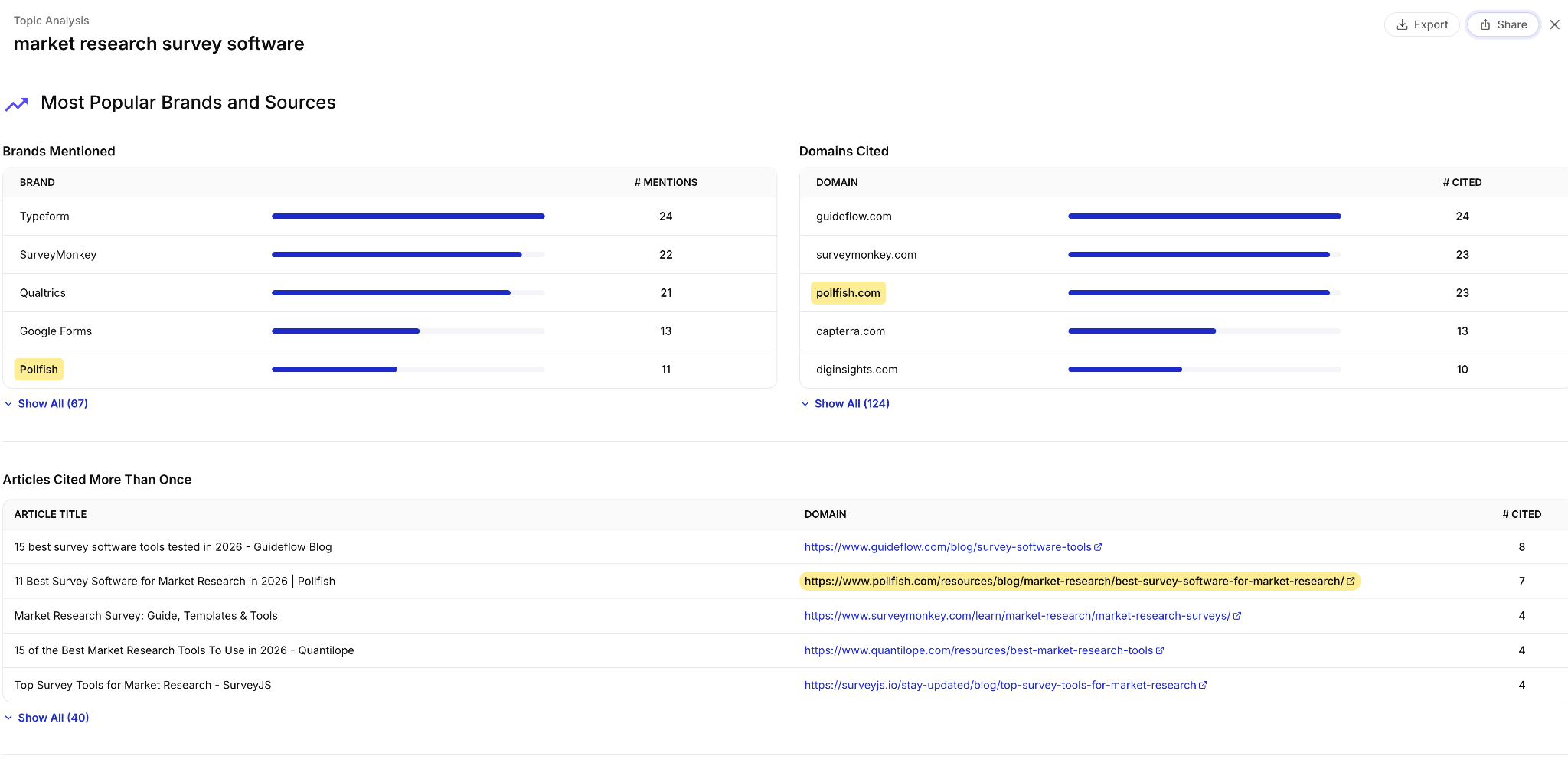
It does two useful jobs. First, your own citations tell you your content is in the pool a model draws from when it searches, which means your cited content has a chance (not a guarantee) of influencing the model’s answer . Second, and more actionable, the full list of cited sources for a topic shows you exactly which pages a model pulls from. This then acts as your outreach target list. If an industry roundup keeps getting cited for a topic you care about (e.g. “accountancy practices for insurance firms” or “places to visit in Geneva”), and you’re not on it, that’s a page to go after.
Citation rate doesn’t guarantee a mention. It’s tempting to assume that getting cited leads to getting recommended, but our own data does not support treating it as a reliable pathway. We see pages cited without the brand being mentioned, and brands mentioned without their pages cited. The recommendation and the citation are related, but one does not cleanly cause the other. So track your citation rate for what it tells you, and follow your brand mention rate on buying-intent topics as the headline number.
How to improve your LLM citation rate
Two approaches are likely to move citation rate, in the order set out in our guide to Prioritized GEO.
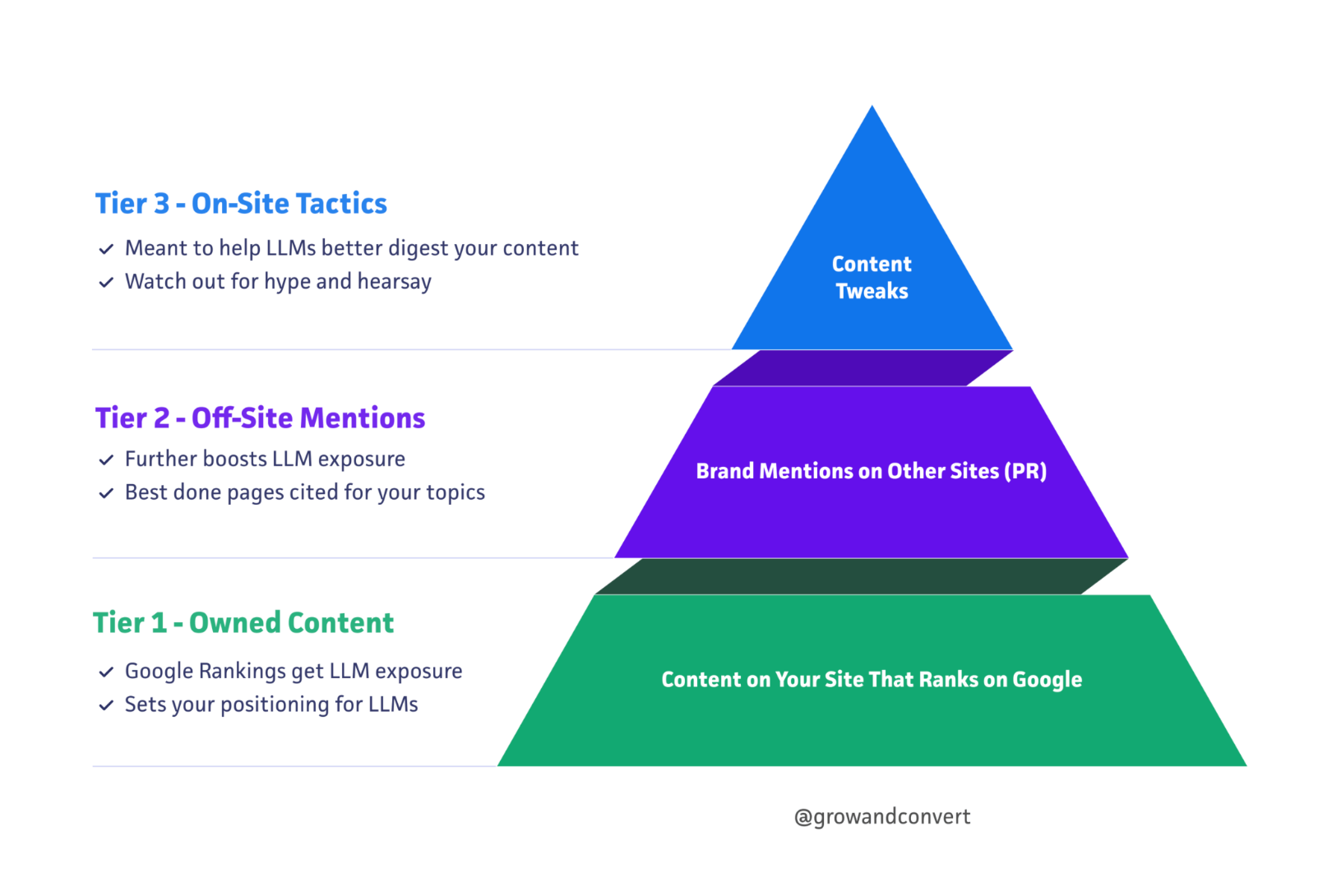
The first is producing owned content that ranks. Content on your own site that ranks in traditional search for a buying-intent term tends to get pulled in and cited when a model answers a related product query, especially on the search-based surfaces. This is the foundation, and it is the same bottom-of-funnel content that works for AI search in general. Our Constitution Lending case study shows product-level content earning citations against much larger competitors.
The second is targeted citation outreach. Once you can see which third-party pages a model cites for a topic, you can go after those specific pages with a guest contribution, an expert quote, or a listing, rather than running a broad campaign on Reddit or generic PR. Across our client topics, the large majority of cited domains are industry-specific sites rather than the general destinations the popular studies point to, which is why targeting the actual cited pages beats a blanket approach. Our Toro TMS case study shows this in a B2B software category.
The on-site tactics that get promoted for this, an llms.txt file, FAQ schema, or rewriting headings as questions, have not meaningfully moved citation rate (or brand mentions) in our experience, and our own tests of llms.txt showed no detectable difference.
How to track LLM citation rate using Traqer, our AI visibility tool
We built Traqer to measure AI visibility in line with the way LLMs actually behave; to give the most reliable data possible. This means citation rate is calculated at the topic level across multiple phrasings, kept separate from brand mentions rather than blended into one score, and broken out per model.
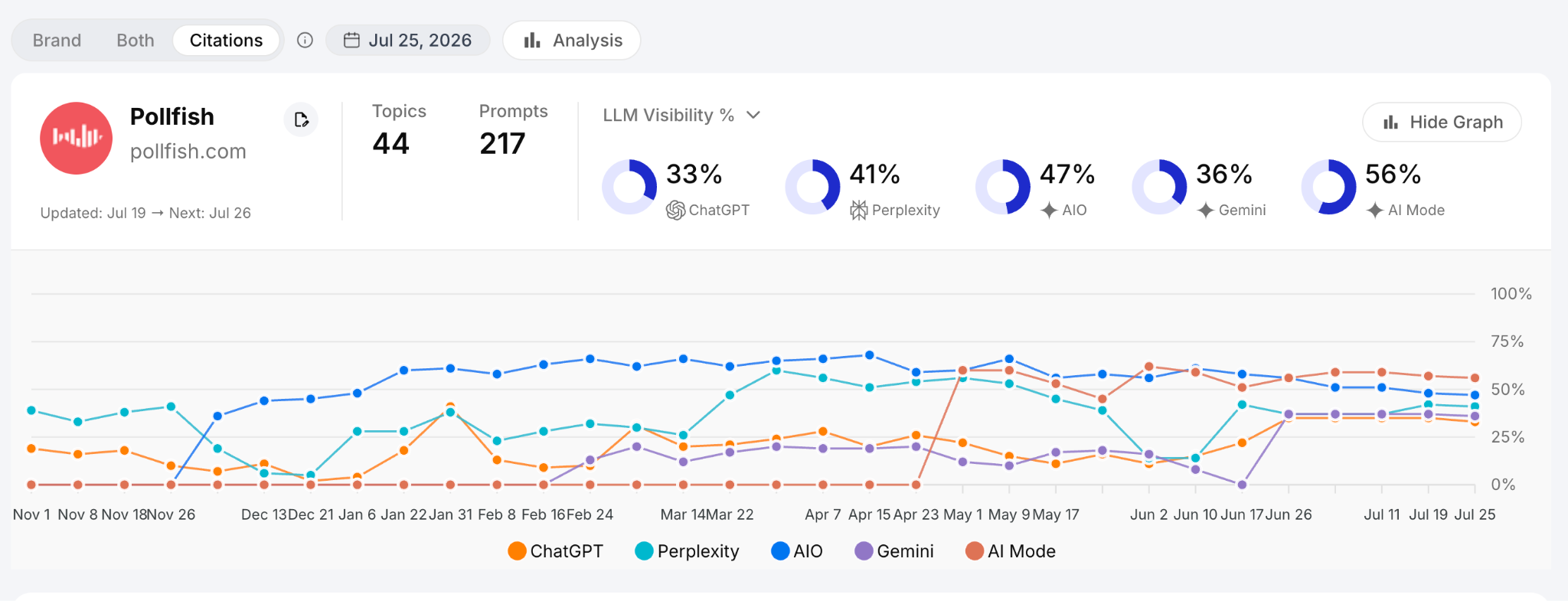
As well as the dashboard where you can monitor citation rates for your most valuable topics, the Analyze and Improve view within Traqer lists the exact domains and URLs cited for each topic. This metric turns straight into an outreach list, and you can export those lists as CSVs or share a topic view with a client.
If you want to see your own citation rate measured this way, you can start a free trial at Traqer.
Traqer is built by Grow and Convert. For more on the strategy behind improving AI visibility, Topic-Based GEO and Prioritized GEO explain the thinking behind how Traqer was built.