
Searching for a Claude rank tracker tool, you’ll run into dozens of products that promise to tell you where your brand “ranks” in Claude, like the way a conventional SEO rank tracker reported your position on a Google results page. We want to start with the thing many people miss: Claude doesn’t produce rankings. There’s no ordered list of results behind a Claude answer, no position one through ten, and no stable output you can check today and reproduce tomorrow.
Ask Claude the same product question twice and you’ll often get two different answers, with different brands named in a different order. So a tool that reports “you rank second in Claude for this prompt” is describing something that doesn’t really exist in the way the word “rank” implies.
But that doesn’t mean tracking Claude is pointless. The question is rather something like “how often does Claude bring up my brand when people ask about my product category?”
We built Traqer with this in mind; to track AI visibility the way we think it should be measured, after running into these problems with existing tools while doing GEO/AEO work for our own clients at Grow and Convert. In this article we’ll explain what a Claude tracker should actually measure, why Claude behaves differently from the other models, and how the main AI visibility tools compare.
Why “rank tracking” is the wrong frame for Claude
Traditional rank tracking works because Google search is relatively stable and repeatable. While there is some volatility in changing SERPs and customization based on previous searches, location, and other variables, broadly speaking most people see the same results from the same keyword searches. This allows you to check where you rank and watch it move up or down over time.
Claude does not work like that, for three clear reasons:
Real prompts aren’t just keywords. People don’t type “barber” or “project management software” into Claude. Instead, they describe their situation in full sentences, often across a longer conversation that involves back and forth. This means there isn’t really a small set of repeatable queries to track. We’ve written about this in our article on Invisible Prompts, which explains more about why the prompts driving your visibility are mostly ones you’ll never get to see.
Claude personalizes, and heavily. It draws on the current conversation, prior chats, and whatever context the user has shared about their company, their size, and their constraints. The answer any real user gets is shaped by all of that context. So even if you were to be able to guess the exact prompt a real user typed into Claude, an AI visibility tool can’t reproduce the answer that user gets.
There’s random variability on top of it all. Even the same prompt, run twice in a row with no personalization at all, can produce different brands and different phrasing. That’s just the nature of LLMs. Your brand might appear in one run and be missing from the next. A single manual check catches only one of those runs, so it can just as easily overstate your visibility as understate it, and either way you are drawing a conclusion from one sample of something that moves.
All this together means that one prompt, run once, is just noise. To get any sort of reliable read on how you’re performing, you need to run several prompts that approach the same buying question from different angles, then look at the pattern across all of them. That’s the shift from prompt-level tracking to topic-level tracking, and it is the most important thing to get right when choosing your tool.
What to look for in a Claude tracker tool
Claude behaves in ways that impact how you measure. Its live search runs on Brave's independent index rather than Google's. Anthropic added Brave Search to its subprocessor list for Claude in March 2025, and analysis from Profound found Claude's citations overlap heavily with Brave’s top organic results, far more than ChatGPT's citations overlap with Bing's. That means strong Google rankings don't automatically carry you into Claude the way they carry you into Gemini and AI Overviews.
Claude is also more cautious than most models about naming a single winner. It tends to present several options and to say plainly when it lacks the information to choose, a disposition reflected in the updated constitution Anthropic published in January 2026, which frames Claude as a careful advisor rather than a decisive recommender. A mention from Claude is therefore harder to earn than one from a model that hands out recommendations more freely, and worth more with the considered buyers who tend to use it.
The practical consequence is that Claude visibility has to be read on its own terms and not averaged into a blended cross-model score, because a brand can look healthy on ChatGPT and nearly invisible in Claude.
With that in mind, these are some of the questions that can help you choose the right Claude tracker:
Does it monitor topics, or track single prompts? This is the question that matters most. A tool that only tracks individual prompts and reports a position is measuring something unstable. A tool that groups related prompts into a topic and reports on how often your brand appears across that topic in Claude is measuring something you can rely on.
Does it separate brand mentions from citations? A brand mention means Claude names your brand in its answer, for example when it says your product is a good fit for a particular use case. A citation means your URL shows up as a source link Claude drew on. Being cited is generally not as valuable as being recommended. Citations are a useful signal and a map of which pages Claude is pulling from, but a brand mention is what drives leads. You need to be able to see them separately.
Is it affordable? Claude is notoriously difficult for tracking because it cannot be scraped in the same way that other LLM platforms can. This means the only way to monitor your performance is by using a tool that gets its data via the Anthropic API. This is expensive to run, which means the costs are usually higher for Claude monitoring. Some tools only include it in their top-tier pricing for enterprise, while others offer it as an extra cost above the other major LLMs. Pricing structure matters particularly if you’re an agency tracking performance across multiple clients; something we explore in more detail in our guide to affordable AI visibility tracking.
How the most established Claude tracking tools compare
The category has filled up fast, and the tools differ more than their near-identical landing pages suggest. Here’s how the main options shape up for tracking Claude specifically.
Traqer
We built Traqer because our agency was running GEO for a portfolio of clients and couldn’t find a tool that measured Claude accurately at a price that worked across multiple brands.
Traqer starts at $25 per month for 10 topics and 50 prompts. Every plan includes unlimited brands and unlimited users, with no per-brand charge. The web-scrapable models, ChatGPT, Perplexity, Google AI Mode and AI Overviews, and Gemini, are included on every plan with no per-model fees. Claude is an optional at-cost add-on, because the data needs to be accessed via the Anthropic API (which is costly).
Traqer is designed around the principle of topic-based GEO, meaning you can create a topic (e.g., “SaaS content marketing agencies”) and add several related prompts that approach the topic from different perspectives. Your visibility is reported as the share of those prompts where your brand appears, broken out per model. This gives you a pretty stable read on your Claude performance.
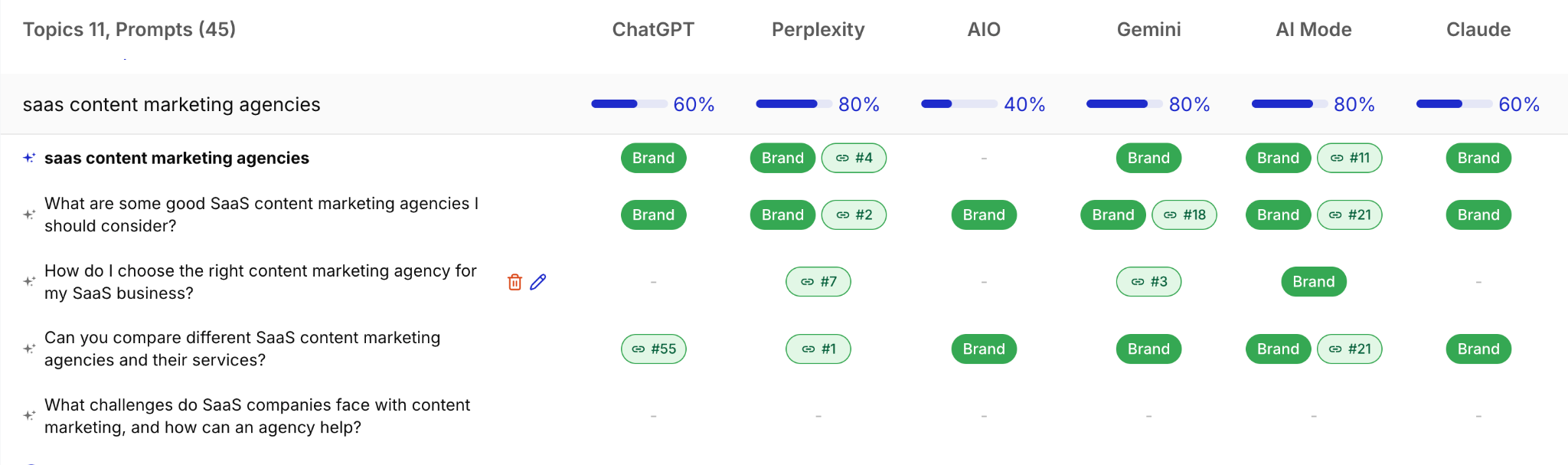
Traqer also keeps brand mentions and citations separate, with a toggle so you can view either on its own. On top of the standard visibility percentage, it reports two metrics that a single percentage cannot give you.
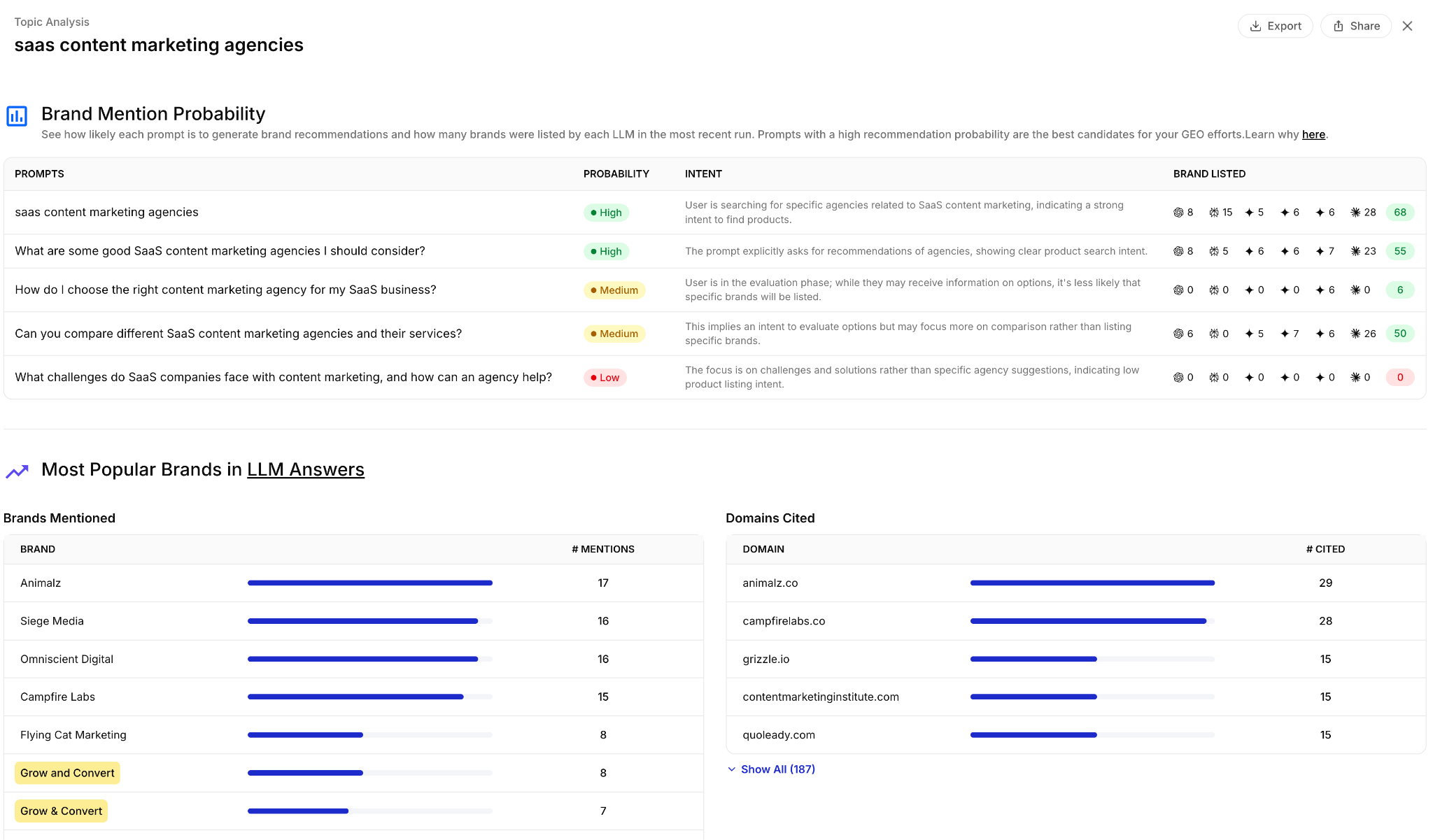
LLM Visibility Count is the raw number of prompts where your brand appears, which only rises when you gain visibility somewhere new and does not drop when you add ambitious new prompts. Topic Visibility groups your topics into high, some, and no visibility, so you can measure progress at the topic level without being able to inflate the number by deleting the topics where you are weak.
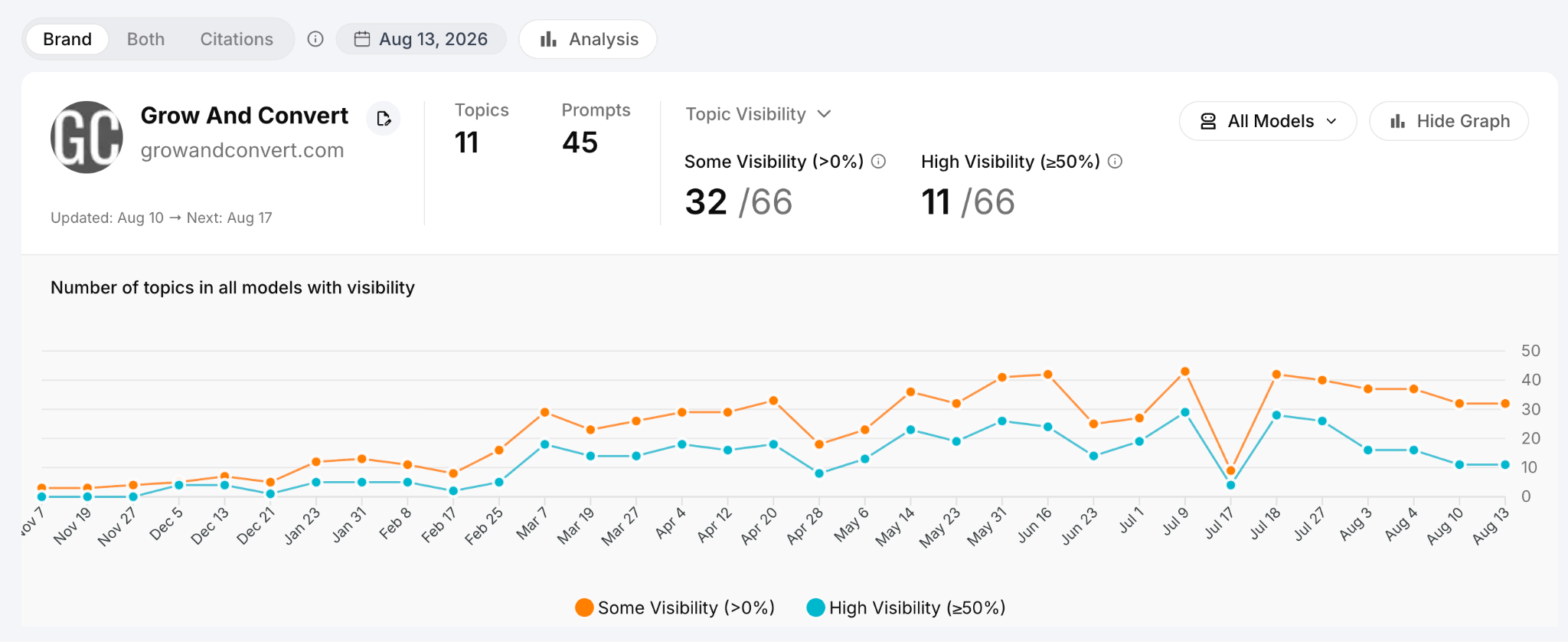
Each topic has an Analyze and Improve view that shows which brands Claude names most often for that topic, which domains and specific pages it cites, and a Brand Mention Probability rating for each prompt so you can tell which prompts are genuinely product queries and which are informational noise where Claude will not name any brand. Our data refreshes weekly, and you can compare any two dates side by side to show a client exactly what moved between reporting periods.
Traqer was built for ourselves and released to the market because it had so much interest from clients and contacts. We’re not VC-funded, and we’re committed to keeping comprehensive AI visibility monitoring affordable and available to small businesses, startups, and agencies who need to measure at scale. This tool is less suited to teams that need thousands of prompts checked many times a day, since the weekly update cadence is built for strategic monitoring rather than real-time alerting.
Start tracking your Claude visibility with Traqer
Profound
Profound is the most established enterprise option in this space. The product is polished, the reporting is built for sharing with stakeholders, and the model coverage is good. It is designed for large in-house teams tracking one brand in depth. There is a detail here that matters if Claude is your reason for buying. Profound gates its engines by tier: the entry Starter plan covers ChatGPT only, the mid Growth plan adds Perplexity and Google AI Overviews, and Claude is available only on the custom Enterprise tier.
So a team that comes to Profound specifically to track Claude cannot do it on any self-serve plan, and will have to move to a custom contract. Public pricing on the self-serve tiers is demo-led and has shifted over the past year, with third-party reviews citing figures from a $99 Starter up to a Lite tier around $499 per month, so confirm the current number and the Claude tier directly before committing. If you manage a small number of high-budget enterprise clients who can absorb an Enterprise contract, it is worth evaluating. For a typical multi-client agency list, the economics are difficult to justify.
Peec
Peec is a VC-backed platform that launched in early 2025 and grew quickly. The self-serve plans let you pick three engines from a pool that includes ChatGPT, Perplexity, Google AI Overviews, Gemini, and Copilot, and additional engines from that pool are paid add-ons between €35 to €165 each per month.
Claude is the catch. It is not in the self-serve engine pool, and it cannot be added with an add-on. Claude runs through an API integration reserved for the Enterprise tier, so a brand that came to Peec specifically to monitor Claude cannot do it on Starter, Pro, or Advanced. On cost, the Starter plan is roughly €89 per month for 50 prompts across three engines, and stacking add-ons on top pushes the effective monthly cost up before you have scaled prompt volume at all.
Scrunch
Scrunch is built more for content and technical SEO teams, with its strengths in citation discovery and in named crawler and agent-traffic analytics, working out which sources the models pull from and how AI crawlers reach your site. If understanding what to publish and how bots access it is a core part of what you deliver, it is worth a look. The same tier pattern applies here. The entry Core plan sits around $250 to $300 per month and covers four engines, ChatGPT, Perplexity, Google AI Overviews, and Copilot, and Claude is gated to the Enterprise tier. So Claude tracking again means a custom contract rather than the entry price. That puts Scrunch in the middle of the market rather than the low end, and the Claude tier is the number to confirm at your actual client count.
What actually moves your content’s visibility in Claude
Since the point of watching your Claude visibility is to learn where to improve it, we want to share some insights on what works and what doesn’t for Claude. Especially as there’s a lot of hype to cut through.
Nobody has a guaranteed playbook for AI search, and the link between a specific action and a visibility outcome is looser than it is in traditional SEO. What we have, from GEO work across dozens of clients at our agency, are two levers that have strong supporting evidence.
The first is producing owned content that ranks for buying-intent queries. Content on your own site that ranks for bottom-of-funnel terms in your category tends to get encountered and cited by the models, because Claude and the others search the web when they answer product questions. For Claude specifically, remember that its search runs on the Brave index rather than Google, so ranking broadly across search engines rather than optimizing narrowly for Google is the safer bet.
Traqer's Domains Cited data shows whether your domain is among the sources Claude is drawing on for a topic. If it is not, ranking content for those queries is the starting point. This is the foundation of the Prioritized GEO framework, where owned content sits at the base of the pyramid.
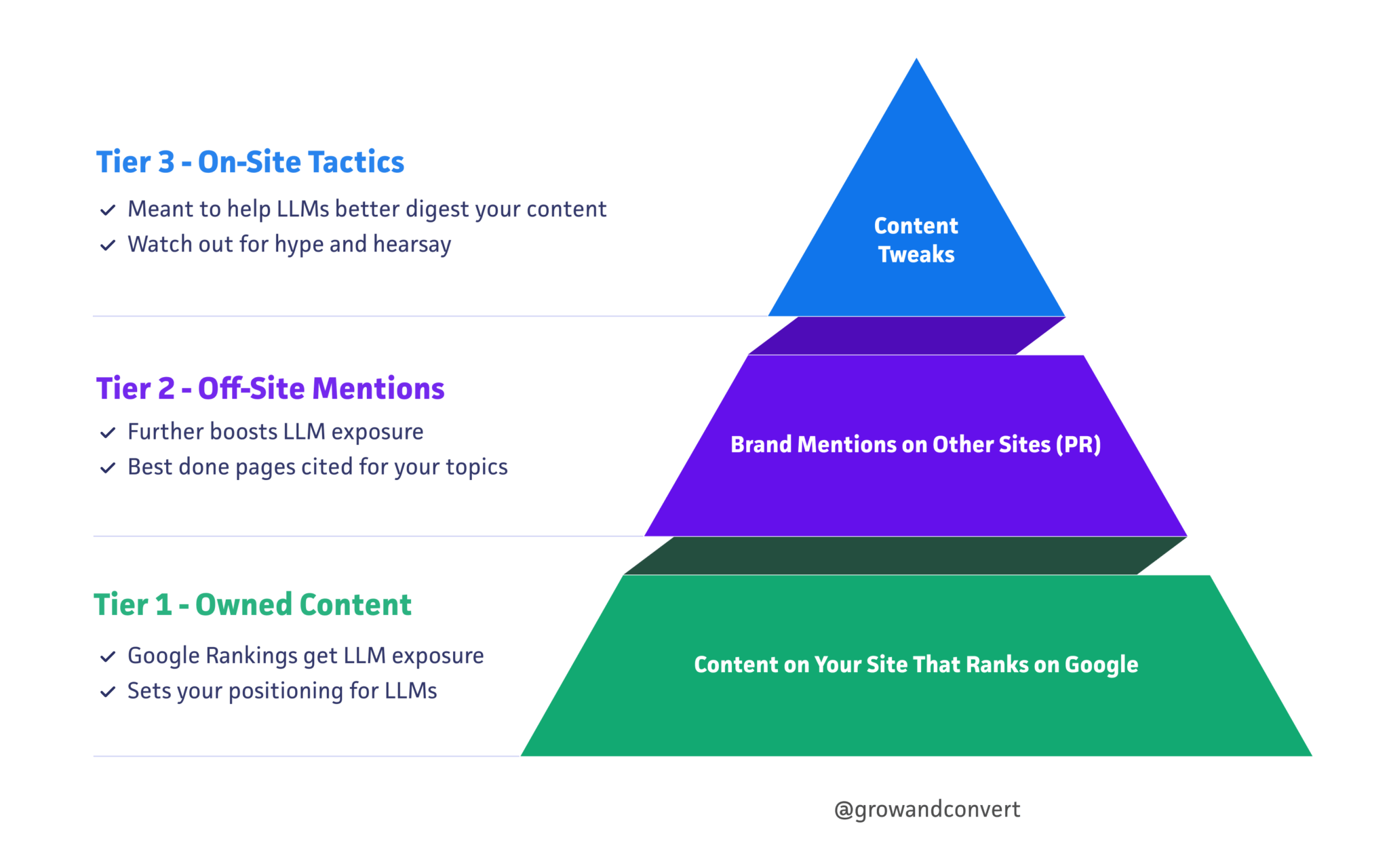
The second is getting mentioned on the third-party pages Claude already cites. Traqer's Analyze and Improve view shows the specific pages that come up repeatedly across prompts for a topic, whether they’re review sites, comparison articles, or industry roundups. Those are your outreach targets, because you know Claude is pulling from them. The logic mirrors SEO link-building, but the mechanism is different. You’re not chasing authority, you are getting your brand in front of the model through sources it trusts.
Both levers come with the same caveat. Ranking a page does not force Claude to cite it, and being mentioned on a frequently-cited page does not force Claude to then recommend you. You’re influencing the inputs, but not controlling the output. We’ve seen both work consistently, but neither is guaranteed.
In our tests, on-site hacks that get hyped (e.g., adding an llms.txt file, rewording headings as questions, or bolting on FAQ blocks and key-takeaway boxes) don’t make a big impact. Experiment with them at the margins if you like, but not at the expense of the two levers above.
Which Claude tracker is right for you?
The tools that gate Claude behind an Enterprise contract tend to make sense for one kind of buyer: a large in-house team or an agency with a small roster of enterprise clients who need polished stakeholder reporting and can absorb a custom contract to unlock Claude. If that describes you, they’re worth evaluating on their own terms. For most teams, and for agencies tracking Claude across more than a client or two, the economics of a custom contract per brand are hard to justify, and paying enterprise rates to add the one model you came for makes even less sense. That is the gap Traqer is built for.
You get real-interface data on the models that allow it, topic-based tracking, a per-model breakdown, brand mentions kept separate from citations, and Claude available on any plan rather than locked behind a custom contract, starting at $25 per month with unlimited brands and Claude offered as an at-cost add-on.
Start tracking your Claude performance now with Traqer
Traqer is built by Grow and Convert. For more on the strategy behind improving AI visibility, Topic-Based GEO and Prioritized GEO explain the thinking Traqer was built on. If you want to see how the same measurement approach applies to other models, we have written about tracking ChatGPT rankings over time, the Perplexity rank tracker, and how to track brand mentions in AI search.