
If you search the term “AI brand monitoring” two different kinds of product come back. The first group is the established social listening tools, now with AI added, that scan social posts, news, forums, and review sites for mentions of your brand and score the sentiment. The second group is newer. These tools track whether LLMs such as ChatGPT, Perplexity, Google AI Overviews, AI Mode, Gemini, and Claude name your brand when someone asks them for a recommendation. This article is about the second one.
Below we cover what AI brand monitoring should measure, why the methods that work for social listening and SEO rank tracking don’t work for AI, how to run brand monitoring in practice, and what tends to improve your brand’s performance in LLMs over time.
What counts as a brand mention in AI answers
Your brand can show up in an AI answer in two ways, and they mean different things for your business.
A brand mention is when the model names your company or product in the text of its answer. Someone asks for the best options in your category, and the model writes your name into the recommendation. That is the outcome that puts you into a buyer's consideration set.
A citation is when a URL connected to your brand appears in the source list under the answer, whether or not your name shows up in the text. The model might pull from your comparison page to help build its reply and still recommend a competitor by name.
You can be cited without being mentioned, and mentioned without being cited. They point to different things. Mentions tell you whether the model is recommending you. Citations tell you which content it's drawing on. A lot of AI brand monitoring tools collapse both into one visibility score, which hides the distinction that matters most.
The distinction matters because a citation rarely earns a click. When Pew Research studied how people interact with Google's AI Overviews, users who saw an AI summary clicked a link cited inside that summary in about 1% of visits. Almost nobody scrolls to the source list and clicks through. A named recommendation in the body of the answer is the thing that changes a buyer's shortlist. That is why we track brand mentions and citations separately, and report each per model rather than blending them.
Why you can't monitor AI answers the way you monitor social or traditional search
Social listening works through reading public artifacts. A tweet about a brand, a review, a forum post, and a news article all remain on a fixed URL. You can scrape them, analyse them, and go back to the same mentions tomorrow if they haven’t been deleted. AI answers don’t behave that way. They’re generated on demand, shaped by the individual user, and they’re different almost every time.
We saw this first hand before building Traqer. Run the same product-related question through ChatGPT several times and the list of brands changes, the order changes, and often the number of brands changes too. There is no fixed “results page” to hold a position on, so any tool that reports a “position” for your brand in an AI answer is describing a stability that doesn’t actually exist.
What holds steadier is frequency. Across the accounts we track, the brands with a strong presence in a category show up in a large share of responses no matter how the question is worded, while the weaker brands appear only now and then. Individual position is close to random. How often you show up across many runs of similar questions is something stable enough to measure, and that’s the foundation of how AI brand monitoring has to work.
Personalization makes this case even stronger. Even the exact prompt a customer typed won't reproduce the answer they saw, because the model factors in their industry, their company size, what they've tried before, and context built up over months of chats. Grow and Convert calls this the gap between the literal prompt and the effective prompt, and we've written about it in Invisible Prompts.
AI answer monitoring, then, has to be probabilistic. You measure how often you appear across a group of related questions, rather than whether you hold a specific position for one of them.
What an AI brand monitoring tool should measure
Once you accept that a single prompt is one data point rather than a picture, there are a few implications:
Topic-level visibility should be monitored, not single-prompt rankings. Group the questions a buyer might ask about a given need into a topic, then measure the share of prompts within that topic where the model mentions you, calculated per model. That share is a far steadier signal than any one answer, and it reframes the question from “did we appear for this exact wording” to “how often do we appear when people ask about this area.” This is the core of the approach, and Grow and Convert explains the measurement thinking behind it in Topic-Based GEO.
Per model, not one blended number. Search-based LLMs such as Perplexity, Google AI Overviews, and AI Mode summarize live search results, so a brand with strong traditional rankings tends to carry over well. ChatGPT leans more on its training data, so strong rankings translate less reliably. A single blended percentage hides that difference. We track Toro, a trucking software company, across 18 topics and 86 buying-intent prompts. Their visibility sits at 91% on Google AI Overviews and 59% on Perplexity, both search-based surfaces, but 35% on ChatGPT with the same topics and the same content behind it. A single averaged score would erase the most useful data.
Brand mentions kept separate from citations. For the reasons above, a tool that folds recommendations and source links into one figure can't tell you whether you're being recommended or merely referenced. You need to see each on its own, per model.
Metrics that only move when something real changes. A single brand-wide visibility percentage is easy to flatter. Stop tracking the prompts you don’t appear in, and the number rises without anything improving. Raw counts of prompts where you appear, and counts of topics with strong visibility, don't behave that way. They rise only when you gain ground somewhere new.
A focus on buying-intent topics. Informational questions like “what is project management software?” rarely produce brand recommendations at all, so tracking them creates noise. The topics that really matter are the ones where the user is looking for a product or service, which is the same bottom-of-funnel focus that has always driven conversions from organic search.
How to monitor your brand in AI, step by step
This section walks through the practice of using a tool like Traqer to monitor your brand in the LLMs.
Start by defining 5 to 10 topics that map to what you sell. For our own content agency, we track topics like SaaS content marketing agencies and B2B content marketing agency. We wouldn't track content marketing on its own, because many of the people searching that term just want information rather than a provider, and the models tend to answer them without naming any/many brands. The more specific the topic is to your product, the better your odds of being mentioned.
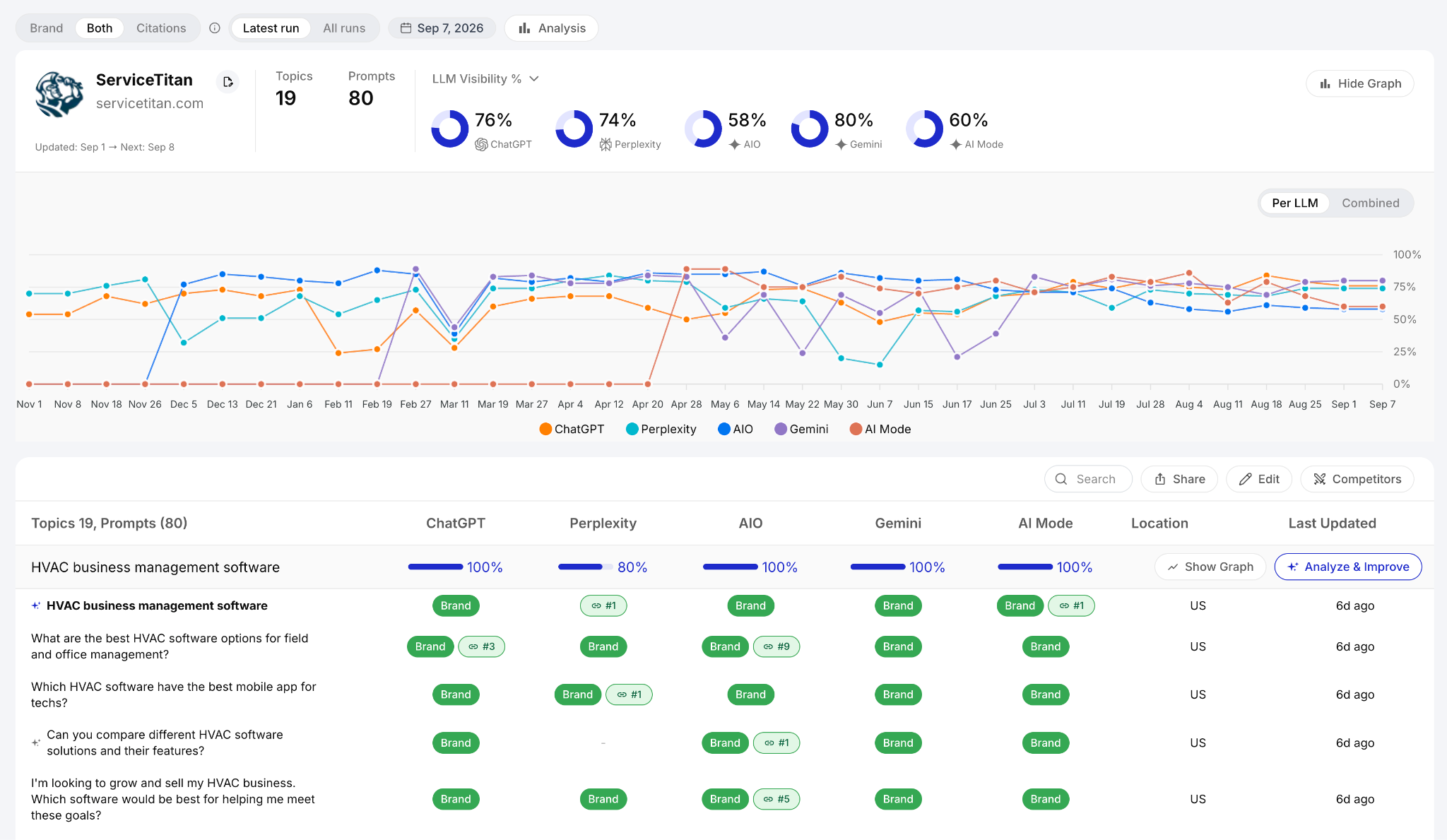
For each topic, Traqer generates several prompts that approach it from different angles, and you can always add your own. It then reports a visibility percentage per topic, per model, where 50% and above indicates you show up reliably no matter how a user phrases the question within that area.
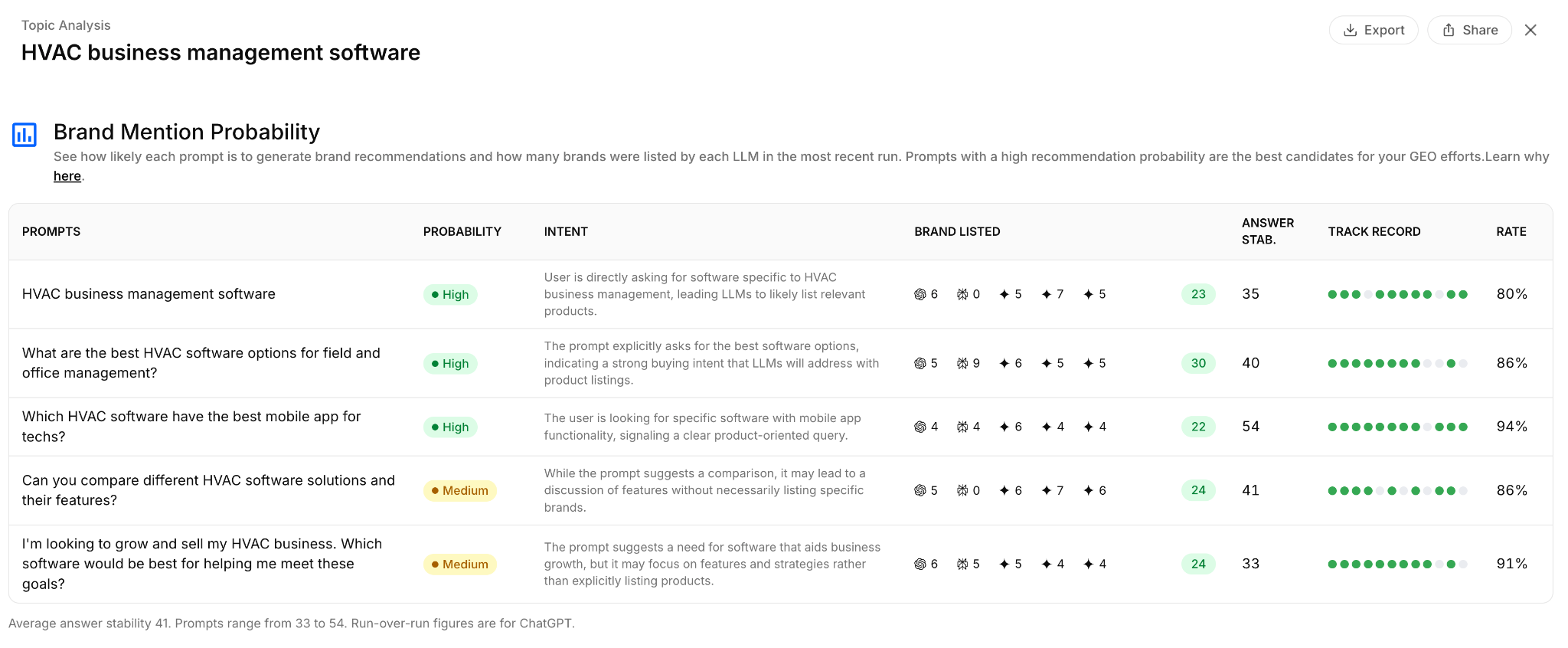
A Brand Mention Probability rating (high, medium, or low) tells you which prompts are likely to produce a brand recommendation at all, so you can spend your tracking budget on the prompts that can actually move and skip the informational ones.
At the top of every view there’s a toggle for brand mentions, citations, or both, so you can separate a topic where you're recommended by name from one where your content is only cited as a source. Alongside the percentage, Traqer reports a raw count of prompts where you appear and a count of topics with visibility, so leadership sees numbers that don’t drop when the team adds ambitious new topics.
Each prompt carries a screenshot of the response as it appeared in a live browser session, not an API reply, so you're looking at something close to a user’s experience. Those sessions run logged out and neutral. That gives you a consistent baseline rather than any one person’s personalized answer, which is the honest position to take. (No tool can reproduce the private context a user brings to a session, so a neutral baseline read across many prompts is a more accurate measure than a single check could be.)
Data refreshes weekly, and you can compare any two dates to see what shifted, both at the brand level and inside a specific topic. A competitor view shows which brands appear most across your topics, with mention and citation counts per model, so you can see exactly where a rival has coverage you don’t.
For a sense of what this looks like from a standing start, our case study on tracking a new brand follows Redline Capital from zero visibility across 83 prompts and five models. The blended figure eventually reached 29%, but the number that guided the work was the topic-level view. It showed that specific niches, merchant cash advances for senior care facilities, electricians, and lawn care businesses, were producing brand mentions, while generic topics like revenue-based financing sat at zero. A single percentage would have averaged those two situations into something no one could act on.
If you want to go deeper on a single platform, we cover the mechanics for ChatGPT brand mentions and Perplexity brand mentions separately, since each behaves differently.
What actually improves your AI brand visibility?
A monitoring tool tells you where you stand. What improves that standing is a separate problem, and in our experience there is a clear order of priority in the approaches that a brand should take.
First and foremost, a brand must produce owned content that ranks for buying-intent queries.
When a model searches the web to answer a product question, it tends to pull from pages that rank well in traditional search, so content on your own site that ranks for a relevant bottom-of-funnel keyword has a decent chance of being drawn on when the model builds its recommendation.
For Constitution Lending, a private lender competing against incumbents with far higher domain authority, this approach earned top-three recommendations across more than 50 bottom-of-funnel prompts on Perplexity and Google AI Overviews. Another example is Toro’s detailed, product-specific articles, which made it the most-mentioned brand in its category, with more than double the brand mentions of the next competitor. The correlation also runs the other way. When Constitution Lending expanded into a newer service line whose content hadn't ranked yet, they barely appeared in AI answers for those prompts.
One detail from that work is particularly useful to remember. When a model does recommend a brand in its answer, it tends to reuse the positioning from that brand’s own webpages. Differentiators only surface if your content states them explicitly, so the way you describe your product/service on your site is close to how the model ends up describing it to buyers. Specificity is key here.
The second priority is off-site mentions that the LLMs already draw on. Models pull from review sites, comparison articles, and industry roundups. A brand that appears across several of those sources is exposed via more routes. Identify which pages are cited for the topics you care about, then pursue a mention on them through a guest contribution, an expert quote, or being added to an existing roundup.
Naturally, this isn’t easy to achieve; it’s old-school outreach just like conventional link-building. But Traqer’s per-topic view surfaces the domains and pages frequently being cited, which gives you the target list. This is the middle tier of the framework Grow and Convert describes in Prioritized GEO.
On-site tactics come last in the priority list. A lot of published GEO advice concentrates on adding an llms.txt file, rewriting headings as questions, or adding FAQ and schema markup aimed at AI crawlers. In our testing across clients, these haven't made a measurable difference to visibility. They’re meant to help a model parse your content once it arrives, not to expose your brand to the model in the first place.
None of this comes with a guarantee. A page that ranks in Google won’t force an LLM to cite it, and a mention on a frequently-cited page doesn't mean it will recommend you. You’re just influencing the inputs. The logic is solid, and we’ve seen it work repeatedly across brands, but anyone promising a fixed cause and effect between one action and an AI recommendation is overstating what’s possible.
Where to start with AI brand monitoring
If you take one thing from this article, it should be that AI brand monitoring is best measured by frequency rather than position, and earned through the same type of web presence that has always driven search visibility. Set up the topics your buyers ask about, measure how often you’re mentioned across each one per model, keep mentions and citations separate, and prioritize the buying-intent topics where a recommendation is actually on the table.
Traqer tracks brand mentions and citations across ChatGPT, Claude, Perplexity, Google AI Overviews, AI Mode, and Gemini, by topic and per model, with screenshots of the live responses, starting at $25 per month with unlimited brands. Start monitoring your brand in AI with Traqer.
Traqer is built by Grow and Convert. For more on the strategy behind improving AI visibility, Topic-Based GEO and Prioritized GEO explain the thinking behind how Traqer was built.