
If you run PR for clients, part of their reputation now forms inside AI answers. Ask ChatGPT, Gemini, Perplexity, or Claude about a company and the answer describes it: where it sits in its market and what it’s known for. Prospects, journalists, and investors read those answers, and clients are understandably interested in what these LLMs are saying about them.
Most of the tools in this space that track AI visibility were built for SEO teams, so the standard advice skips the parts PR cares about. Any tool will tell you whether a client is mentioned (though some more accurately than others). The PR questions are about how the client is described; whether the story you’ve built is the one the models repeat, which sources feed that framing, and which outlets you’d pitch to shift it.
We run AI visibility across dozens of client brands at Grow and Convert, and built our own tool, Traqer, because the tools we tried didn’t measure visibility the way we think it should be measured, and the cost didn’t work across a roster of clients. For general background on reputation monitoring in AI search, our guide to AI brand monitoring covers the basics.
Here, the focus is choosing a tool for PR agency work.
This article covers:
What to look for in an AI visibility tool for PR agencies
How the main tools compare, the PR suites included
What actually moves a client’s AI reputation
What to look for in an AI visibility tool for PR agencies
A PR team needs different things from this type of software than an SEO team does. Five things matter:
How AI describes the client, not just whether it mentions them. A mention on its own says little. The reputation question is the framing. Does the model present your client as a leader or an afterthought, and does it attach the qualities and use cases the client wants to be known for?
A tool worth using for PR shows the actual language the models use, broken out per engine, because a client can be framed one way on ChatGPT and another on Gemini. The most useful version goes beyond a single positive-or-negative score to the specific characterizations, the things the models say your client is, since that is the narrative you are paid to shape.
The receipts. For PR reporting, you want the exact sentences each engine returns about a client, the prompts that produced them, and a way to open the full answer (ideally from a real logged-out session, the closest view to what a buyer or journalist actually sees, rather than an API). That verbatim record is what you put in a client report, what you use to flag an off-narrative or inaccurate claim and trace where it came from, and what settles a “that’s not what I saw” moment on the spot.
Which sources the models cite. When an AI answer cites its sources, you can see those pages as your earned-media targets: the publications, roundups, and reviews the models keep pulling from for a client’s topics. If you have a tool that surfaces the sources cited most often and shows the gaps where rivals are cited and your client isn’t, you have something that turns AI monitoring into a pitch list. We go deeper on the mechanics of this in our guide to LLM citation tracking.
Share of voice in the narrative. Clients ask how they stack up against named rivals. You want to see where competitors are being recommended, and described well, and your client is not, per topic and per engine, so you can aim coverage at the gaps and show the gap closing across a retainer.
Built for a roster, and for client reporting. The practical agency part: white-label reports under your own name, a login clients can use without being able to change what’s tracked, and pricing that doesn’t climb every time you add an account.
It’s important to be clear that AI answers vary from run to run, so no single answer is the reputation.
The useful thing to know is a pattern across many runs and related questions, not one screenshot. This is why measuring trends across runs matters, as we cover in AI search visibility metrics. And you’re influencing what the models read, not dictating what they say; so treat it as something to monitor and act on, not something to be directly controlled. The better tools are built around this philosophy.
How the main AI visibility tools compare for PR agencies
In this space you have focused AI visibility tools and the big PR suites adding an AI layer. Here’s how the main options look through a PR lens, as of late 2026:
Traqer
Traqer is a focused AI visibility tool built, at our own agency, for running many client brands at once. For PR work the most relevant functionality is its sentiment analysis.
Described As shows the categories and characterizations the models attach to a brand.
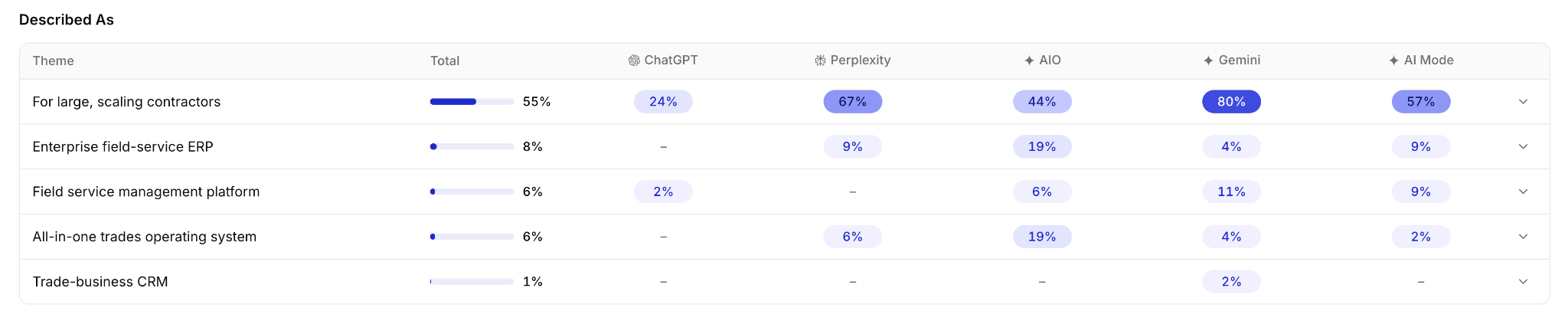
Positive and negative sentiment show the specific favorable and unfavorable themes, with the excerpts behind them. Every theme is broken out for ChatGPT, Perplexity, Google AI Overviews, AI Mode, Gemini, and Claude, and clicks through to the exact prompt and answer it came from. A client trying to shift from “legacy vendor” to “category innovator” can see how far that has landed on each engine, and a new negative theme arrives with its source attached.
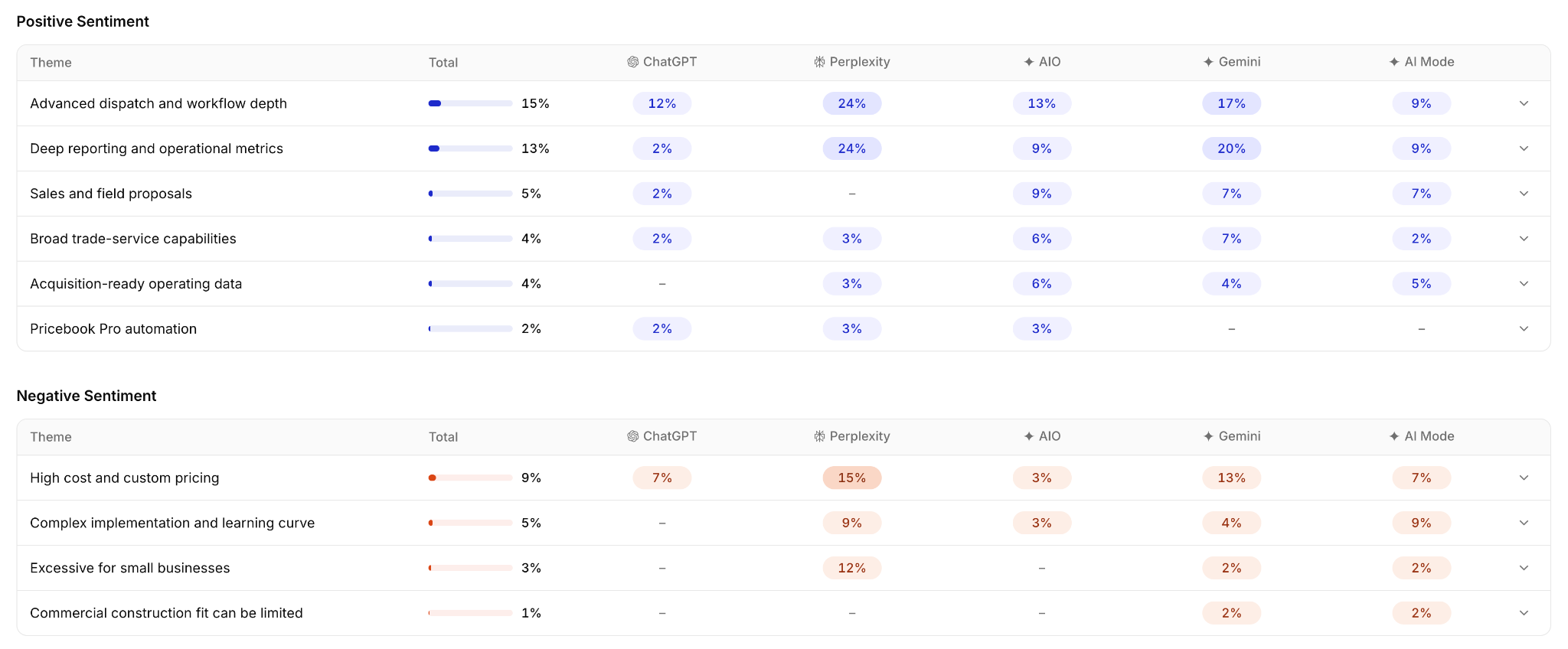
Underneath this is every mention verbatim, grouped by topic, with the source prompt and a link to the full response. Responses come from real, logged-out sessions on the engines that have them, with a screenshot stored for each, so a report claim can always be traced to what a model actually said. Mentions are tracked separately from citations, and for each topic Traqer surfaces the sources cited most often alongside the gaps where rivals are cited and the client is not, which doubles as a prioritized pitch list for earned coverage.
Competitors can be tracked by name, with their visibility shown per topic and per engine next to the client’s, down to their exact mentions, so share of voice and the gaps behind it sit in the same report.
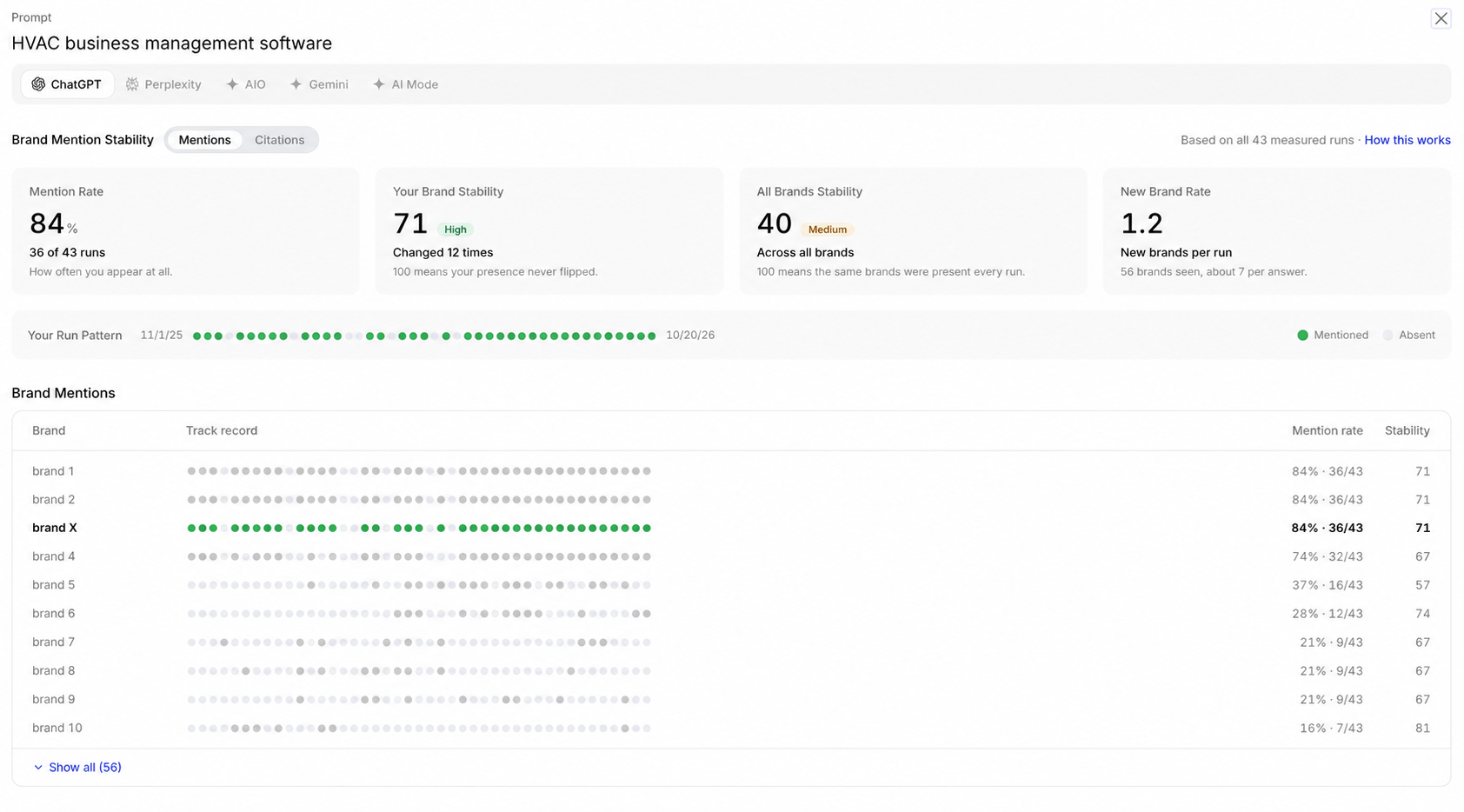
The stability view shows every run of every prompt rather than only the latest, with a mention rate, a run-by-run pattern, and a new-brand rate that flags when fresh names start entering the client’s space. You can use this when a client screenshots a bad response; you know whether it was a blip or a pattern, and a weekly refresh with date comparison gives you a before-and-after for a campaign or placement.
Topics can be set up as a client’s specific narrative themes, and you can add as many prompts as you need within that theme. Clients can get a viewer login to their own data, and reports go out white-labeled under your name. Pricing is per prompt, with unlimited brands and unlimited users on every plan from $25 a month, and there is a 14-day free trial (no credit card required).
Other features to note:
Analyze & Improve, a per-topic view that gathers the cited sources, competitor gaps, and sentiment in one place, so each topic ends with what to do next.
Fan-out queries, showing the sub-questions an engine runs while answering, useful for finding the specific angles worth pitching.
Non-gameable headline metrics: alongside the visibility percentage, a raw count of prompts where the client appears and a topic-level high, medium, or low view, so the numbers can’t be flattered by changing what’s being tracked.
Export and share on the brand and sentiment views, for dropping straight into client decks.
Claude coverage as an at-cost add-on you switch on yourself, where several tools reserve it for enterprise tiers.
An MCP server on every plan, so an AI assistant can query the whole client roster (“which articles do the engines cite most for this topic but never mention us?”) and pull report-ready answers. Several tools gate their MCP to higher tiers.
Profound
Profound is the most enterprise-focused platform, and it has a dedicated PR and brand solution. For a communications team that means sentiment on brand mentions, scored good, neutral, or bad, share of voice against named rivals, discovery of the sources behind AI answers, and its Prompt Volumes demand feature, in reporting built for executive audiences. For a large PR firm with enterprise clients and the budget to match, it’s worth considering. The issue for a smaller agency is that client workspaces are priced individually, there’s no white-label on the standard plan, and pricing that isn’t built for a growing roster.
Peec
Peec has got a good reputation among the self-serve tools; tracking visibility, position, and sentiment over time in a clean interface, which makes it straightforward to show a reputation trend across a retainer. PR teams also get a log of recent AI answers with the actual wording, cited sources grouped by type, which shows how much of a client’s AI presence rides on earned coverage versus owned pages, and automatic competitor detection. It’s built with agencies in mind too, with unlimited seats and pitch workspaces on every plan. The reservation is cost at volume, since its credit model, where one prompt tracked against one model for one day is one credit, adds up as you track more across more clients, and the agency plans start around $245 a month. (Reminder: Traqer’s plans start at just $25 a month).
Scrunch
Scrunch, now owned by Sitecore, is strong on the source side: which pages and publications the models cite, plus detailed analytics on how AI crawlers reach a site. For a PR team whose job is getting earned placements, that source discovery is useful, since it shows where coverage would need to land to reach the models. Its emphasis is on sources and site readiness rather than narrative tracking, though, so it answers where to appear more than how the client is described. The catch is cost, with plans from $250 a month per brand and wider engine coverage gated to higher tiers.
Otterly
Otterly is the cheapest way into visibility tracking (apart from Traqer), with plans from $29 a month. It covers the main engines and does mention and citation tracking, and it shipped a proper brand sentiment feature in 2026: a net sentiment score per engine with a trend over time, drill-down to the sentence that produced each score, and the same scoring applied to competitors for benchmarking. The limits for agency use are the prompt allowances, which tighten quickly as you scale, and the per-engine add-ons.
The PR suites: Meltwater, Cision, Muck Rack, Agility, etc.
If you already run media monitoring through one of the big suites, most now bolt on an AI-visibility layer: Meltwater’s GenAI Lens, Cision’s AI Visibility Dashboard inside CisionOne, Muck Rack’s Generative Pulse, and Agility’s AI visibility. Several of them lean into the PR-native angle directly, surfacing which journalists and publications AI answers cite and turning that into outreach targets.
The appeal is one platform for monitoring, outreach, and AI visibility. The trade-offs are the usual ones: enterprise and custom pricing, an AI-visibility layer that’s not always as detailed as you need, and a bigger commitment than an agency testing the channel across a few clients may want. If AI visibility is a small part of a relationship you already pay for, the add-on may be enough to stay in the loop. If AI reputation/visibility is becoming a service you sell, a focused tool might be worth a shot.
What actually moves a client’s AI visibility/reputation?
For PR, two levers move AI visibility and reputation. Both are close to the work you’ll already be doing.
The first is earned mentions on the sources the models cite. When an AI answer draws on the web, it pulls from review sites, comparison pieces, industry roundups, and news as well as company pages, so a client that recurs in those sources reaches the models through more routes. The practical version is the one the citation data hands you: find the pages the models cite most for a client’s topics, then go earn a presence there, a placement, a quote, an inclusion in the roundup. It’s a pitch list drawn from what the models actually read. There’s no guarantee at the end, since you’re shaping the inputs, not the output.
The second is the framing in those sources. How a client is described in the coverage the models trust shapes how the models go on to describe them, so the narrative discipline that is PR’s core skill, consistent and well-placed messaging, is also what shifts the characterizations in the sentiment view over time. Owned content that ranks remains the foundation, as our client work keeps showing, but it’s often with the client or their content agency rather than with PR. The earned part is the one in your hands.
The tactics that get oversold, schema, llms.txt files, FAQ markup, we haven’t been able to tie to real visibility gains across clients, so we wouldn’t build a PR program around them. More on the content side sits in how to optimize content for LLMs.
How to choose the right AI visibility tool for your PR agency
Does it show how the client is described, per engine, not just whether they’re mentioned?
Does it show which outlets and pages the models cite, so you know who to pitch?
Does it fit a roster, with agency features and pricing that doesn’t climb with every account?
Traqer is built specifically for agencies and consultants who are tracking AI visibility for multiple clients at the same time. You can see how every engine describes each client, trace it back to the exact answers and the sources behind them, and report it accurately.
Traqer is available on a 14-day free trial, no credit card required. Start for free today.
Traqer is built by Grow and Convert. For the measurement thinking behind it, Personalized GEO and Prioritized GEO explain the approach in more depth.