Most online lists of the best AI visibility tools for small business rank a dozen different tools by feature count and price, then leave you to work out for yourself which one fits. But this approach isn’t particularly helpful when you’re navigating a crowded field. So we’re going to dispel some myths around LLM tracking and introduce you to a few tools that genuinely match small business use cases.
A small business is in a specific situation: the owner or the one marketer is usually wearing several hats, so an AI visibility tool has to be something you can run yourself in the time you have. The best tool is the one that’s affordable, usable, and provides data that you can trust to help drive your marketing strategy.
We built Traqer at our content agency, Grow and Convert. It is primarily designed for agencies and consultants, but it’s also a good fit for small businesses who want accurate tracking across LLMs without exorbitant costs. In this article we’ll explain why that is, and we’ll list some of the other tools around.
Why AI visibility is harder to measure than it looks
The natural place to start is to check AI visibility for yourself. Ask ChatGPT how it answers a question in your category and see whether you come up. It is worth doing, but what you see once is not what your customers see, and not even what you’d see the next time you ask.
Two things make this hard to measure, and both are important to know before you choose a tool:
The first is that you cannot know the prompts. People don’t type short, repeatable keywords into ChatGPT the way they type them into Google. They have longer, personal conversations, and the model folds in context you never see, from the size of their business to the tools they already use to the specific problem they are solving. Grow and Convert calls these invisible prompts. You cannot reproduce a real customer’s prompt, so you cannot check your visibility by typing in what you imagine they asked.
The second is that the same prompt does not return the same answer twice. LLMs generate responses probabilistically, so asking the same question repeatedly surfaces different brands, in a different order, from one run to the next. Ask ChatGPT for the best option in your category today and you might appear, ask again tomorrow and you might not. There’s no fixed ranking, which is why checking once tells you little.
There is a stable signal underneath that noise, though. While the exact answer shifts run to run, the pool of brands a model draws on for a given topic holds much steadier. That is the thing worth measuring.
What matters is how often you show up across many versions of the same question, rather than whether you appeared the one time you happened to check. A tool earns its keep by measuring that reliably; something you can’t do by hand. We go deeper on the specifics in our guide to AI search visibility metrics.
Do you actually need an AI visibility tool yet?
If your website has little or no content that ranks in traditional search, a tracker will mostly confirm that the models aren’t finding you. When an LLM answers a product or service question, it usually searches the web and leans on pages that already rank. If you’re not ranking for anything yet, the first month is better spent on one or two pages that do, and then you turn on tracking to see whether the models pick them up.
You might think that purely local businesses, such as cafés and salons, or painters and electricians, are not well-suited to GEO. But imagine someone visiting a city for the first time, using an LLM to ask about the best affordable cafés for a young family who are vegan. Or someone searching for a female painter in London who has experience with old terraced houses. The standard Google Business Profile and local SEO tactics will serve you well, but it’s also helpful to know how the LLMs talk about you (if at all).
How to audit your AI visibility as a small business
Before you commit to a tool, it helps to audit where you stand, which means getting a baseline read of whether, and how often, you show up when people ask AI about your category.
Here’s how to audit your AI visibility as a small business without a marketing team:
Start with a rough manual check. Open (incognito, logged out) ChatGPT, Perplexity, and Gemini, and ask each one a few buying-intent questions a customer might ask in your category, the kind that end in a recommendation rather than a definition. Note whether you come up, which competitors appear, and which sources the answer cites. This costs nothing and gives you a sense of your brand visibility in AI. Treat it as a snapshot rather than a verdict, because the same question asked again can return a different set of names.
For anything you want to follow over time, a manual check isn’t enough. An AI visibility tool runs many phrasings of each question across the models, repeats them, and reports how often you appear, so your audit becomes a baseline you can measure against later rather than a one-off reading.
The sections below cover what to look for in that tool and which ones fit a small business.
What to look for in LLM trackers for your small business
Feature lists can be overwhelming, so here is a handful of things to consider when weighing up a tool:
Start with a low entry point and pricing that only charges for what you use. The tools that stay affordable tend to charge by how much you track, not by brand or by seat, so you’re not paying a premium to watch a single brand. Look for a low monthly floor so you can start and stop without a sales call or an annual contract, so you can try it for a month or so without too much commitment.
Make sure it measures the real web, not the API. Some tools query the model through its API rather than the interface a customer actually uses. API responses are stripped of the tuning that shapes real answers, so a brand that looks visible through API can be absent in the product people use. If you are going to act on the data, it needs to reflect what your customers are likely to see.
Check that it differentiates brand mentions from citations. A brand mention is the model naming you as a recommendation (which is what brings in customers). A citation is your website link showing up as a source, which is useful but is not the same value as being recommended. Some tools blend the two into one visibility number.
Favor a tool that tracks topics, not single prompts. Because any one prompt is noisy, a single-prompt score bounces around for reasons that have nothing to do with you. A tool that groups many phrasings of a question into a topic and measures how often you appear across them gives you a figure you can actually trust and track over time.
Look for something that tells you what to do next. As a small business you probably don’t have a data analyst to interpret a complex dashboard. The most useful tools for SMBs show you clearly which pages the models cite for your topics, which competitors they name most, and where your gaps are, so the report doubles as a short to-do list you can work through yourself.
AI visibility tools for a small business: a list of the most suitable options
Here’s how the main options shape up for a one-brand business on a limited budget.
1. Traqer
We built Traqer to track AI visibility for our own brand and our clients without the cost getting out of hand. It covers ChatGPT, Claude, Perplexity, Gemini, AI Overviews, and AI Mode, and it starts at $25 a month.
We built it mainly for agencies, consultants, and freelancers who track AI visibility across several brands at once, and that is who we market it to. But the same pricing model that serves them is what makes it a sensible choice for a single small business that wants useful insight for its digital marketing strategy.
You pay for the prompts you track, not for brands or seats, so an agency is not charged per client and a small business is not pushed into a higher-cost tier or billed for seats it doesn’t need. You track the handful of prompts that matter for your one brand and pay only for those, which is how a capable tool comes in at $25 a month rather than the hundreds that enterprise platforms start at.
Beyond the price, there are other reasons to consider Traqer:
The data comes from real logged-out web sessions (runs) rather than APIs
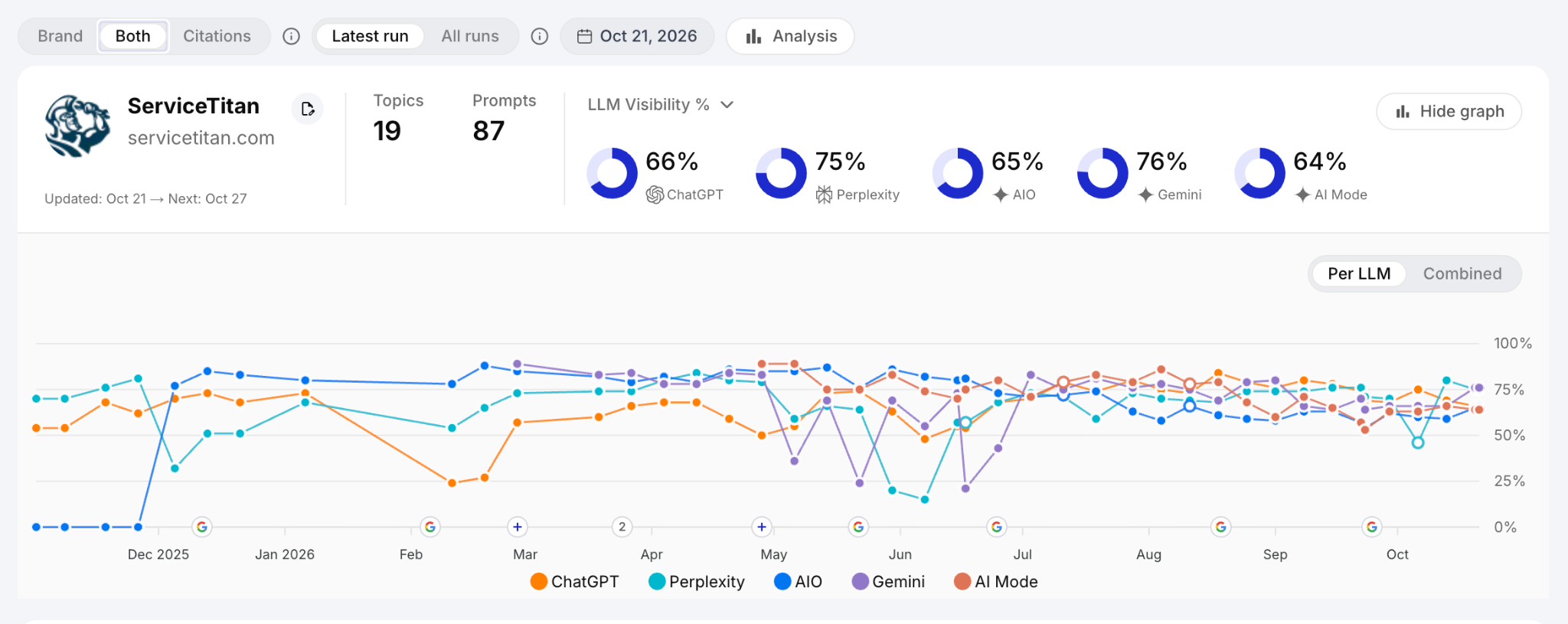
The tool tracks topics by default, so your visibility figure is an average across many phrasings
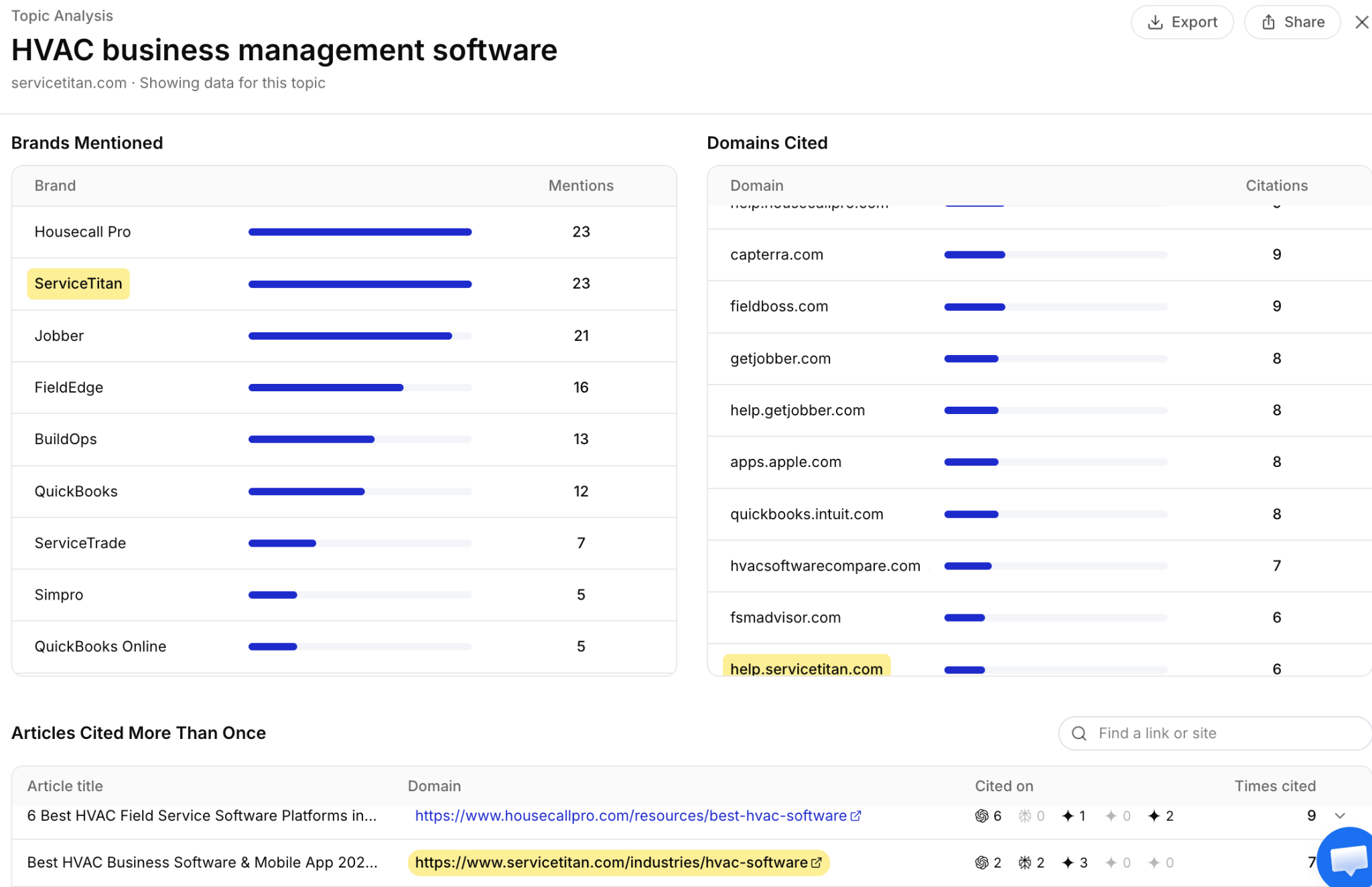
Brand mentions and citations are separable and can be analyzed independently
You get MCP (connector to your own LLM, so you can run data queries) on all plans
You can also open any prompt and switch from viewing the latest run to “all runs” to see how often you’ve appeared over time, so a single lucky or unlucky answer does not mislead you. This gives you a sense of how stable your AI visibility is (also in comparison to your competitors).
The Analyze and Improve view shows which brands the LLMs name most, which pages they cite, and where your gaps are, which turns tracking into a list of pages to write and sites to get mentioned on. It also shows sentiment analysis (i.e., how the LLMs talk about your brand).
None of this needs a specialist. You can set Traqer up yourself and keep an eye on it without much effort, and at $25 a month it is cheap enough to try for a month before you decide.
2. Otterly
Otterly sits at the accessible end of the market, with a low entry price aimed at light monitoring. The setup is straightforward, the interface is clean, and for a small business that wants to watch brand mentions across AI answers without much complexity, it is a pretty good starting point.
The thing to remember is that Otterly is built around single-prompt tracking, and because any one prompt is noisy run to run, results from a single prompt are harder to trust without a topic-level structure to average across. For a simple, single-brand monitoring need that may be acceptable. Otterly has been developing its product, so it is worth checking again where it stands when you evaluate it.
3. SE Ranking
If you already use an SEO tool for your traditional search work, it’s worth checking whether it has added AI visibility tracking before you buy a separate product. SE Ranking has done exactly that, covering brand mentions and citations across ChatGPT, Perplexity, Google AI Overviews, AI Mode, and Gemini inside its broader platform, with competitor comparison and most-cited sources. For a small business already paying for an SEO suite, getting AI tracking under one login, with no extra tool to manage, is convenient.
The trade-off is that in these cases the AI tracking is one module in a general-purpose suite, usually built around a fixed set of prompts rather than topic-level clustering (which we strongly believe is the only proper way to monitor AI visibility).
4. Rankscale
Rankscale is one of the cheapest dedicated AI visibility trackers, with entry pricing from around $20 a month. Its coverage is broad, spanning ChatGPT, Perplexity, Gemini, Google AI Overviews, Claude, and more than ten engines included on the entry plans. It also runs page-level audits that check how your individual pages read to AI, which is more than some tools offer at this price.
On measurement, Rankscale tests the engines from the outside and lets you drill from a headline visibility score down to the exact answer, citation, and prompt behind it, so little of the data is a black box. The main consumer interfaces are read much as a user would see them, while some of the wider engine list is pulled through model APIs. It also analyzes query fan-out, the follow-up web searches an engine runs while answering a prompt, which surfaces the domains being pulled in, and the refresh frequency is configurable from hourly to monthly depending on the plan.
There are two practical caveats. The pricing is credit-based, so your monthly fee buys a pool of credits that each check draws from, and the rate varies by engine, which means the headline price maps to an allowance you need to size against what you track. And reviewers note the interface takes some getting used to; though that’s the case with many tools.
5. Nightwatch
Nightwatch is a different kind of tool from the others featured here. It combines traditional Google rank tracking with AI visibility across ChatGPT, Claude, Gemini, and Perplexity in one platform. Its Citation Intelligence feature links a ranking change to a change in AI citations, so a position lost in Google and an AI answer that stops naming you can be traced to a specific page and keyword.
The rationale is that AI answers are largely assembled from pages that already rank, so the same work drives both, and both sit in one place instead of two tools. Each rank check also stores the raw result page it was measured from. One caveat on how to approach its AI side. The focus is citations and the link between ranking and citation, and in our experience that link is real but looser than it looks. A ranking makes a citation more likely without guaranteeing it, and a citation, your page showing up as a source, is not the same as being named as a recommendation, which is what tends to bring in customers. The link it draws is best read as a signal about the input side of the work rather than proof that AI will recommend you.
Nightwatch starts at €99 a month, or €79 billed yearly, for 500 keywords and 50 AI prompts, with AI tracking and unlimited seats included, not charged as add-ons. That sits above the budget trackers, so it suits a small business that also wants Google rank tracking and would otherwise pay for two tools.
A free starting point
If your budget is zero, a free spot-check is possible. Semrush, for instance, offers a free AI online search visibility checker that gives you a rough read on whether you show up in AI answers for a given prompt. It gives a one-off snapshot rather than tracking anything over time, so it won’t show you trends; and given how answers vary drastically on each run, it can’t tell you much about your overall performance.
What about the chunkier tools?
Tools like Profound, Scrunch, and Peec come up in most AI visibility comparisons, so it’s worth mentioning them. They’re capable products, but they’re built and priced for larger marketing teams and agencies, with entry points and feature sets aimed at that scale. For a single small business they’re more tool, and more spend, than the job calls for. We cover the mid-market and agency end in our roundup of affordable AI search visibility solutions, and the solo end in our guide to AI visibility tools for freelancers.
What actually moves your AI visibility?
AI search is less predictable than traditional SEO, and anyone selling a guaranteed playbook is not being straight with you. Across Grow and Convert’s work with clients, two levers come up consistently. The first is owned content that ranks in traditional search, because when a model answers a buying question it usually searches the web and tends to pull from pages that already rank, especially on Perplexity and Google AI Overviews. The second is being mentioned on the pages the models already cite for your topics, which a tool like Traqer can show you as a ready-made outreach list.
However, a Google ranking does not guarantee a model will cite you, and a mention on a frequently cited page does not guarantee it will then recommend you. You’re influencing the inputs, not controlling the output. What the tracking gives you is the feedback loop to see whether any of it worked. If you want the reasoning behind that approach, Personalized GEO and Prioritized GEO set it out in full.
Which tool is right for your business?
There’s no single best tool, only the one that suits where you are. If you already run an SEO suite, start with its AI module. Otherwise, for a single brand on a small budget, we’d start you on Traqer, at $25 a month with no contract, which is enough to show you whether AI search deserves more of your attention.