
If you’re tracking AI visibility for clients, ChatGPT is often the first thing they’ll ask about, because it’s the LLM many people use themselves. The good news is that tracking it is easy to start, since every tool covers ChatGPT, usually on its cheapest plan. Paradoxically, the issue is exactly that: when every tool covers it, the one you pick isn’t decided by whether it tracks ChatGPT or not, but the way it tracks and how much it costs for a marketing agency like yours.
We run SEO and GEO for dozens of clients at Grow and Convert, and we built our own tracker, Traqer, after the tools we tried turned out to be inaccurate and expensive to run across a roster of clients. So take this as a view from inside an agency that does the work.
This article covers:
What to look for in a ChatGPT tracker built for agency use
How the main options compare for agencies
What actually moves a client’s ChatGPT visibility
What to look for in a ChatGPT tracker for agencies
Because every tool covers ChatGPT, the one you choose comes down to three main considerations:
Pricing that works across a roster. ChatGPT is on every entry plan, so the cost question is more about how the packages add up rather than the initial headline price.
You’ll want per-prompt pricing, or packages that give you a set number of tracked prompts, rather than a per-brand or per-seat charge that climbs with every account and every login you hand out. A tool that looks cheap for one brand can be the most expensive option across twenty. Our case for it is in our piece on affordable AI visibility solutions, and the wider agency picture is outlined in our guide to AI visibility tracking tools for agencies and the best LLM SEO tools for agencies.
Measurement that fits how ChatGPT answers. This is where lots of tools out there fall short. The same ChatGPT question rarely returns the same answer twice. Real users don’t type short, repeatable keywords; they ask long, conversational questions shaped by their earlier messages, their account history, and their location, none of which a tracker can see or reproduce. Ask ChatGPT the same product question a few times and the brands it names, and the order it names them in, shift from run to run. Run a single prompt once and you’re reading one isolated moment, which tells you little about whether a client shows up when people ask about their category.
What does help is knowing how often a brand appears across many variations of the same question, so the unit worth measuring is the topic: a cluster of related prompts that circle one buying question from different angles, tracked across repeated runs. If ChatGPT names a client in 70% of a topic’s prompts, that’s a far steadier read than any single result, and one prompt swinging between runs barely moves it. It’s more accurate than single-prompt tracking, though never a complete picture, since no tool can reproduce every real conversation. Pair it with a view across all the runs that a tool does of your prompts, so you can see whether a client’s presence is steady, patchy, or drifting over the weeks you report on, rather than where it sat on the day you checked.
You also need to see brand mentions kept apart from citations, because on LLMs they’re different outcomes. A mention means ChatGPT named the client, whereas a citation means one of their pages showed up as a source. Those mean different things, and shouldn’t be conflated.Clear progress reporting and next steps. Weekly refreshes on data, data comparison views, client viewer logins, and white label reports are necessary for agencies to keep clients in the loop. But a ChatGPT tracker should also indicate what the next steps are for improving visibility. This means surfacing the pages and publications cited by ChatGPT, revealing concrete outreach target, but also where competitors are being recommended and your client isn’t.
Where the AI visibility tools differ on their measurement approach
All of the reputable tools on the market track how a brand is mentioned and cited across the LLMs. ChatGPT is the platform people most want a “demand” number for, the AI equivalent of keyword search volume, and it’s where the tools most openly disagree about whether that number can even exist.
Profound, one of the most well-known tools, promotes a feature called “Prompt Volumes” that puts an absolute number on how often a particular prompt is asked, drawn from pools of real user data. Peec has similar data but doesn’t publish absolute figures, showing a relative one-to-five demand score instead, on the view that real user prompts are close to unique and so a true “prompt volume” doesn’t really exist.
For the same reason variability matters, at Traqer we’re closer to Peec, though we go a step further. Rather than score individual prompts at all, we measure at the topic level across many runs, since if the same prompt rarely returns the same answer, and a single question fans out into several machine queries before it’s answered, there’s no stable volume to count. We get into that in our piece on fan-out queries.
In summary: there’s an unresolved disagreement about how much demand you can honestly measure in AI search, and it’s worth knowing how a tool approaches this before you weigh the options featured below.
How the main ChatGPT tracking tools compare for agencies
Since every tool here covers ChatGPT, what matters for agency use is roster economics, measurement, and reporting. Here’s how the main options stand:
Traqer
Traqer is our own tool, built at our content marketing agency, Grow and Convert, because the ChatGPT trackers we tried were inaccurate and far too expensive to run across a roster. It’s built for agencies and consultants tracking many client brands, not for a single in-house team.
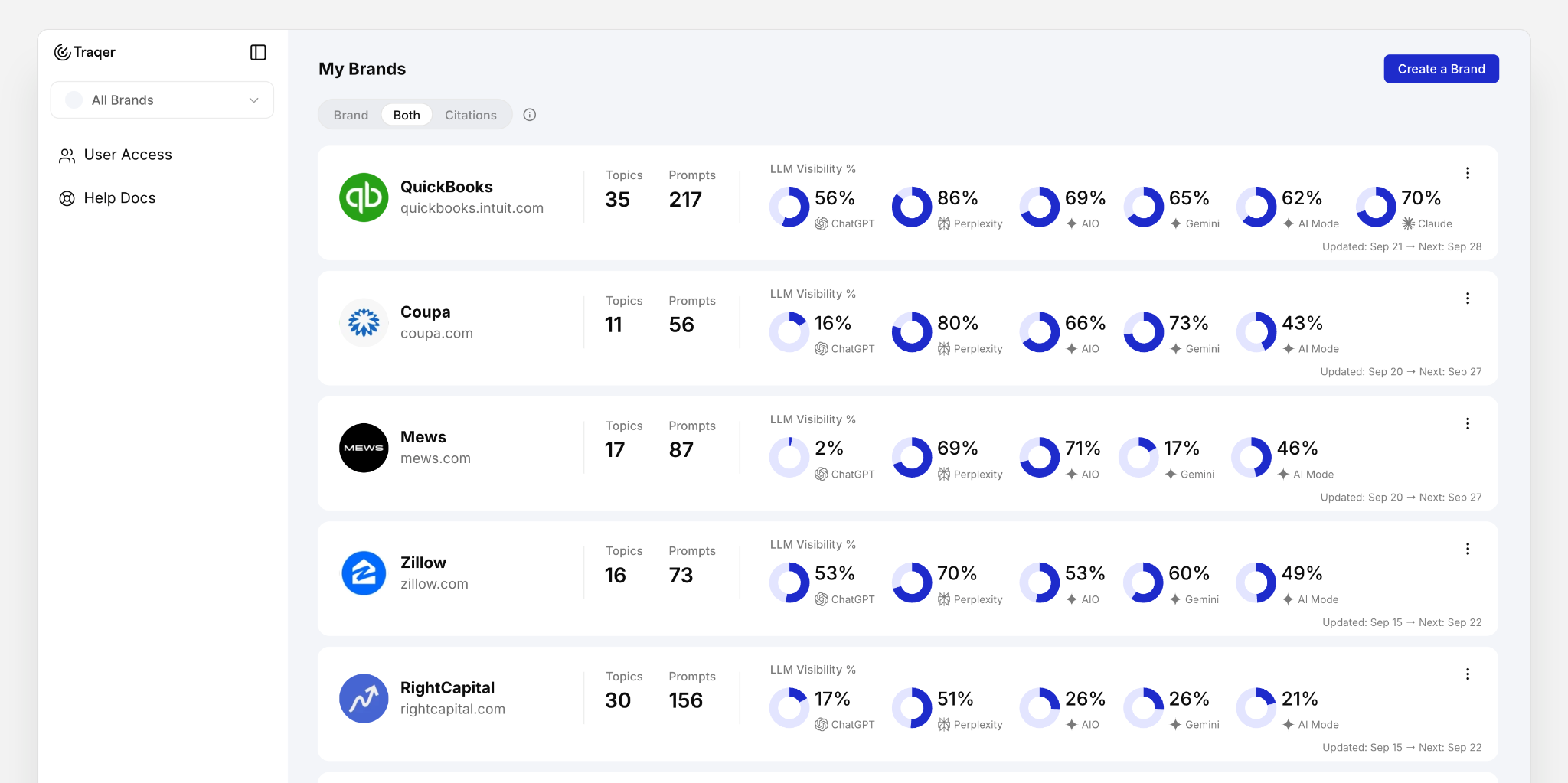
Traqer is topic-based rather than prompt-based: you set up a topic, it generates a spread of prompts that approach it from different angles, and it reports the share of those prompts where a brand appears, broken out per engine. ChatGPT, Perplexity, Google AI Overviews, and Gemini are included on every plan, with Claude a low-cost add-on you can switch on yourself. Pricing starts at just $25 a month for 50 prompts, with unlimited brands and unlimited users on every plan, which works out to around $0.50 per tracked prompt. Cost scales with prompt volume, not with how many clients or logins you add.
Brand mentions and citations are tracked separately, and the stability view shows each prompt’s full run history. The metrics are built so you can’t game them by changing what you track: alongside the visibility percentage, you get a raw count of prompts where a brand appears and a topic-level view of where it’s high, medium, or low, so the numbers only move when something real does.
What sets Traqer apart from other ChatGPT trackers?
The tools in this space are capable, but they were built for a single in-house brand and priced for one. We built Traqer from the other side of the table, at an agency running GEO for dozens of clients, so the agency case is the default rather than the upsell. Three things follow from that:
The economics. Where other trackers charge per brand, bill per client workspace, meter you on credits, or cap prompts and sell the rest back, Traqer is priced per prompt with unlimited brands and unlimited users. A ten-client roster costs no more to run than one brand at the same volume.
The measurement. Most tools can hand a client one headline number that's easy to flatter and hard to defend. Traqer's is per engine and topic-level, and built to move only when something real changes, which is what survives a client checking it themselves.
The client layer. White-label reports and a per-client login come as standard, not an Enterprise step-up, so each client sees their own ChatGPT visibility and nothing else.
If you want to track ChatGPT across your whole roster without the price climbing per client, and show clients genuine wins, try Traqer for free today. No credit card required.
Profound
Profound is the category’s most enterprise-focused platform, built for large in-house teams that need depth on one brand, which it does well. ChatGPT is its most accessible LLM, since its entry plan has historically tracked ChatGPT alone and the standard agency plan covers ChatGPT, Perplexity, and Google AI Overviews. For agency use, the friction isn’t ChatGPT coverage, it’s that the agency plan prices client workspaces individually, and white-label reporting isn’t part of the standard plan.
On method, Prompt Volumes is one particular area where our approach diverges from Profound’s, for the reasons in the section above. It's a difference of view about what AI demand can be measured, not a knock on the tool specifically. For a large agency serving enterprise clients with budgets to match, Profound is a capable choice. The mismatch is with more modest rosters and budgets.
Peec
Peec was founded in 2025 and backed by about $29 million in funding, built for marketing teams who want a read on AI visibility without an enterprise contract. It runs dedicated agency plans with unlimited client projects, consolidated billing, and pitch workspaces, and every paid plan includes unlimited seats.
ChatGPT is one of its core engines, included from the entry plan, and it scrapes the web interface rather than using an API. Pricing works on credits, where one prompt tracked against one model for one day is one credit, so the bill rises with the number of prompts, models, and daily runs rather than the number of clients. It’s quick to get going with and separates brand mentions from the sources behind them.
The issue is the cost of Peec at volume: the agency plans start around $245 a month and the credit model adds up as you track more prompts across more clients.
Scrunch
Scrunch, now owned by Sitecore, is a mid-market and enterprise platform and one of its strengths is finding which sources ChatGPT and the other engines cite, through strong on-page audits and detailed reporting on which AI crawlers are fetching a site. ChatGPT is included on every plan, alongside Perplexity, Google AI Overviews, and Microsoft Copilot; Claude, Gemini, Meta, and Google AI Mode sit on the custom Enterprise tier. The challenge for agencies is cost.
The Core plan is $250 a month for one brand, Agency Core is $500 a month for three brands with unlimited seats, and wider multi-brand coverage runs through its agency partner program on quote-based pricing, so the bill grows with each client you add. If content discovery is the job you most need help with and the budget’s there, it’s a strong option, especially for existing Sitecore customers.
What actually moves a client’s ChatGPT visibility
Our background as an agency helps us think deeply about how to improve ChatGPT visibility, rather than just focusing on measuring it. This is why Traqer is designed the way it is; to provide tracking that clients can trust but also give you guidance about the work you need to prioritize to get them more wins.
Two things tend to move the number, both backed by our client data.
The main lever is owned content that ranks. When ChatGPT answers a product question it searches the web, because its training data doesn’t hold current product detail, and it pulls from what ranks. When we analyzed more than 400 bottom-of-funnel keywords across 16 clients, a client ranking on Google’s first page for a term showed up in ChatGPT and Perplexity answers for that term about 77% of the time, rising to 82% in the top three. Redline Capital is the clearest case we’ve got: an unknown brand with a low domain rating reached consistent visibility across ChatGPT and the other engines on the back of bottom-of-funnel content on its own site, with no citation outreach and no schema work.
The second lever is off-site mentions on the pages ChatGPT already cites. When it searches, it pulls from review sites, comparison articles, and roundups as well as company sites, so a brand that keeps showing up in those sources reaches it through more routes. The practical version: find the pages ChatGPT cites for a topic, which a tracker’s citation data gives you, then go and earn mentions there. It’s link building by another name, with no guarantee at the end.
A third set of tactics is worth mentioning, but gets more attention than it deserves. On-page markup, FAQ blocks, llms.txt files, and headings rewritten as questions are fine to incorporate in your strategy, but across our clients we haven’t been able to attribute serious visibility gains to them. A page that doesn’t rank for what its buyers search won’t earn ChatGPT visibility on markup alone.
How to choose the right ChatGPT tracker for your agency
Two questions are important for marketing agencies looking at ChatGPT trackers:
What does the tool cost at your actual (and forecasted) client count and prompt volume?
Does it measure ChatGPT the way it actually answers, per model, at the topic level, with mentions and citations kept apart?
Traqer is built for the agencies and consultants that want to track ChatGPT and the other LLMs across a roster without breaking the bank. It’s built by the team at Grow and Convert, where we use it to report wins and show progress to our own clients. For more about the measurement thinking behind it, the articles about topic-based GEO and prioritized GEO explain the approach in more depth.
Try Traqer for free today. No credit card required.