
Peec and Profound are two of the leading tools for tracking how your brand shows up in AI search, across the engines people actually use, from ChatGPT and Perplexity to Google’s AI Overviews, AI Mode, and Gemini. If you’re choosing between them, this piece compares what each one does, what it costs, and who it’s for. We also make a tool in this category, called Traqer. We built it at our agency, Grow and Convert, to track AI visibility across a roster of client brands, and we’ll introduce it properly later.
What separates Peec and Profound?
Both Peec and Profound measure the same core thing: the share of AI answers that mention your brand.
Profound calls this its “visibility score” and defines it as the percentage of responses where the brand is named. Peec measures visibility the same way, as brand mentions, and tracks which sources the engines cite as a separate signal. Both break the data out engine by engine rather than averaging it into one number. On the fundamentals, the two are closer than their marketing suggests.
The differences are about cost and scope rather than the basic measurement. Profound is the enterprise end of the market, with the widest feature set and a price to match. Peec is more affordable and quicker for a single team to pick up, though it has grown into a broad product of its own. The gap we built Traqer for sits below both on price, for agencies and consultants tracking many brands at once. We’ll come back to that.
One difference is worth understanding before you buy, because the category disagrees about it. Profound sells a feature called prompt volumes that estimates, in absolute numbers, how often particular prompts get asked, much like keyword search volume in traditional SEO. Those numbers come from a panel of real users that Profound draws on, not from anything we or the other tools collect for them.
Peec has access to similar panel data and chooses not to publish absolute figures, showing only a relative one-to-five signal instead. Its position, which is also ours, is that real user prompts are long, personalized, and close to one-of-a-kind, so there’s no true prompt search volume to report. This is the invisible prompts problem, and it’s worth being aware of before you lean on any absolute prompt number.
Profound
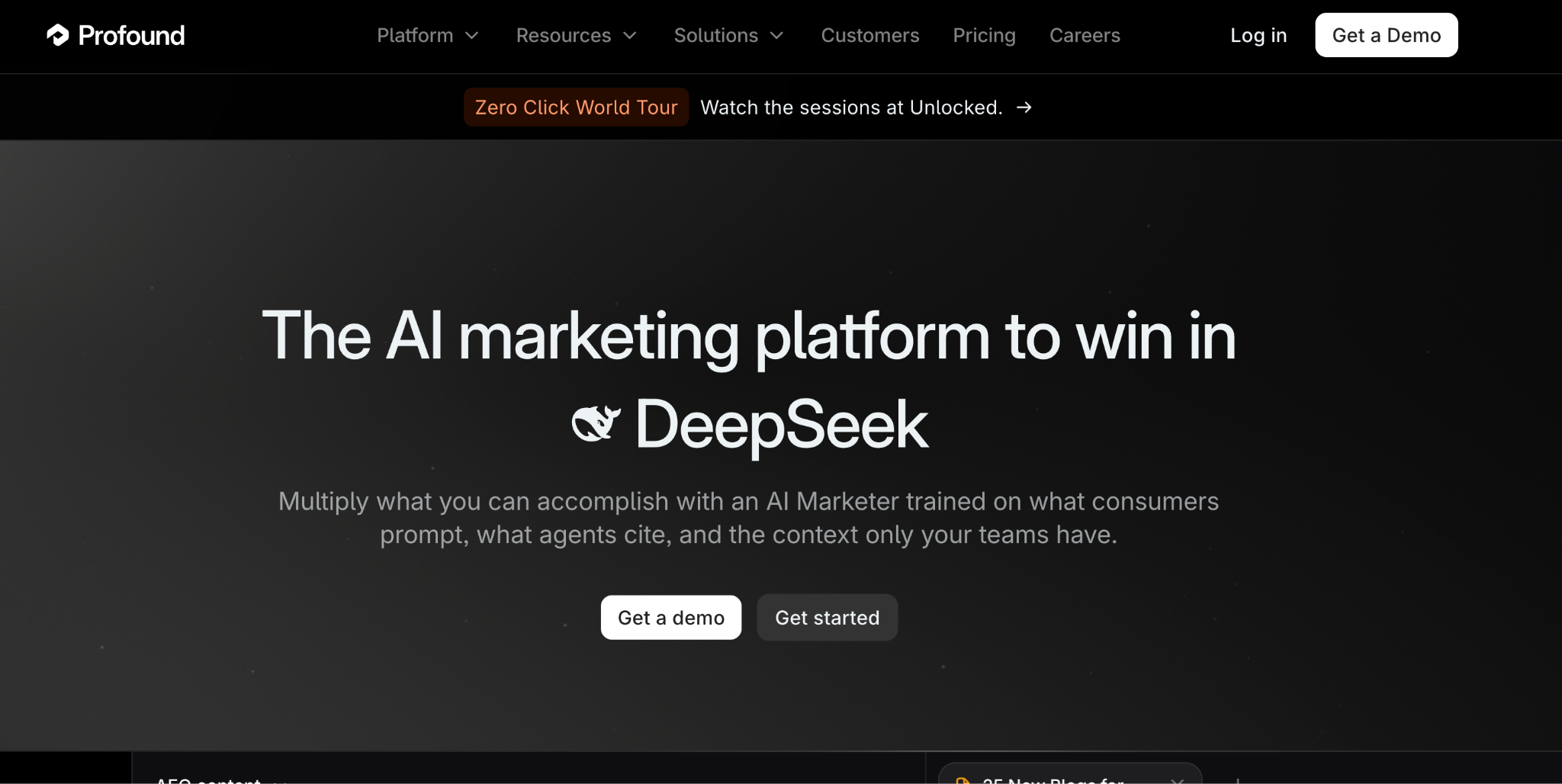
Profound is the enterprise end of this comparison, one of the most complete tools in the category and also one of the most expensive. It raised a $96 million Series C at a $1 billion valuation in February 2026, led by Lightspeed, and it’s built for larger marketing teams that want to run deep analysis.
As of late 2026, Profound offers two self-serve tiers and keeps a custom enterprise plan behind a sales call. Starter runs $99 a month billed annually and is deliberately thin. It covers one engine, ChatGPT, with 50 prompts and a single seat. Growth is $399 a month and covers three engines, ChatGPT, Perplexity, and Google AI Overviews, with 100 prompts and three seats. The wider engine roster, including Gemini, Copilot, and Claude, plus prompt volumes, single sign-on, and API access, sits on the enterprise tier at custom pricing.
(Prices in this category move regularly, so confirm the current figures on Profound’s own pricing page.)
Profound tracks mentions and citations across engines, benchmarks you against named competitors, and reads sentiment, and then it goes further than the lighter tools. Its crawler analytics show how AI bots reach and read your site, which pages they take and which they skip. It offers shopping visibility for retail brands, prompt-volume research, and a content workflow that scores your pages and drafts new ones.
An overview of what independent reviewers say about Profound
On strengths, there’s general agreement across reviewers that Profound has unusual depth and the widest data set in the category, the interface is well-built, it ships new features quickly, and its support is responsive and hands-on. People who’ve spent time in it come away impressed by the product itself.
On limitations, price is the common thread, and some of the most interesting features are behind the highest tier. The other recurring point is that the breadth needs a dedicated owner rather than an occasional visitor, which fits Profound’s own aim of becoming the marketing platform for the AI age, with visibility tracking as one entry point. This cost-and-complexity picture shows up across the independent hands-on breakdowns, in competitor comparisons, and in Profound’s own G2 summary.
Our perspective on Profound
Profound is a reputable tool, and it’s building toward something much larger than AI visibility tracking.
But we’re skeptical about a couple of things.
One is how useful the “prompt volumes” feature really is, given our view that prompts can’t be counted that way. The other is where Profound directs your content work. Its optimization tooling is built around earning citations, and the prevailing playbook it draws on leans toward on-site tactics such as FAQ schema and answer-first formatting. In our own testing those tactics haven’t moved how often AI answers name a brand, and we think the more common mistake in this category is treating the citation rate as the goal.
Citations matter as a foundation and an outreach signal, but the metric that does the commercial work is the brand mention, and the two are worth keeping separate. Where to focus instead is the subject of our article about prioritized GEO.
We’d recommend trying Profound if you work at a large company and want tracking on such things as crawler analytics and shopping visibility, or you have an eye on the wider marketing tooling they’re building around AI agents. Profound talks often about its share of Fortune 500 customers, so that’s clearly the market it’s looking at. If you mainly want to know where you stand across the main LLMs for buyer-relevant topics, it might be more tool, and more cost, than the job needs.
Peec
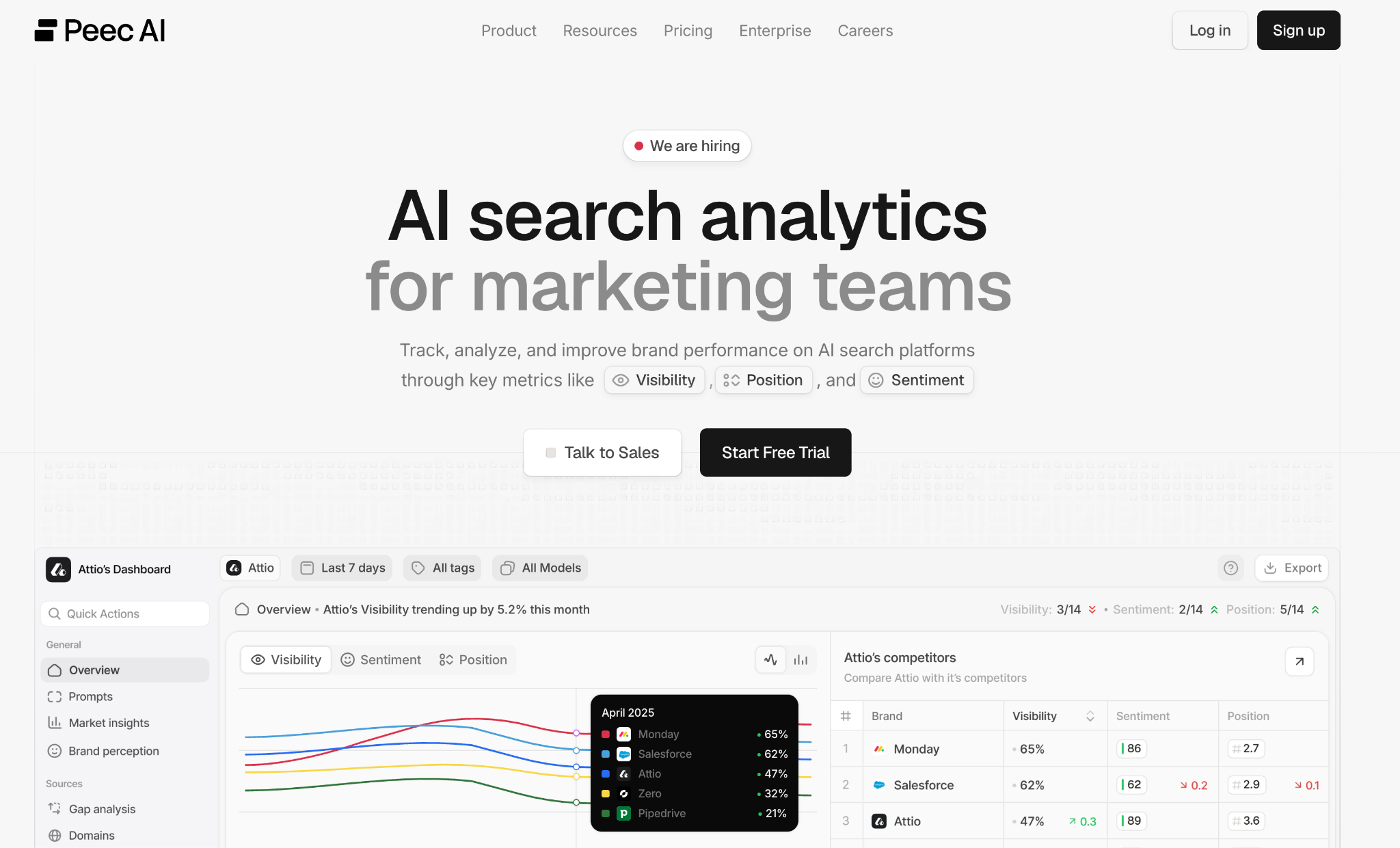
Peec is at the more affordable end of this comparison, and the one a single team can pick up quickly. It launched in 2025, is based in Berlin, and has raised around $29 million. It’s built for marketing teams and agencies that want a clear read on AI visibility without an enterprise contract.
At the time of writing, Peec runs standard self-serve plans plus a dedicated set of agency plans and a custom enterprise tier. The standard plans, aimed at in-house teams, run roughly €70, €180, and €360 a month billed annually. The agency plans, priced from about $245 to $795 a month, add unlimited client projects, consolidated billing across clients, and pitch workspaces for winning new business. Every paid plan includes unlimited user seats, and there’s a 14-day free trial.
The pricing works on credits, where one prompt tracked against one model for one day is one credit, so the cost rises with the number of prompts, the number of models, and how often you run them. Entry plans include three engines chosen from a menu of six or seven, with more available higher up. Claude isn’t on the entry plans, but Peec’s Scale agency plan and above include Claude through an API connection.
(Peec renders pricing in the browser by region and changes it often, so confirm the current figures on Peec’s own pricing page.)
Peec tracks visibility and mentions as its primary metric, separates brand visibility from source visibility, and runs its prompts daily against the live engines using logged-out web sessions rather than an API. It types every cited source into categories, keeps a log of recent AI answers with the actual wording, detects competitors automatically, and shows the fan-out queries the engines run while answering. It also offers persona and funnel-stage segmentation, a gap analysis that surfaces where competitors are cited and you aren’t, crawl and referral analytics, and a growing set of recommended actions.
An overview of what independent reviewers say about Peec
The general consensus among reviewers is that Peec is user-friendly and well designed, that a marketer can be productive within about half an hour, and that its sentiment tracking is really excellent. Reviewers rate its multi-engine monitoring and reporting highly, and one confirmed directly with Peec’s support that it runs on the live engines rather than through an API.
On limitations, the recurring critique has been thin actionability, that Peec told you where you stood more clearly than what to do about it. That’s becoming less true as Peec ships recommended actions, an agent, and the crawl and referral analytics that the earlier reviews predate.
Our perspective on Peec
Peec is a well-built, focused tool, and it gets many of the fundamentals right. It measures visibility as brand mentions by default, runs on the live engines rather than an API, and it’s honest about the limits of prompt volume. It also takes agencies seriously, with unlimited client projects, unlimited team and client seats, consolidated billing, and pitch workspaces.
One big reservation is price, particularly for agencies and consultants running multiple brands. Peec’s agency plans start at $245 a month and climb from there, and its credit model charges for every model and every daily run. For a freelancer or a lean agency, that’s a lot to commit.
That’s the gap we built Traqer to fill, and it’s where we turn next.
Traqer
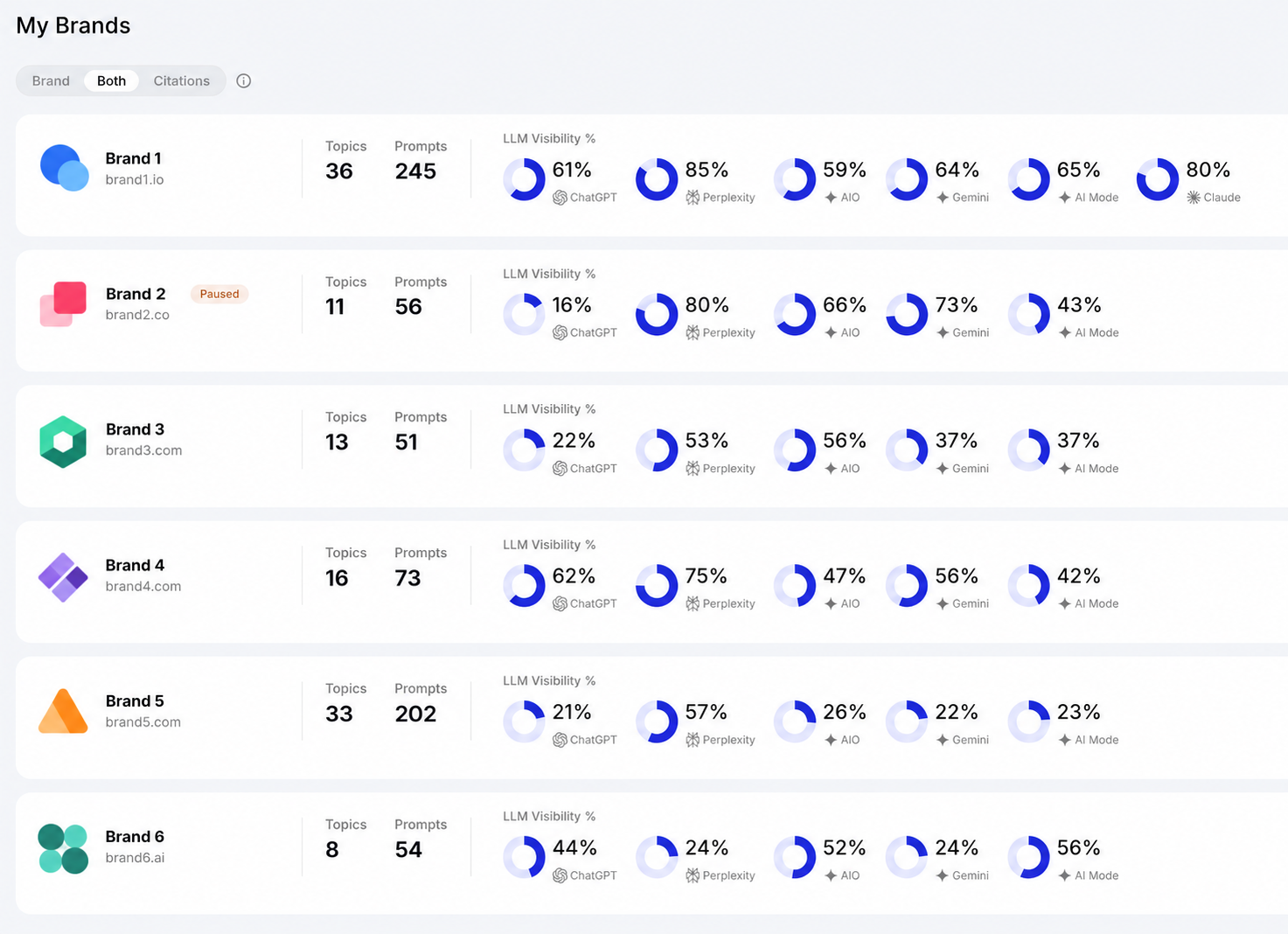
Traqer is our tool, built at our content marketing agency, Grow and Convert, to track AI visibility across a roster of client brands. We made it because the tools we tried were priced for a company watching a single brand, not for an agency watching dozens, and because their tracking methods didn’t seem to make sense.
Price is one of the clearest differences, so we’ll start there. Traqer costs just $25 a month for 50 prompts across 10 topics, with ChatGPT, Google AI Overviews, Google AI Mode, and Gemini all included.
There’s no per-brand fee and no per-model surcharge for those five engines, so you track unlimited brands and add unlimited users, and the price only moves when you add prompts. Claude and Copilot are available on any plan as at-cost per-prompt add-ons, which matters because other tools reserve Claude for their higher or enterprise tiers. Claude has no logged-out access to capture, so it has to run through the API, which costs more; we pass that cost through without markup.
A free trial runs for 14 days with no card. Because pricing scales with prompts rather than clients, an agency can put a whole roster on Traqer for a fraction of what the agency plans elsewhere cost to start.
Traqer is built around topics rather than single prompts. You give it a topic, and it generates a set of realistic prompt variations you can edit, add to, or remove.
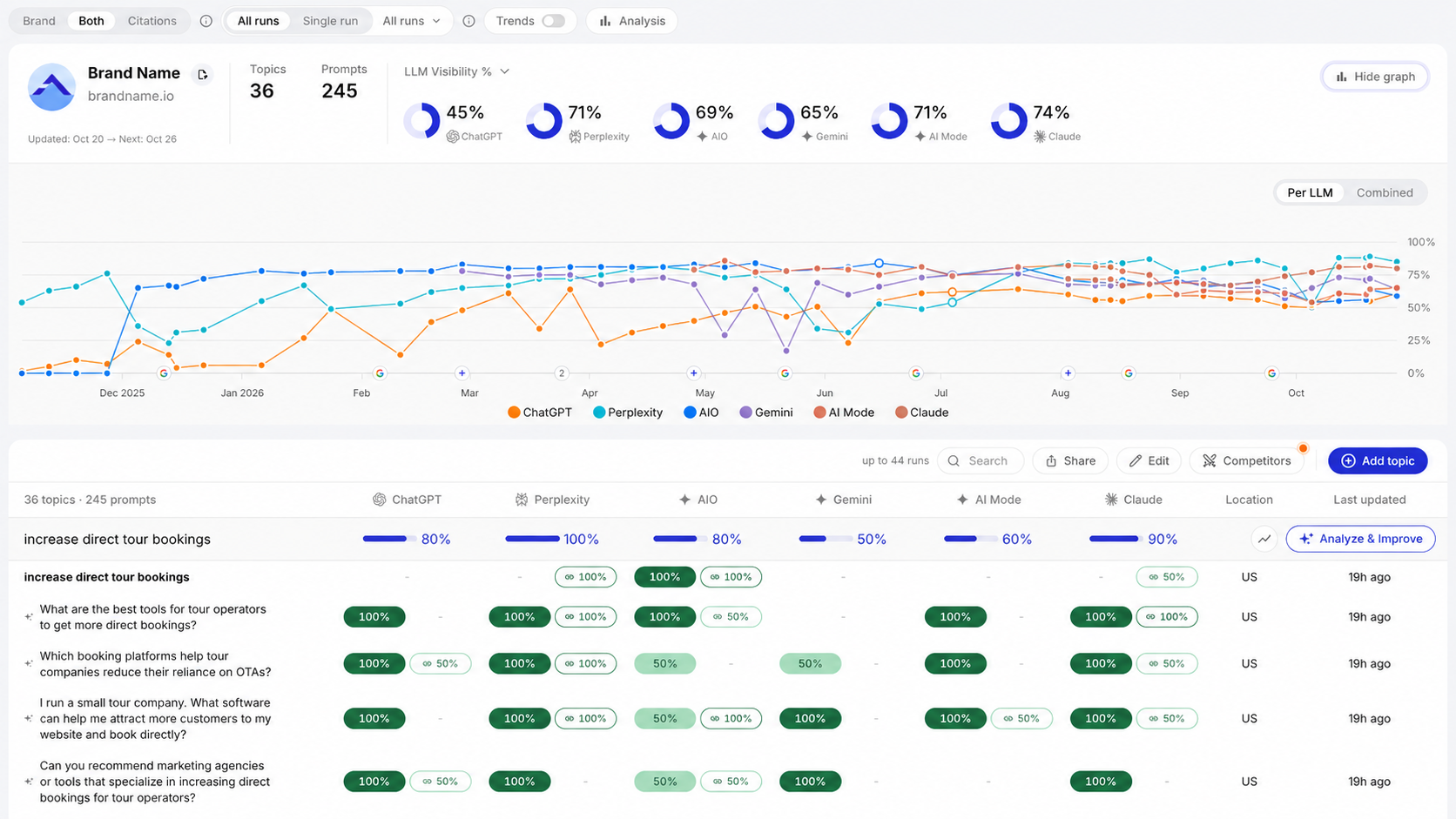
We work this way because no one knows the exact words a buyer types, and the same prompt returns different brands from one run to the next, so a single hard-coded prompt tells you very little. That topic-level view shows how often you show up when someone asks about it, which is the question that matters. The reasoning behind this is our note on personalized GEO.
Traqer is also built to show the stability behind those numbers. Because an AI answer isn’t fixed, a brand can be listed today, gone tomorrow, and back the day after, so a visibility figure from one run means little on its own. Click into any prompt and you’ll see a row of dots, one per run, green when your brand appeared and grey when it didn’t, alongside a stability score for how often that presence flips between runs.
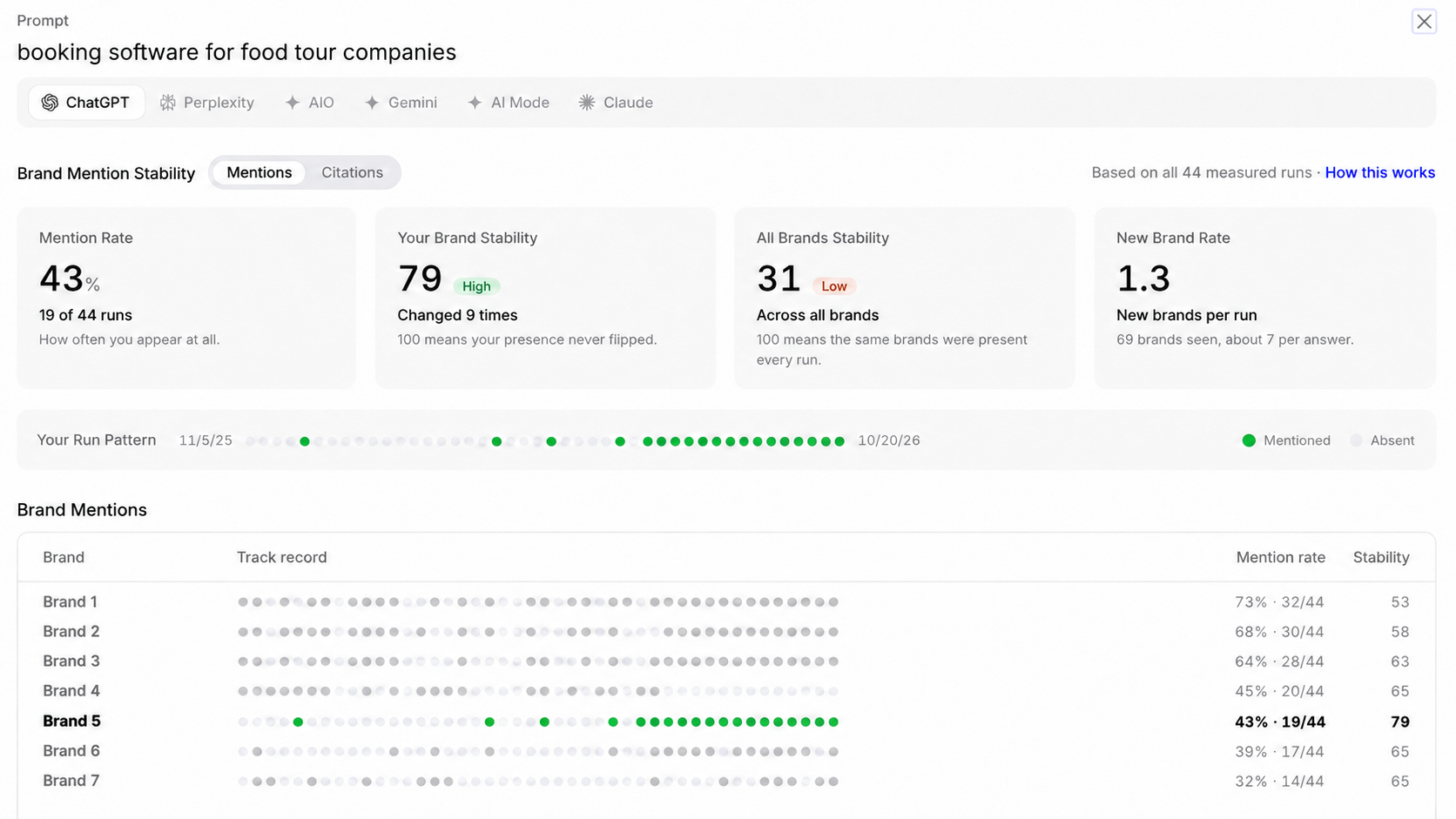
Two prompts can both show 60% yet tell different stories. A recent green streak is rising presence; scattered dots are unreliable presence. For an agency, this is the answer to a client who screenshots one lucky or unlucky response. You can show that visibility is probabilistic and prove a trend.
From there, Analyze & Improve turns tracking into a to-do list. It shows which prompts actually produce brand recommendations, where you rank against everyone the models name, and which domains and pages the engines cite most while leaving you out, including the exact articles and threads worth pitching.
Traqer refreshes weekly, where Peec and Profound run daily, so it isn’t built for same-day movement or very high prompt volumes. It reads a neutral, logged-out baseline, which is the closest view of what a real buyer sees (but can’t reproduce one person’s history and context).
Which tool fits your LLM tracking needs?
Both Profound and Peec are reputable tools that are growing steadily. Profound is perhaps the outlier in terms of being well-known, and if you’re a large company with enough budget and a dedicated owner to run it, and you want the deeper tracking, crawler analytics, shopping visibility, and the wider marketing platform (AI agents), it’s worth considering. Traqer, on the other hand, is designed specifically for measuring AI visibility in a way that’s affordable, accurate, and reliable for agencies and consultants.
Try Traqer for free today. 14-day free trial, no credit card required.