
Almost all AI visibility tools now offer an MCP server, and so do we at Traqer. Connect any of them to Claude, ChatGPT, or another assistant that supports MCP, and you can ask about your AI visibility data in plain language. Access varies drastically by plan. Profound limits its MCP to Enterprise customers and Otterly starts it on its $189-a-month Standard plan, while Peec and Traqer do include it on every paid plan.
The important point is that since all of these tools have an MCP, and they work the same way, the MCP itself shouldn’t really be the biggest factor when choosing an AI visibility tracker. Pulling your tracking data into a chat lets you find wins and check hunches against the numbers quickly, but the value of that effort depends on having accurate, reliable, data at the source. We measure AI visibility differently than many other tools out there, and this article explains what that means for using our MCP.
How we measure AI visibility at Traqer (and why this matters for MCP)
The team that built Traqer also runs Grow and Convert, an SEO and GEO agency with dozens of clients across B2B and B2C. We built Traqer because doing GEO work every day gave us a first hand knowledge of how GEO works, how customers find brands through AI, and what visibility data is useful or useless.
In short, we weren’t satisfied with the way the popular AI visibility tools were constructed and how they measure visibility; so we designed Traqer to fix these problems.
While the MCP of any of these tools can let you slice and dice the data however you want in Claude, ChatGPT, etc. The details of how that tool is designed to measure visibility matter because that’s the data that will be passed to your LLM via its MCP server.
Here’s exactly what Traqer measures and why we designed it that way.
Key Principle: Traqer measures a brand’s AI visibility at the topic level, not individual prompts
A key principle behind GEO is that prompts are not the same as SEO keywords. Real users don’t enter prompts; they have long, meandering conversations. These conversations are unique to them. There’s no “search volume” for a unique conversation. Furthermore, the LLMs responses to prompts are heavily personalized to individual users. Two people could enter the exact same prompt (“Good dinner spots in NYC” or “what project management software should I use?”) and get wildly different answers back because each person’s LLM has a trove of context about the user from previous chats.
(See our article about “invisible prompts” for more about this).
So, the idea of tracking single prompts in GEO the way we used to track single keywords in SEO is a fallacy. And so is ascribing “search volume” or popularity to AI prompts.
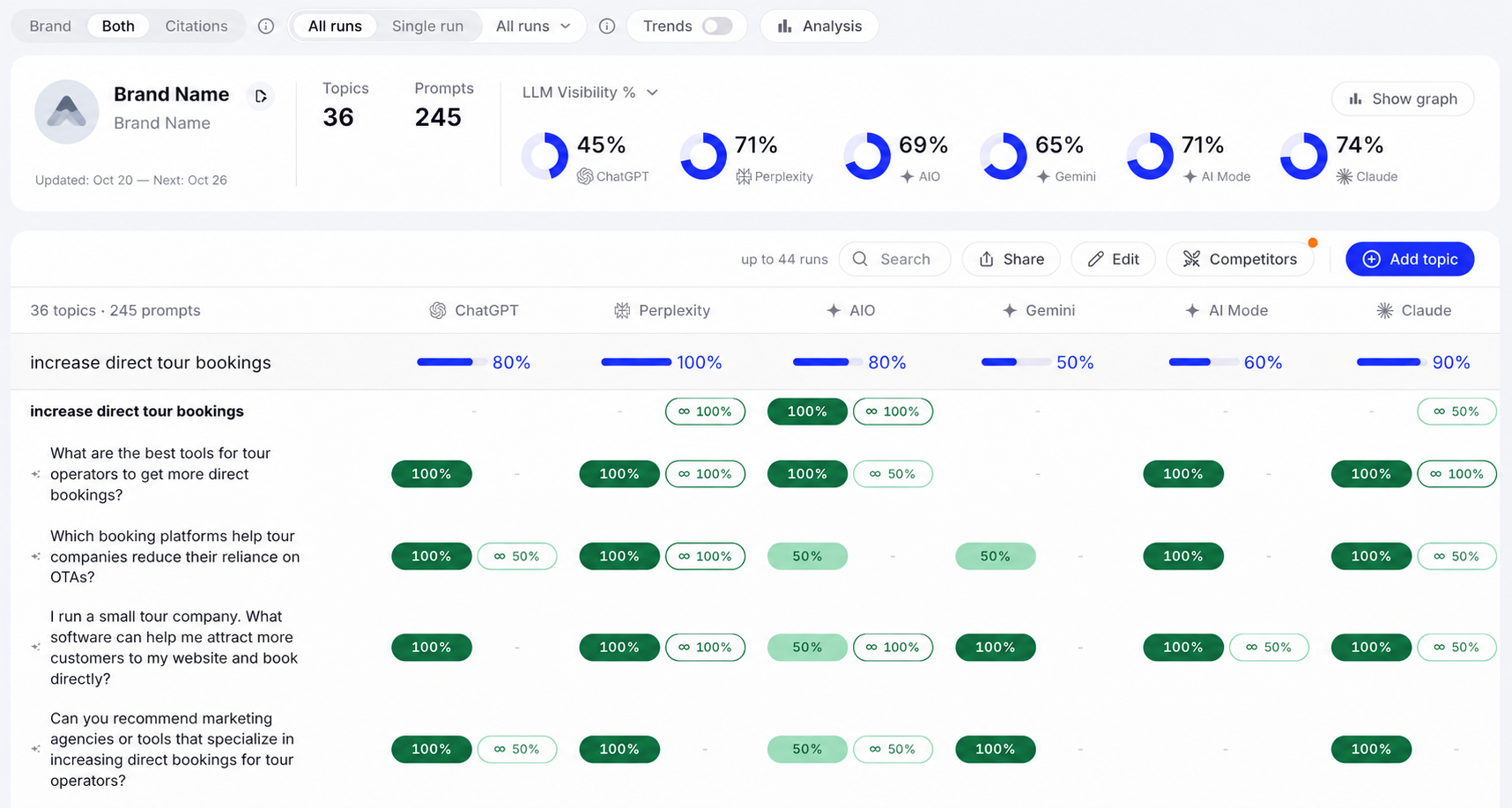
To account for this, Traqer was built from the ground up to track a brand’s visibility at the topic-level, not at the single prompt level. A topic is a buying question, such as “best accounting software for small businesses,” covered by several realistic prompt variations that approach it from different angles. Visibility is the share of those prompts where a brand appears. When that share moves, it reflects a change in how the models treat the brand across the whole subject. The full argument is in our guide to Personalized GEO.
With Traqer’s MCP you can ask your LLM a quick question like “Which topics for my client have shown the greatest uptick in visibility over the past quarter?” and it has that data natively from Traqer.
Traqer’s default reports and brand dashboard are also organized by topic to begin with, so the view the client sees is consistent with any analysis you might show them from an MCP:
We keep track of every run and help you measure LLM stability
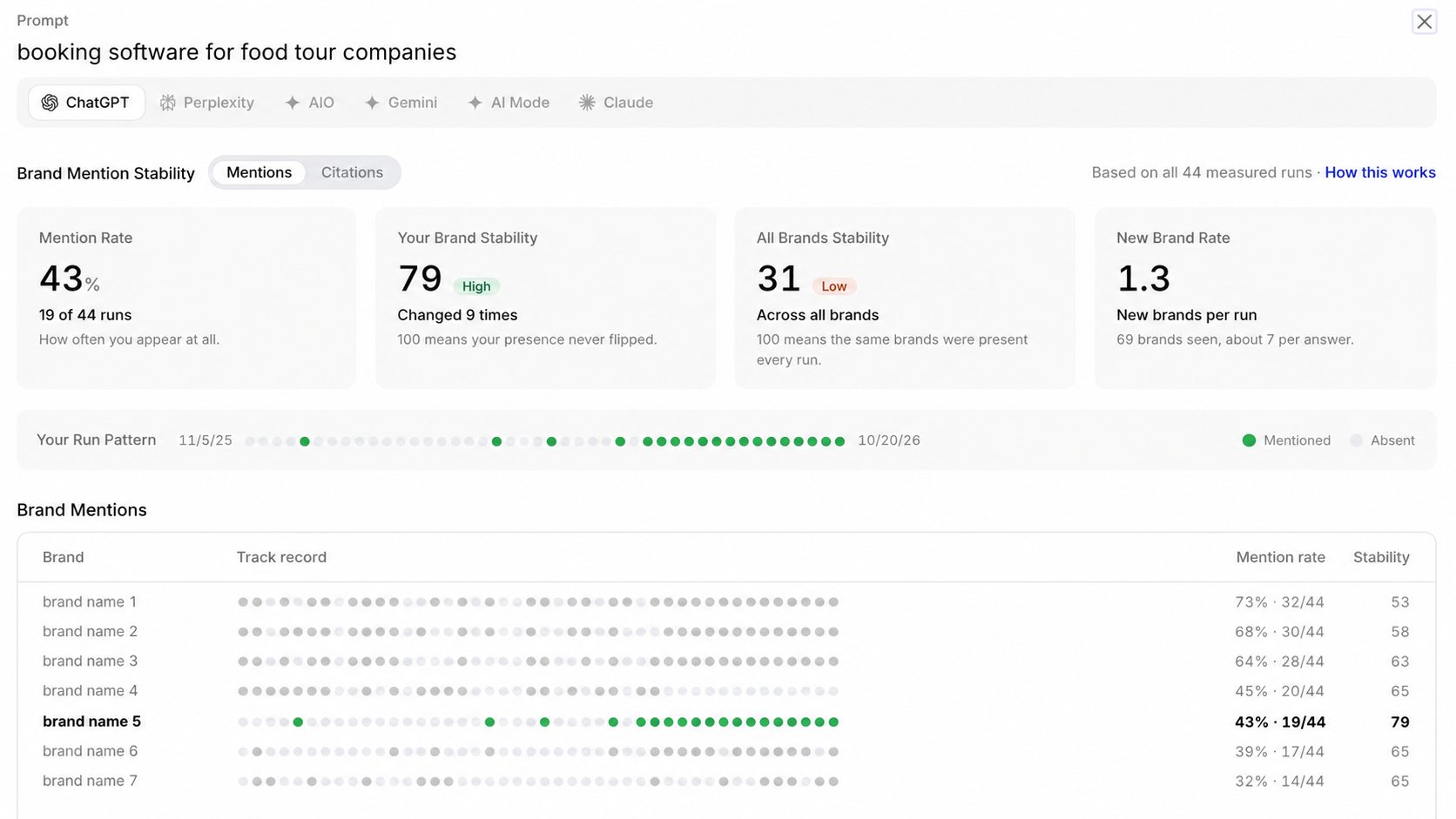
Because answers vary from week to week, one result tells you little on its own. We run every prompt on a weekly cycle and store each run with a screenshot of the response, so the full history is there to query.
You can see how often a brand appeared across a reporting period, whether a prompt is reliably won or swings from week to week, and when a change began. With that history, you can show a client the trend across the whole period.
We keep brand mentions and citations separate by default
A brand mention is an LLM recommending a brand by name. A citation is the brand’s URL appearing as a source. A recommendation is what puts a brand in front of a buyer, so we treat mentions as the commercial metric and citations as a supporting signal. Many tools combine the two into one visibility figure, which overstates how often a brand is actually recommended. In Traqer (and via the MCP) you can monitor mentions only, citations only, or both, so you can be specific about the type of growth you’re reporting.
We monitor and report each LLM independently
ChatGPT relies more on its training data, while Perplexity and Google AI Overviews summarize search results, so one brand can perform very differently across them. One established brand we track shows 59% visibility on ChatGPT and 85% on Gemini. An average of the two describes neither LLM, and hides where the work is needed. We track ChatGPT, Perplexity, Gemini, Google AI Overviews, and Google AI Mode on every plan, with Claude available as an affordable add-on, and we never blend them into one score.
Our headline metrics only rise with real gains
A standard “visibility percentage” moves whenever you change what you track. Add ambitious prompts and it falls. Remove the ones a client is losing and it rises, though nothing in the answers has changed.
Our two headline metrics don’t behave that way. LLM Visibility Count is the number of prompts where a brand appears, per engine. Topic Visibility is the number of topics where a brand has some or high visibility. Neither falls when you add prompts or topics, so you can widen a client’s tracking as their goals grow, and any increase you report reflects a real gain (more on these metrics). Growth questions asked through the MCP follow the same rule and only count prompts tracked across the whole period.
What you can ask Traqer’s MCP
Traqer runs a hosted MCP server. Our setup guide walks through adding it to Claude as the Claude connector, and because MCP is an open standard, the same server can be added to other assistants and tools that support MCP, such as ChatGPT. Your assistant can query every brand you track.
The MCP gives your assistant the underlying data, including every prompt, run, answer, and citation. Alongside the reports in the Traqer app, it can answer questions those reports don’t cover, and combine the results with anything else in the chat, such as a client brief or last month’s report.
Here are examples, grouped by what you’d use them for:
Find wins to report
“Which of [client]’s topics grew the most since we started tracking, by mention rate and by share of voice against their competitors?” Traqer compares the first and latest runs, plus the runs in between, and counts only prompts present throughout, so newly added prompts can’t inflate the result.
“Which of my clients gained the most ChatGPT visibility this month?” Your assistant checks every brand you track, so you can review the whole roster with one question.
“Chart [client]’s weekly brand mentions on Perplexity and Gemini for the last quarter.” Your assistant pulls the weekly series and builds the chart for your deck.
Test a hunch against the data
“We published a comparison page in August. On ChatGPT, which sites started being cited for this topic after that, and how did our mention rate change before and after?” Traqer lists the domains first cited partway through the period, with the brand’s mention rate on either side. It reports the pattern and makes no claim that the page caused it.
“Is this prompt volatile, or are we consistently losing it?” Traqer returns the mention rate and a stability score across every run.
“Did our drop in Google AI Overviews coincide with a Google update?” Traqer pulls Google’s published ranking updates alongside the brand’s visibility series.
Plan the next move
“Which prompts in this topic is [client] missing from on Perplexity?” Traqer lists them, along with how many brands each answer named.
“Which articles do the engines cite most for this topic but never mention us?” Traqer reads the most-cited articles for the topic, counts the brands named inside them, and lists the articles that leave your client out, which gives you an outreach list.
“Where are we behind [competitor], and on which engines?” Traqer returns the current standings for each engine, with the gap to the leader.
See how the models describe a brand
“How do ChatGPT and Gemini describe us compared with [competitor] for this topic?” Traqer returns the sentences each engine uses about the brand. Your assistant can also pull the full answer to any prompt, including the order in which brands were named and the searches the engine ran to build it, which shows the fan-out queries behind the response.
The connector is built for reading and analyzing your data. Traqer refreshes weekly, so it suits reporting and planning rather than real-time alerts. Where the data shows a pattern, such as a site that started being cited as a client’s mentions rose, we report it as a pattern and leave the cause as an open question.
Start your free trial and connect your LLM
Connect every brand you manage
We price Traqer by prompt volume, with unlimited brands and unlimited users on every plan, starting at $25 a month. You can add a brand without changing the price unless you need more prompts, and logins for colleagues and clients cost nothing. In contrast to many other tools, the MCP is included on every plan, including the $25 one, so there’s no upgrade or enterprise contract needed to use it.
Your assistant can work across your whole roster, including questions that compare clients against each other, without a per-brand charge for each one you connect.
If you’re choosing an AI visibility tool with an MCP server to report growth to clients or leadership, judge it on how it measures. Look for topic-level tracking with every run kept, brand mentions reported separately from citations, each engine shown on its own, and headline metrics that only rise with real gains. Then check which plan includes MCP; some tools keep it locked behind the highest tiers.
We built Traqer around all of these considerations.
Traqer is built by Grow and Convert. For the thinking behind how we measure AI visibility, see Personalized GEO and Prioritized GEO.