
Search for how to optimize for Claude visibility and lots of the advice you’ll find treats LLMs as a separate technical discipline. There’s a common idea that Claude has its own unique set of “ranking” rules, and if you learn how to game the system, your brand will start appearing in its answers.
We track Claude visibility for dozens of client brands at our agency, Grow and Convert, and that’s not what the data shows. Optimizing for Claude is mostly the same work as optimizing for any AI assistant, and the on-site technical tactics that dominate the search results have very little measurable effect.
With this in mind, this article covers the following:
How Claude gets its answers
The two levers that move Claude visibility for brands
The Claude-specific technical setting to check on your website
How to measure Claude visibility accurately
(Our tool, Traqer, is designed to help you measure how often your brand appears in LLMs for topics that drive leads and sales. You can try it for free, no credit card required.)
How Claude produces its answers to queries
Claude’s answers come from two places: the data it gets trained on, and the live web.
Anthropic added web search to Claude in 2025, and it is now built into the chat interface across plans. When you ask Claude a product question, it often runs a web search, reads what it finds, and synthesizes a recommendation from those results. The search itself is powered by a third-party search provider rather than Claude crawling the open web in real time. For questions it can answer from training data alone, it will sometimes skip the search entirely.
This puts Claude between the other assistants we track. Perplexity and Google AI Overviews are closer to pure search summarizers, so a brand with strong traditional rankings tends to show up in them quickly. ChatGPT leans more heavily on training data. Claude does both, and which one it relies on depends on the question. For a high-intent product query like “best DSCR lenders for real estate investors,” it usually searches. For a broad definitional query, it may answer from what it already knows.
Two consequences follow from this. First, the same content strategy that earns visibility in web-based assistants also works for Claude when it searches, because Claude is reading the same kind of ranking content. Second, Claude visibility will not always match your visibility elsewhere, which is why it has to be measured on its own rather than folded into a blended score.
We go deeper on why a single cross-model number misleads in our guide to AI visibility metrics.
What will improve your brand’s Claude visibility?
There are two levers that actually work, and they are the same two we apply across every AI platform. We lay out the full hierarchy in Prioritized GEO, but here is how it applies to Claude specifically.
1. Owned content that ranks for buying-intent queries
The foundation for improved Claude visibility is content on your own site that ranks in traditional search for the queries where your product is an answer. When Claude searches the web for a product recommendation, it tends to pull from pages that already rank, so your organic performance and your Claude visibility are driven by the same underlying signals.
We have the data to put numbers on this. When we analyzed over 400 bottom-of-funnel keywords across 16 clients that ranked on the first page of Google, those pages were mentioned by Perplexity 77% of the time and by ChatGPT 67% of the time, a 72% average across the two. For top-three rankings, the figures rose to 82% on Perplexity and 72% on ChatGPT. The study measured ChatGPT and Perplexity, but the mechanism is the same one Claude uses when it searches, so the implication carries over.
The content that earns this is product-centric and written at the depth of a sales conversation, not an introductory overview. Claude is less likely to name brands for an informational query like “what is project management software?” because there’s nothing specific to recommend. It names brands for comparison and shortlist queries, which is where bottom-of-funnel content does its job.
Our client Toro TMS is a clear example of this working from a standing start. As we produced detailed content targeting keywords where their product was a solution to a pain point, their AI visibility followed as a byproduct. You can read the full story in our B2B AI search case study.
Owned content alone can carry you a long way. Our client Redline Capital came to us as a new brand with no SEO foundation, and we reached strong visibility across AI answers led by owned content on their own domain. We wrote up how that went in our piece on tracking a new brand's AI visibility from scratch.
The importance of specificity for AI search visibility
A query in AI search is rarely two or three keywords. It is closer to “I run a ten-person consulting firm, I have a blog that gets traffic but no leads, and I need an agency that has done this for B2B services.” Claude matches its answer to those details (as well as the person’s in-account context), so the more specific the situation someone describes, the more specific your content has to be to match it.
In practice, that means writing for distinct use cases and buyer situations rather than one broad overview of your category. A general page will lose to content that speaks to the exact circumstance contained within a prompt, whether that’s the enterprise buyer who has been burned by a previous vendor, the solo operator with no content yet, or the team whose traffic does not convert.
For each piece of content, state plainly who the product/service is for, how it works, what it costs, and what the results look like after using it. Detailed case studies can really help here, because the kind of company, the specific problem, and the outcome are the details Claude draws on when a detailed query comes through. Generic “relevant” content produced at volume gives Claude nothing specific to match.
2. Mentions on the pages Claude already pulls from
The second lever is getting your brand named on the third-party pages that Claude cites when it answers questions in your category. When Claude searches, it reads review sites, comparison articles, and industry roundups alongside company sites. A brand that appears across those sources has more routes into the answer. This works like link-building, except the goal is exposure to the assistant rather than ranking a page or building domain authority. You identify which pages Claude and other LLMs cite most for a topic, then pursue a mention on those pages through a guest contribution or getting added to an existing list.
It’s important to be transparent about the limits here, because the vendors who are selling “guaranteed Claude rankings” are not. Neither lever is a guarantee. Ranking in Google doesn’t force Claude to cite you, and getting listed on a frequently-cited page does not force Claude to recommend you by name. You’re simply influencing the inputs, rather than controlling the output. The logic is solid and we see it work for many companies, but anyone promising certainty in generative engine optimization is overselling.
What to be wary of in Claude visibility optimization
The on-site tactics for Claude SEO and Claude GEO are the ones we’ve found make the least difference. We’ve tested llms.txt files, FAQ schema, question-formatted headings, and AI-specific markup across client accounts and seen no measurable movement in visibility from them.
These tactics are built to help an assistant parse content it has already reached. A well-structured page that ranks for nothing relevant will not earn visibility through formatting. If you want the broader version of this argument beyond Claude, we cover it in our guide on how to optimize content for LLMs.
One related point that does matter is query fan-out. When Claude and other assistants search, they often break a single prompt into several sub-queries rather than searching for your exact target phrase. Chasing one precise string is the wrong instinct. Covering a topic thoroughly is the right one. We explain the mechanism in our breakdown of fan-out queries.
The one Claude-specific setting worth checking: Claude’s web crawlers
There is a single Claude-specific action that can affect your visibility; something that can go unnoticed in the background that hampers your performance.
Anthropic runs three separate web crawlers, and it documents them in its help center article on crawling. ClaudeBot collects content that may be used to train Claude’s models. Claude-SearchBot indexes the web to improve the quality of Claude's search results. Claude-User fetches a page when a user’s question calls for it. The three are independent, and each honors robots.txt on its own token.
The mistake happens when a company decides it doesn’t want its content used for AI training, so it adds a blanket block for AI bots in robots.txt. The same rule blocks ClaudeBot, Claude-SearchBot, and Claude-User together. Anthropic’s own documentation is explicit that disabling Claude-User stops its system from retrieving your content for a user query, which can reduce visibility for user-directed search.
You can block training without disappearing from Claude’s answers. If you want to keep your content out of model training but stay visible in Claude’s live answers, block ClaudeBot and allow Claude-SearchBot and Claude-User. Each needs its own directive, because blocking one doesn’t block the others.
This is one case where an on-site setting can move visibility, and it moves it in the wrong direction if you get it wrong. It’s worth checking your robots.txt before you spend time on the other stuff.
How to measure Claude visibility accurately
It goes without saying that you need to be able to monitor where your brand stands in Claude; which topics it appears for, and whether a change you made moved anything. But measuring Claude is less straightforward than measuring ChatGPT or Perplexity, for one specific reason.
The other assistants provide public, logged-out interfaces that a tool can read and scrape. Claude does not. Its answers sit behind a login, so visibility tools measure Claude through Anthropic’s API instead, which costs more to run than reading an open page. This is why many tools keep Claude on their more expensive plans. At the time of writing, Profound and Peec reserve it for their top, custom-priced tiers.
Scrunch includes it on every plan but starts at a price that climbs as you add clients. Otterly offers it as an add-on whose cost rises steeply up the tiers.
We compare the options in detail in our guide to the best Claude tracker for agencies.
Our tool, Traqer, reaches Claude through the API in the same way, but prices it at cost (i.e., no margin). Claude is a $20 add-on to the $25 Basic plan, with no enterprise contract required. It sits alongside ChatGPT, Perplexity, Google AI Overviews, Gemini, and AI Mode, and every plan includes unlimited brands and unlimited users. Our guide to the Claude rank tracker tool covers how it works in practice.
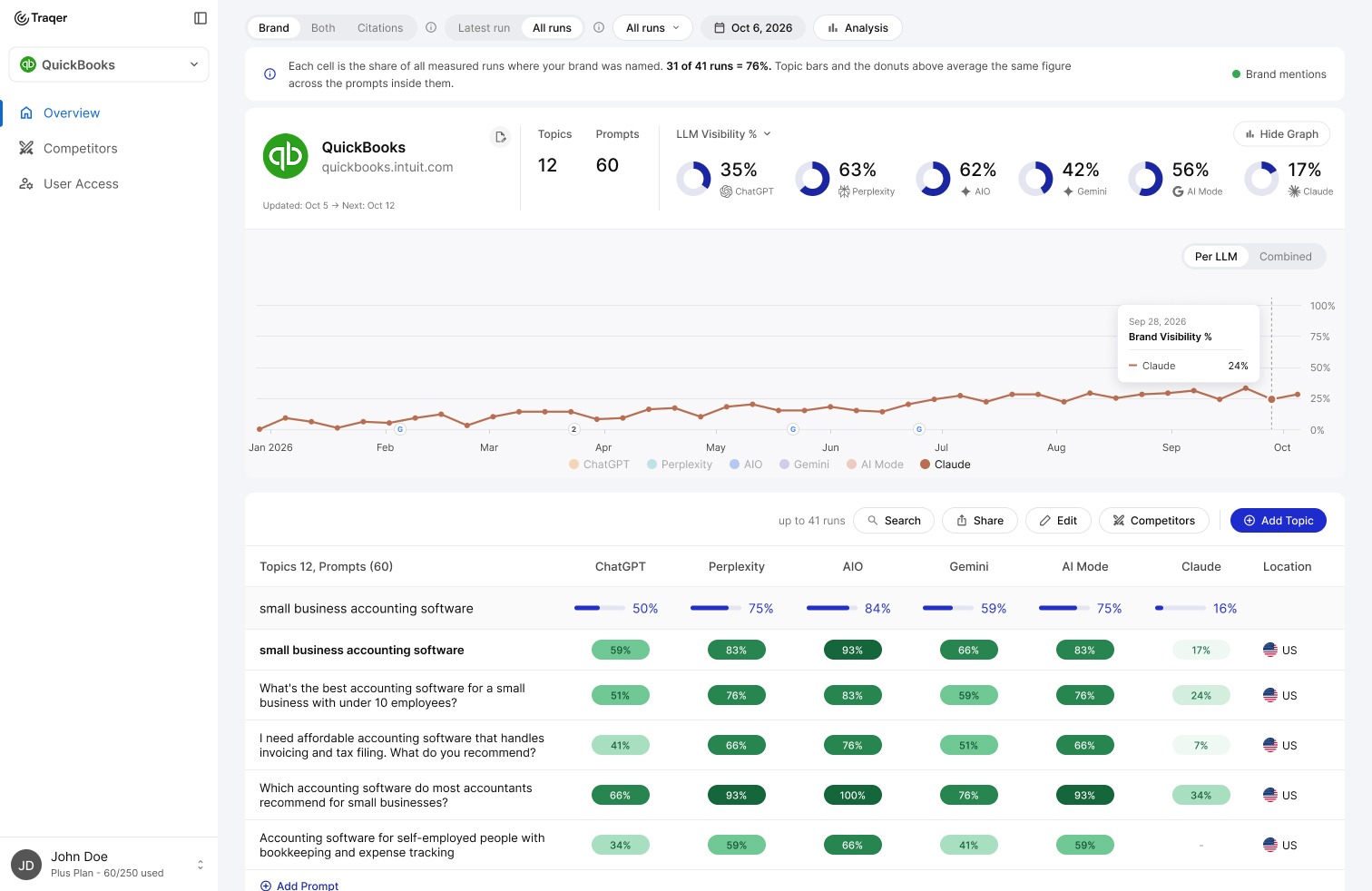
Two things are vital for how you measure, and both apply more to Claude than to the other LLMs:
The first is reporting Claude on its own rather than inside a blended score. Claude leans on its training data more than the LLMs that mostly summarize live search, so a brand with strong traditional SEO can appear in Perplexity and Google’s tools and still be absent from Claude. A single averaged visibility number hides that divergence, which is something you need to see.
Claude’s answers also vary from run to run, shaped by chat history and user context, so one response is just a single data point. Tracking a topic across several related prompts, and looking at how often your brand appears across the full run history rather than the latest result, gives you a better signal. This is the thinking behind Topic-Based GEO (and the stability view in Traqer).
The second is keeping brand mentions separate from citations. Claude naming your brand in a recommendation is worth more than Claude listing your URL as a source, because the mention is what reaches the buyer. A brand that is cited often but rarely named has a different problem from one that doesn’t appear at all, and the response to each is different. Reporting the two together as one number blurs that distinction. We explain why it matters in our piece on LLM citation tracking.
Key takeaways: how to improve Claude visibility
Beyond checking your site’s robots.txt to make sure Claude-SearchBot and Claude-User are allowed, you should focus on publishing bottom-of-funnel consent that ranks for queries where your product or service is an answer, and be as specific and detailed as possible about what makes your offer distinctive.
Alongside this, work on earning mentions on some of the pages that Claude already cites around the topics you want to appear for. The on-site formatting tactics are fine, but don’t expect them to improve Claude visibility alone. Generally it’s important to remember that there’s no magic formula, and no guarantees. If anyone promises certain “rankings” or a certain level of visibility in Claude, take it with a pinch of salt.
Start tracking your Claude visibility with Traqer to know where you stand, and what you need to do next to stay ahead of your competitors. Try it for free today, no credit card required.
Traqer is built by Grow and Convert. For the thinking behind how we approach AI visibility, Topic-Based GEO and Prioritized GEO explain the frameworks Traqer is built on.