Many Scrunch AI alternative round-ups rank tools from one to ten. That’s rarely much help, because the tools people treat as Scrunch competitors are built for very different buyers, and the right pick depends on which buyer you are. How a tool prices itself tells you most of that, and how it measures tells you the rest. So this guide sorts the field by the kind of team each tool suits rather than ranking them.
We make one of these tools, Traqer, built at our content marketing agency, Grow and Convert, to track AI visibility across a roster of client brands. Where a different tool fits you better, we will say so. In one line, if you are at an agency, work solo, or run several brands, Traqer is built for exactly that.
AI visibility tracking for agencies and multi-brand teams
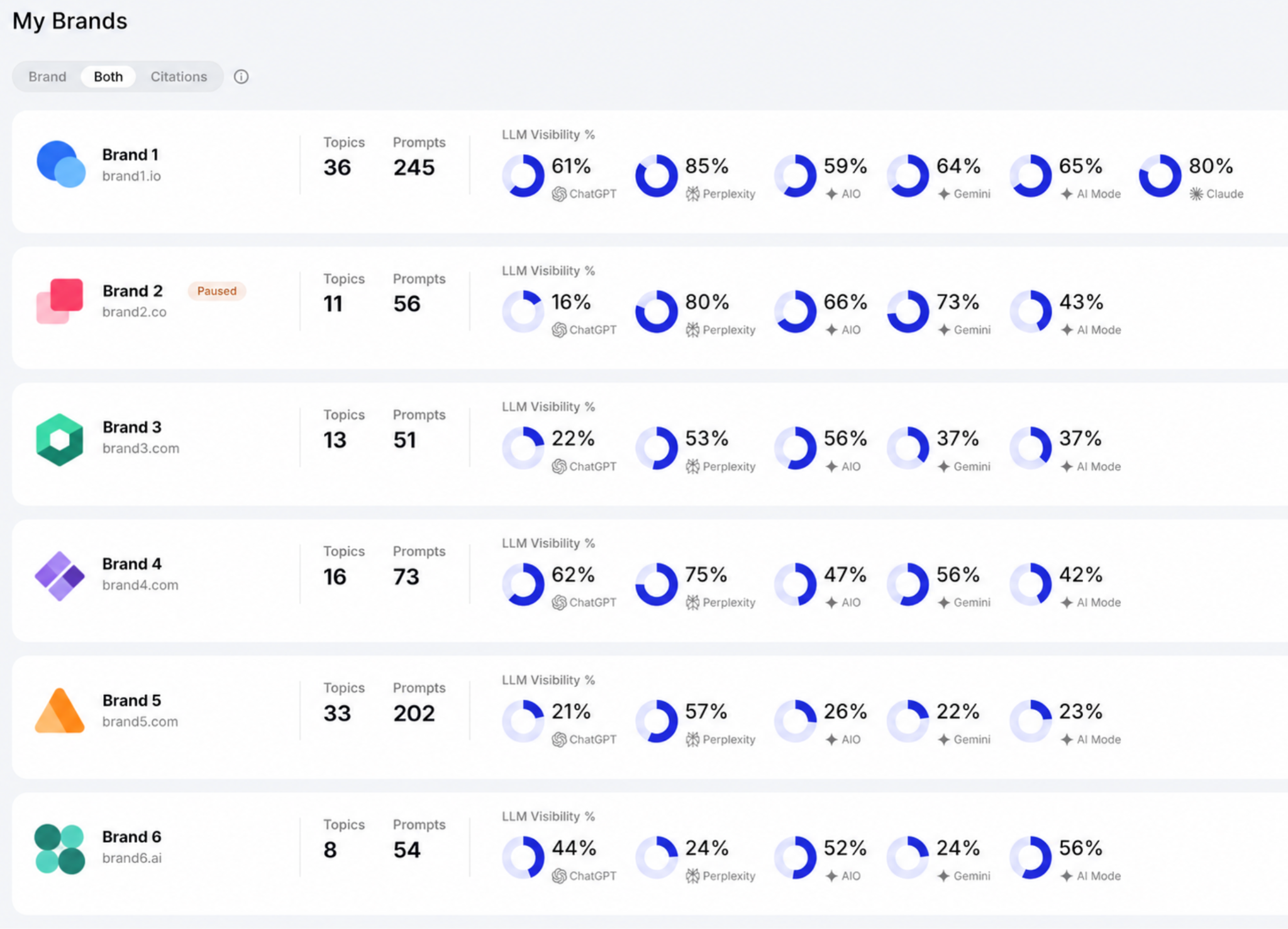
Traqer was made for this group. These are some of the features that matter for multi-brand work:
Flat, prompt-based pricing. You are billed for the prompts you track, with unlimited brands and unlimited users on every plan, from $25 a month for 50 prompts.
Run-to-run stability. Each prompt keeps its full history of runs and a stability score for how often your presence flips between them, so you can show a client a trend rather than one lucky or unlucky screenshot.
Tracking by topic, not fixed prompts. You set a topic and Traqer writes realistic prompt variations around it, because buyers never ask the same question the same way and one hard-coded prompt tells you little. The thinking is in our guide to personalized GEO.
Mentions and citations kept apart. Brand mentions are the headline number, with citations beside them as a separate signal rather than blended into one score.
One prompt, every core engine. A prompt runs once across ChatGPT, Copilot, Google AI Overviews, Google AI Mode, and Gemini. Claude and Perplexity are affordable add-ons on any plan, not reserved for enterprise buyers.
A to-do list, not just a dashboard. Where a client is missing on a topic, the Analyze & Improve view points to the exact pages and threads the engines cite, in the priority order set out in prioritized GEO.
Competitor tracking and change over time. It picks up the brands named alongside your client and compares any two periods, which is what a monthly client report runs on.
Unlimited client seats, and a free trial. Every plan carries unlimited users, so each client can have a login, and the trial runs 14 days with no card.
Traqer updates weekly, which suits a monthly reporting rhythm more than minute-by-minute monitoring. And it queries the engines from a neutral, logged-out session, the closest stand-in for what a buyer sees, though like every tool it can’t recreate one specific person’s history.
Two other tools we know of have agency features:
Peec has brand sentiment that reviewers rate highly, and its dedicated agency plans give you unlimited client projects and seats, consolidated billing, and pitch workspaces for winning new business, with Claude on its higher tiers. One reservation is cost. It runs on credits that charge for every model and every daily run, so the bill grows with engines and frequency, and its agency plans start around $245 a month.
Rankscale is one of the lower-cost options that offers agency features, including multi-brand dashboards, white-label client reporting, and a dedicated agency plan. It bills on credits rather than a flat rate, and LLMs cost different amounts to track, with Claude the priciest at roughly 8x a cheaper one, so the monthly bill is hard to predict across a client list.
Dedicated enterprise AI visibility platforms
Profound is the heavyweight of the field and aims squarely at larger companies. Prices start near $99 a month for a single LLM and rise to custom enterprise deals for the full model roster, with Claude held for the enterprise tier, and beyond tracking it adds crawler analytics, shopping visibility, prompt-volume research, and a content workflow. Its direction is bigger than visibility tracking, toward a platform for AI marketing built around agents. If you want AI woven through your whole marketing operation, it’s worth a look, and if you only need LLM visibility tracking today it is probably more than you need.
Low-cost, single-brand tools for tracking AI visibility
Otterly is one of the most transparent of the cheap options, with every price published on its site. Lite is $29 a month for 15 prompts across four engines, ChatGPT, Google AI Overviews, Perplexity, and Copilot, with Gemini, Google AI Mode, and Claude as paid add-ons, so the cost climbs as you add engines. The next plan, Standard, jumps to $189 for 100 prompts. It tracks daily, with unlimited seats.
LLMrefs is a flat-rate option. One plan at $79 a month covers 500 prompts across its full engine set, Claude included, plus AEO hygiene tools like an llms.txt generator and a crawlability checker. It is aimed at SEO teams, and there is a free account to try it. Across a client roster or set of brands, it’s worth remembering that the cheap headline prices will be affected by the add-ons and the prompt caps.
AI visibility as an SEO-suite add-on
If your team already lives in an SEO suite, the easiest move may be the AI visibility feature it has bolted on. Ahrefs Brand Radar offers a lot. It covers six AI platforms and builds its AI Visibility Index from hundreds of millions of search-derived prompts, modeled on observed search demand and run through the engines, so you can look up any brand at once, with tracking of your own prompts available alongside. The Index is priced per platform, at $199 a month for one or $699 for all of them, and custom-prompt tracking sells standalone from $50 a month without an Ahrefs subscription.
Semrush’s AI Visibility Toolkit is priced per domain, at $99 a month for 25 tracked prompts across ChatGPT, Gemini, and Google’s AI Overviews and AI Mode. Because it bills per domain, every client brand you add is another $99. It tracks a prompt list you set, which is closer to how Traqer works.
SE Ranking is one of the cheapest entries here, from around $71 a month on an annual plan, with extra users at $16 and proper multi-user and client features, which makes it the most agency-minded of the three. One issue is coverage. Below its enterprise tier it tracks only three engines and skips Perplexity.
Conductor comes at AI tracking from the SEO angle, too. It is a long-running organic marketing platform that has added AEO into a broader suite, priced by custom annual contract with nothing published, generally in the five and six-figure range per year. It makes sense for a large organization already running a serious SEO program that wants its AI tracking in the same place rather than as a standalone tool.
Choosing a Scrunch alternative
None of this is really about which tool has the longest feature list. What matters is who a tool is priced and built for. We built Traqer for agencies, consultants, and anyone tracking several brands at once, so if that’s your situation we’d steer you towards it.
For a wider agency-specific comparison, our guide to AI visibility tracking tools for agencies goes broader, and our note on the AI visibility report covers what belongs in a client-facing report once you have decided. Start a 14-day free trial of Traqer. No card needed.