Profound is an enterprise-oriented AI visibility platform with a wide feature set, priced from around $99 a month for a single engine up to custom enterprise contracts. Most people looking for a Profound alternative either don’t need everything it does and can’t justify the cost, or want a different approach to measurement.
We make one of these tools, Traqer, built at our content marketing agency, Grow and Convert, so we have a stake in this. The list below starts with Traqer, kept to a short note, then covers the rest of the field in brief, and our fuller case for Traqer follows it.
10 Profound alternatives and competitors
Pricing is included where the vendor publishes it, and each entry is kept to the essentials. It’s always worth checking this against current pricing, because the numbers change often.
Traqer. It runs $25 a month for 50 prompts, with unlimited brands and users on prompt-based pricing, and Claude and Perplexity as at-cost add-ons on any plan. (We present our case for considering Traqer as your AI visibility tool below.)
Scrunch. Now owned by Sitecore, it may be the closest like-for-like to Profound, with bot-traffic analytics, site audits, and an Agent Experience Platform. Core is around $250 a month billed annually for four engines and one brand workspace, with Claude on higher tiers.
Conductor. An established enterprise SEO platform with AEO folded into its suite, sold on custom annual contracts in the five and six-figure range, it suits organizations already running SEO on it.
Peec. Well-regarded in the market, Peec offers dedicated agency plans from about $245 a month with unlimited client projects and seats, and bills on credits per model per day, so cost rises with engines and frequency.
Rankscale. Credit-based from about $20 a month, it has multi-brand dashboards, white-label reporting, and an agency plan. Claude costs roughly eight times a cheaper engine, so the bill is harder to predict at scale.
Otterly. It publishes every price, starting at $29 a month for 15 prompts across four engines, with Gemini, Google AI Mode, and Claude as paid add-ons, and Standard is $189 for 100 prompts.
LLMrefs. One flat plan at $79 a month covers 500 prompts across its full engine set, Claude included, plus AEO tooling like an llms.txt generator. It is aimed at SEO teams.
Semrush AI Visibility Toolkit. It costs $99 a month per domain for 25 tracked prompts across ChatGPT, Gemini, and Google’s AI Overviews and AI Mode, and each extra domain is another $99.
Ahrefs Brand Radar. It covers six AI platforms and builds its index from hundreds of millions of search-derived prompts, so you can look up any brand at once. The Index is $199 a month per platform or $699 for all, with standalone custom prompts from $50.
SE Ranking. The cheapest SEO-suite route, from around $71 a month annually with extra users at $16, it tracks three engines below its enterprise tier and skips Perplexity.
Our case for considering Traqer as your Profound alternative
Traqer is ours, built at our agency to track AI visibility across a roster of client brands, and it is priced and designed for teams that need solid, reportable, tracking. We’ve built it with agencies and consultants in mind, though it’s also well-suited to multi-brand companies for the same reasons.
Our argument for you to consider Traqer is built on two things: cost and on how we measure.
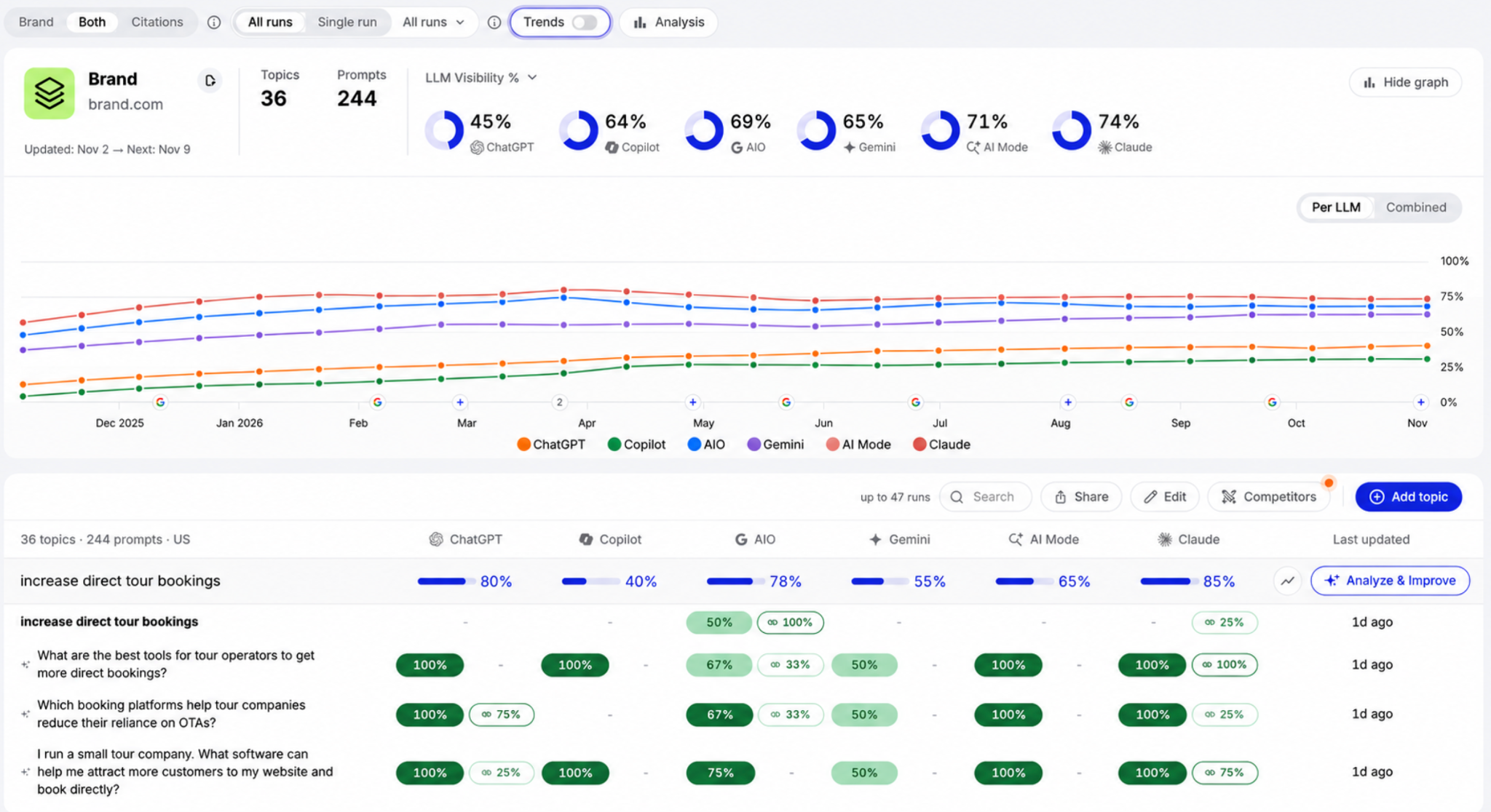
Let’s start with cost, because for many people this is the reason they’re looking for an alternative to Profound in the first place. Profound starts near $99 a month for one engine and runs to custom enterprise contracts for the full roster. Traqer is just $25 a month for 50 prompts, with unlimited brands and unlimited users on every plan, and the price moves only with the prompts you track.
A prompt runs across ChatGPT, Copilot, Google AI Overviews, Google AI Mode, and Gemini, and Claude and Perplexity are at-cost add-ons on any plan (rather than reserved for enterprise).
But measurement methodology is another key area where we differ from Profound (and differ from other LLM visibility trackers, for that matter).
Prompt volumes are maybe the clearest example here. Profound sells estimates of how often prompts get asked, drawn from a panel of real users, like keyword volume in SEO. We don’t publish anything like it, because in our view real prompts are long, personal, and close to one of a kind, so there’s no true prompt volume. That’s the invisible prompts problem, and it’s also why Traqer tracks on a topic level, monitoring realistic variations of prompts/questions within that topic rather than counting a single isolated phrase.
(Our personalized GEO guide explains more about this).
Another big distinction is what each tool encourages you to do with the data. Profound’s content tooling is built around earning citations, with a score that predicts how likely a page is to become a top-cited source.
Our stance is different. We treat brand mentions as the main outcome that matters commercially, and keep citations as a separate supporting signal rather than folding the two together or linking them necessarily. In our client work we’ve seen owned content carry a brand to strong visibility without chasing citations first. And in our own testing, on-site tactics such as FAQ schema haven’t produced a measurable change in how often AI answers name a brand, which is why prioritized GEO puts owned bottom-of-funnel content first. Reasonable people in the industry weigh this differently, and it’s an ongoing debate.
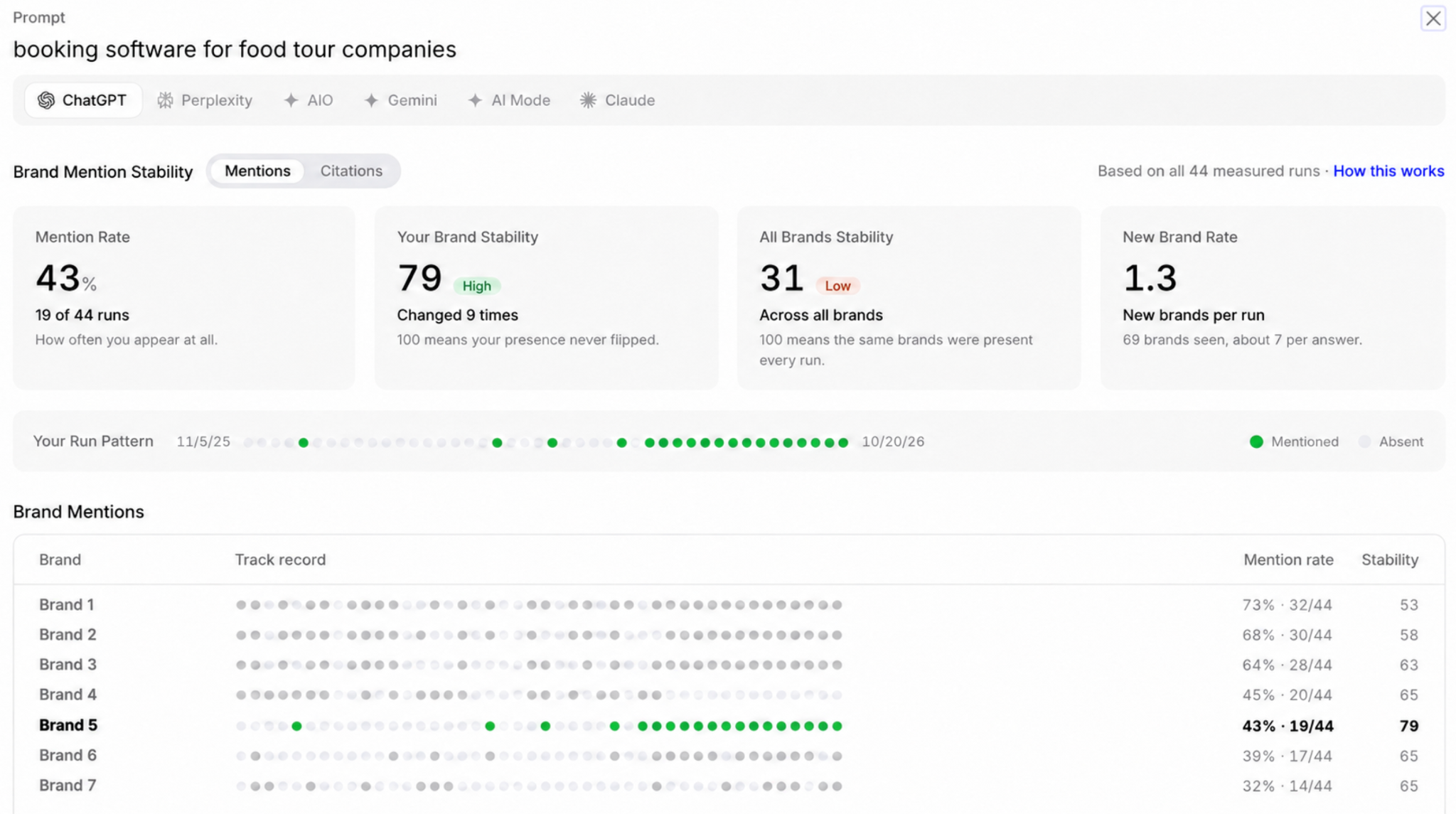
Stability is an important element that we focus on. An AI answer isn’t fixed, so the same question can name different brands on different days, and one check tells you little on its own. Traqer keeps every prompt’s full run history and generates a stability score for how often your presence flips between runs, so you can tell a reliable position from a lucky one and show a trend rather than a single screenshot.
This is demonstrated using a clear pattern of dots across all the recent runs:
The quickest way to see how this works for your own brand is to track a few topics for a couple of weeks.
Start a 14-day free trial of Traqer. No credit card needed.