If you’re weighing up Peec AI alternatives, the most useful way to sort the field is by who each tool is built for. The products people group as Peec competitors are designed for quite different buyers, and that difference shows up first in how they’re priced and then in how they measure visibility. So instead of ranking them, we’ve grouped them by the kind of team they suit.
We make one of these tools, Traqer, built at our agency, Grow and Convert, to track AI visibility across a roster of client brands. We’ll be clear about where it fits and where another tool might be the better option. In short, if you’re an agency, freelancer, or you run several brands, Traqer is built specifically for that.
Agencies and teams tracking multiple brands
Traqer is our AI visibility tracking software, built for agencies, consultants, and anyone tracking several brands at once. These are some features that are important to mention:
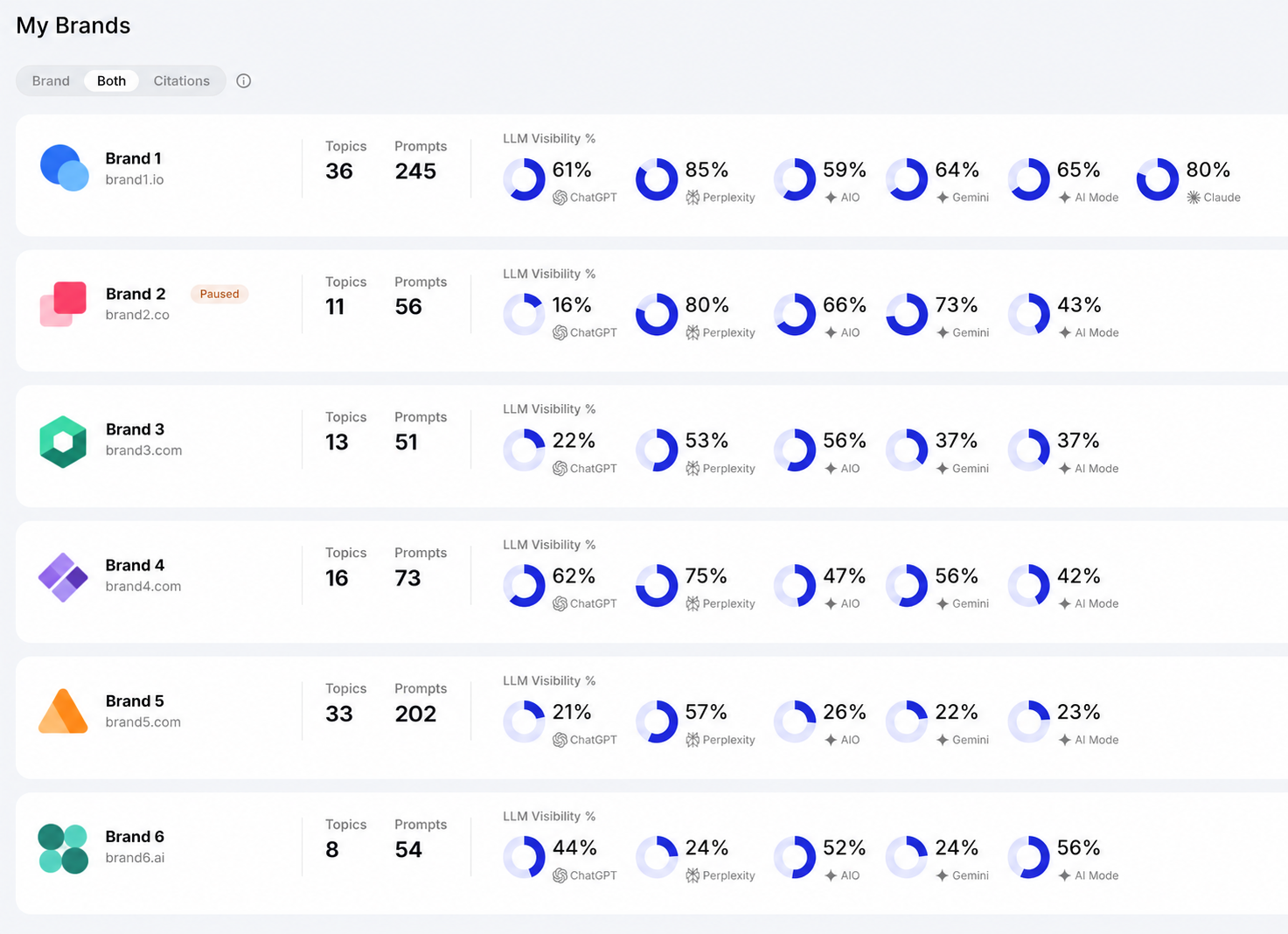
These are some features that are important to mention:
Prompt-based pricing, with unlimited brands and users. You pay for the prompts you track, not per brand or per seat, from $25 a month for 50 prompts. This is much cheaper than the alternatives.
One prompt across every core engine. A single prompt runs across ChatGPT, Copilot Google AI Overviews, Google AI Mode, and Gemini and counts once. Claude and Perplexity are available on any plan as at-cost add-ons, not held back for enterprise customers like with some other tools.
Topic-based tracking. You track a topic and Traqer generates realistic prompt variations around it, since no one knows the exact words a buyer types and the same prompt returns different brands from one run to the next. The reasoning is in our guide to personalized GEO.
Brand mentions, kept separate from citations by default. Brand mentions are the headline metric, with citations tracked as their own signal rather than folded into one blended number.
Stability across runs. Every prompt keeps its full run history and a stability score for how often your presence flips between runs, so you can show a client a trend instead of a single lucky or unlucky screenshot.
Analyze & Improve. For any topic where a client is missing, it surfaces the pages and threads the engines cite, the content and outreach to prioritize, in the order set out in prioritized GEO.
Competitor tracking and period comparisons. It detects the brands named alongside your client and compares any two date ranges, which is what a monthly client report runs on.
Unlimited client logins and a 14-day trial. Every plan includes unlimited users, so clients can hold their own access, and the trial runs 14 days with no card.
Traqer refreshes weekly rather than daily, so it is built for meaningful agency reporting cadence rather than constant daily monitoring. It runs a neutral, logged-out session to the LLMs, which is the closest view of what a buyer sees; but can’t reproduce one person’s history (honestly, no tool can do this).
Rankscale is the other lower-cost tool with agency features, including multi-brand dashboards, white-label client reporting, and a dedicated agency plan. It runs on credits that cost more on some engines than others, with Claude at roughly eight times the base rate, so an agency bill is harder to forecast than a flat per-prompt plan, and it leans toward monitoring and audits more than telling you what to do next.
Enterprise and large in-house teams
Profound is probably the most heavyweight tool in the category, and intentionally targets larger companies. It runs from around $99 a month for a single engine up to custom enterprise contracts for the full model roster, with Claude reserved for the enterprise tier, and it adds crawler analytics, shopping visibility, prompt-volume research, and a content workflow on top of tracking. They’re moving beyond AI visibility tracking towards being a platform for AI marketing; leveraging AI agents heavily. This means Profound is a good option to consider if you’re looking to integrate AI workflows into all aspects of your marketing strategy. If you’re only interested in LLM visibility tracking for now, it’s probably overkill.
Scrunch focuses largely on what happens on your own site. It runs AI bot-traffic and crawler analytics, site and page audits, and an Agent Experience Platform that serves AI-readable pages to the crawlers, with content-strategy and source-discovery work alongside. Sitecore acquired Scrunch in June 2026 for a reported $225 million, so it’s now part of a much larger enterprise martech stack, and its roadmap points into that suite. Core runs around $250 a month billed annually, covering four engines and a single brand workspace, with the wider roster, Claude included, and more workspaces held for higher tiers. That fits a Sitecore customer or a team optimizing one brand, and less an agency spreading clients across one account.
Conductor starts from enterprise SEO. It’s a long-established organic marketing platform that has folded AEO into a wider suite, sold on custom annual contracts to large organizations that already run a serious SEO program and want AI tracking inside it rather than as a separate tool.
AI visibility inside an SEO suite
If your team already works inside an SEO suite, the simplest alternative to Peec may be the AI visibility feature your current tool has already bolted on.
Semrush’s AI Visibility Toolkit runs $99 a month per domain as an add-on and tracks 25 prompts across ChatGPT, Gemini, and Google’s AI Overviews and AI Mode. The per-domain pricing is what bites an agency, since every client brand you add is another $99. Ahrefs Brand Radar covers six AI platforms, more than the others here. It prices its AI Visibility Index per platform, at $199 a month for one or $699 for all of them, and sells custom-prompt tracking standalone from $50 a month without an Ahrefs subscription.
SE Ranking is the cheapest way in, with AI visibility from around $71 a month on an annual plan and extra users at $16, though below its enterprise tier it tracks only three engines and leaves out Perplexity.
They also differ from Traqer in how they gather the data. Ahrefs Brand Radar leads with breadth. Its AI Visibility Index is built from hundreds of millions of search-derived prompts, modeled on real search demand and run through the engines, so you can check any brand’s visibility across them at once, and it offers custom prompt tracking of your own questions alongside.
Semrush and SE Ranking track a prompt list you set, which is closer to how Traqer works, though the lists are short, at 25 prompts on Semrush’s standalone toolkit. Traqer tracks topics instead and builds prompt variations around each one, on the view that no fixed handful of prompts captures the range of ways real buyers ask (which is part of the invisible prompts problem).
The appeal across all three SEO tools is you have one login for SEO/GEO tracking, with AI visibility sitting next to the rank tracker you already report on.
For agency use the economics vary. Semrush charges per domain, so each client is another bill, Ahrefs meters custom prompts on top of its index, and SE Ranking keeps extra users cheap but covers fewer engines. SE Ranking is the most agency-minded of the three, with multi-user and client features built in; Semrush and Ahrefs are oriented more around a single team’s own program. For running visibility across a roster of client brands on the full engine set, a tool built for that from the start fits more naturally.
Budget and single-brand monitoring
Otterly starts at $29 a month for its Lite plan, which tracks 15 prompts across four engines, ChatGPT, Google AI Overviews, Perplexity, and Copilot. Gemini, Google AI Mode, and Claude are paid add-ons, so the real monthly cost rises as you add engines, and the next plan up, Standard, is a jump to $189 for 100 prompts. The pricing is published in full, with daily tracking and unlimited seats.
LLMrefs is a flat-rate option. One plan at $79 a month covers 500 prompts across its full engine set, Claude included, plus AEO hygiene tools like an llms.txt generator and a crawlability checker
On Claude specifically, both offer it on self-serve rather than reserving it for enterprise. Otterly sells it as an add-on, and LLMrefs includes it in its base plan.
All of them suit a single brand or a quick baseline. Run many clients on one and the cheap headline price gives way to the catches above, the per-engine add-ons, the credit math, and the prompt limits, managed brand by brand. We go deeper on the low-cost options in our guide to affordable AI visibility tools.
How to choose a Peec AI alternative
The best way to determine the right Peec alternative is to start from your own situation rather than a feature table. A large in-house team with a big budget that wants agentic capabilities might be best served by Profound, Scrunch, or Conductor. A team already inside an SEO suite can often use the AI visibility feature it already pays for. A single brand on a tight budget has good, cheap options in Otterly and LLMrefs. And an agency, a consultant, or anyone tracking many brands is the case Traqer is built for, on pricing that doesn’t punish you for adding clients and measurement designed for how AI search actually behaves.
If you want the fuller agency comparison, our guide to AI visibility tracking tools for agencies goes wider, and our note on the AI visibility report covers what to put in front of a client once you’ve chosen.
Try Traqer for free for 14 days. No credit card required.