Search for an AI visibility tool that handles multiple brands and you’ll mostly find articles written for agencies, where “multiple brands” means multiple clients. If you sit on the central marketing or digital team of a group, a house of brands, or a holding company, that angle doesn’t quite fit. You’re not reporting to clients. You’re trying to see, in one place, how every brand in the portfolio shows up when people ask ChatGPT, Gemini, Perplexity, or Google’s AI about the categories those brands compete in, and most of the tools you’ll be pointed at price each brand as if it were a separate customer.
We run AI visibility across dozens brands on a single account at our agency, Grow and Convert, and we built Traqer ourselves because the tools we tried didn’t measure visibility the way we think it should be measured, and the cost didn’t work across that many brands. The problems a group team faces are similar to the ones we had, so this is written from direct experience rather than theory.
This article covers:
What to look for in an AI visibility tool when you’re tracking a portfolio of brands
How the main tools compare for multi-brand use
What actually moves AI visibility across a portfolio
What to look for in an AI visibility tool for multiple brands
In our experience, a few things separate a tool that works across a brand portfolio from one designed around a single brand. These are:
Pricing that doesn’t treat each brand as a new customer. Most AI visibility tools price per brand, per workspace, or on credits that multiply with every brand you add. That structure is tolerable for one brand and very punishing for twelve. You want the cost set by how much you track, not by how many brands exist on the account.
Per-brand, per-model numbers that the centre can combine. Averages are often where AI visibility reporting goes wrong, and a portfolio multiplies the temptation. Brands in the same group might be at completely different stages: in our published GEO work, an established brand measured between 59% and 85% visibility across the engines while a younger brand sat between 8% and 24%, and one portfolio average would say almost nothing about either.
The useful setup is per brand, per engine, per topic; with a group view to combine everything and provide a broader view. We go through the metrics in our guide to AI search visibility metrics.Topics that respect each brand’s own market. A portfolio isn’t one category, so each brand needs its own topic set built around the buying questions of its market. (The thinking behind topic-level tracking is in Personalized GEO.)
How each brand is described, not just how often it appears. A group team usually owns brand architecture, and the models have their own view of it. You want to see the characterizations each engine attaches to each brand, so you know whether the premium, value, and specialist positions are landing or blurring. Our guide to AI brand monitoring covers this.
Access that matches how a group works. The centre needs admin control and the full portfolio view; each brand team needs a login to its own data and nothing else, without a per-seat negotiation.
How the main AI visibility tools compare for multi-brand companies
Since every serious tool here covers the main LLMs in some capacity, the questions for a portfolio are whether the tracking method actually makes sense, and whether it’s affordable to monitor multiple brands across all the LLMs. Here’s how the main options stand:
Traqer
Traqer was built for exactly this type of problem: many brands on one account, with the economics and the reporting designed around that use case. Every plan includes unlimited brands and unlimited users, and pricing is per tracked prompt, from $25 a month for 50 prompts.
For example, let’s say a group runs ten brands at 25 tracked prompts each. That’s 250 prompts; the $100 a month plan, working out at about $10 per brand.
(Note: If you had the same portfolio on a tool with a per-brand pricing model, where single-brand plans commonly start around $250 a month, you’d be at nearly $2,500 for those ten brands!)
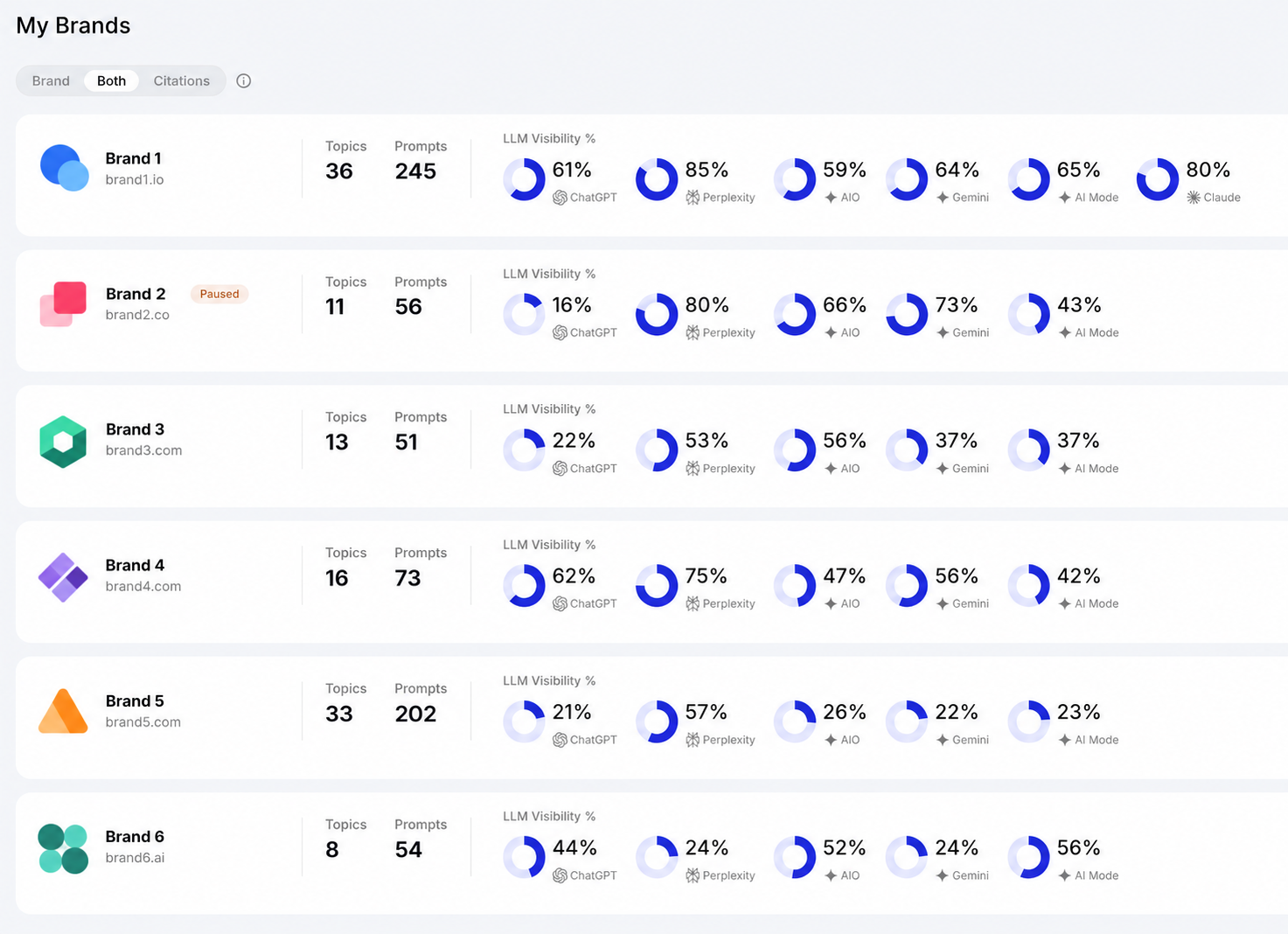
Each brand on the account is set up with its own topics, built from the buying questions in its own market, and its own competitor set. Where two brands compete in the same category, both could track the same buying questions, split by price point if that’s how the portfolio is built, so you can see on identical prompts which brand the models recommend for the budget question and which for the premium one.
Brand name variants are set per brand, so the short and alternative names people actually type into LLMs get counted, and mentions are tracked separately from citations throughout. The headline metrics can’t be flattered by trimming what gets tracked, which also means adding an ambitious new startup brand to the account doesn’t drag the established ones down overall.
The reporting works on all the levels that a group needs. The portfolio view (see above) combines every brand, and each brand drills out to its own per-engine, per-topic picture (see below).
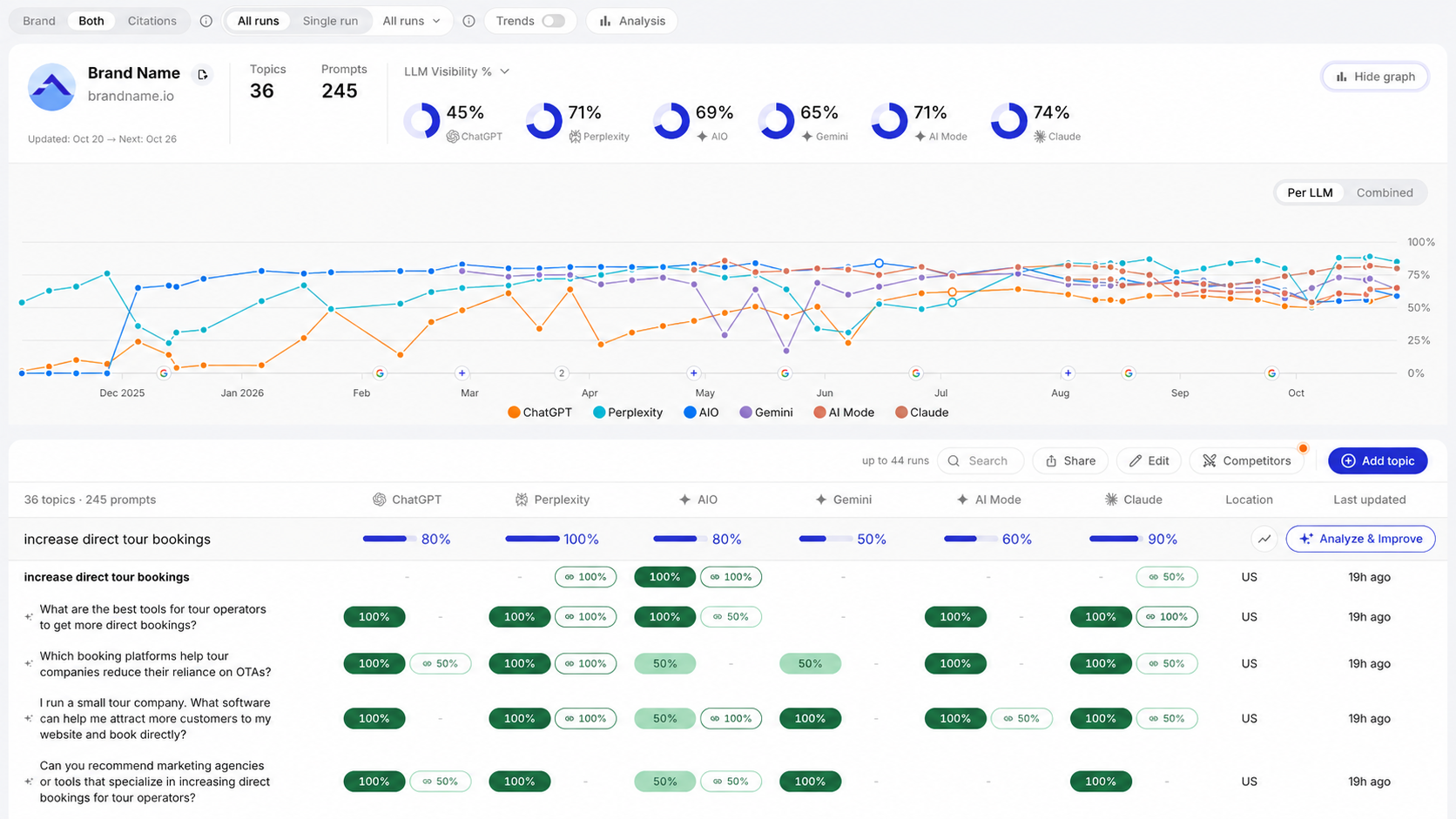
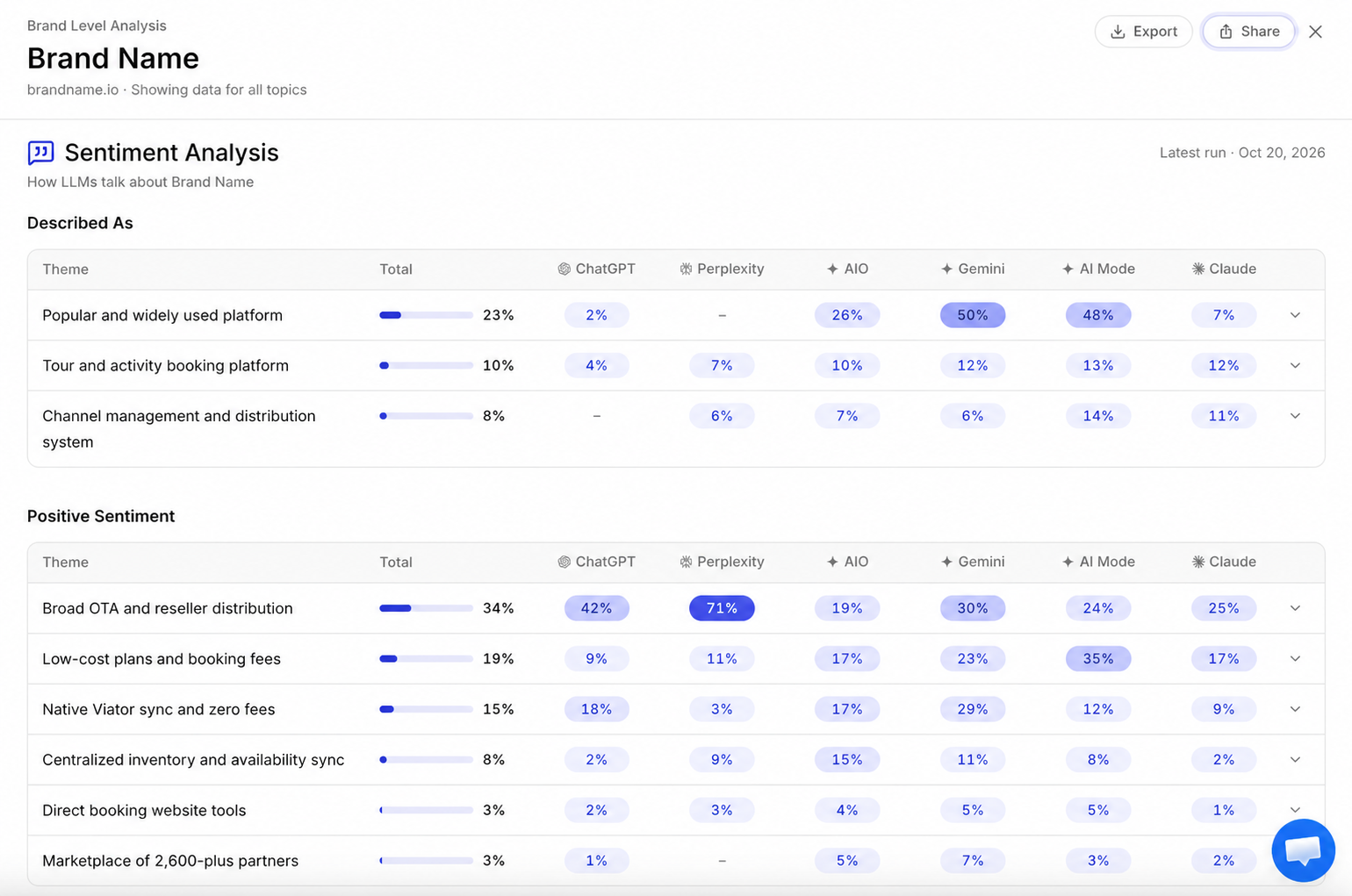
Sentiment analysis shows the characterizations each engine attaches to each brand:
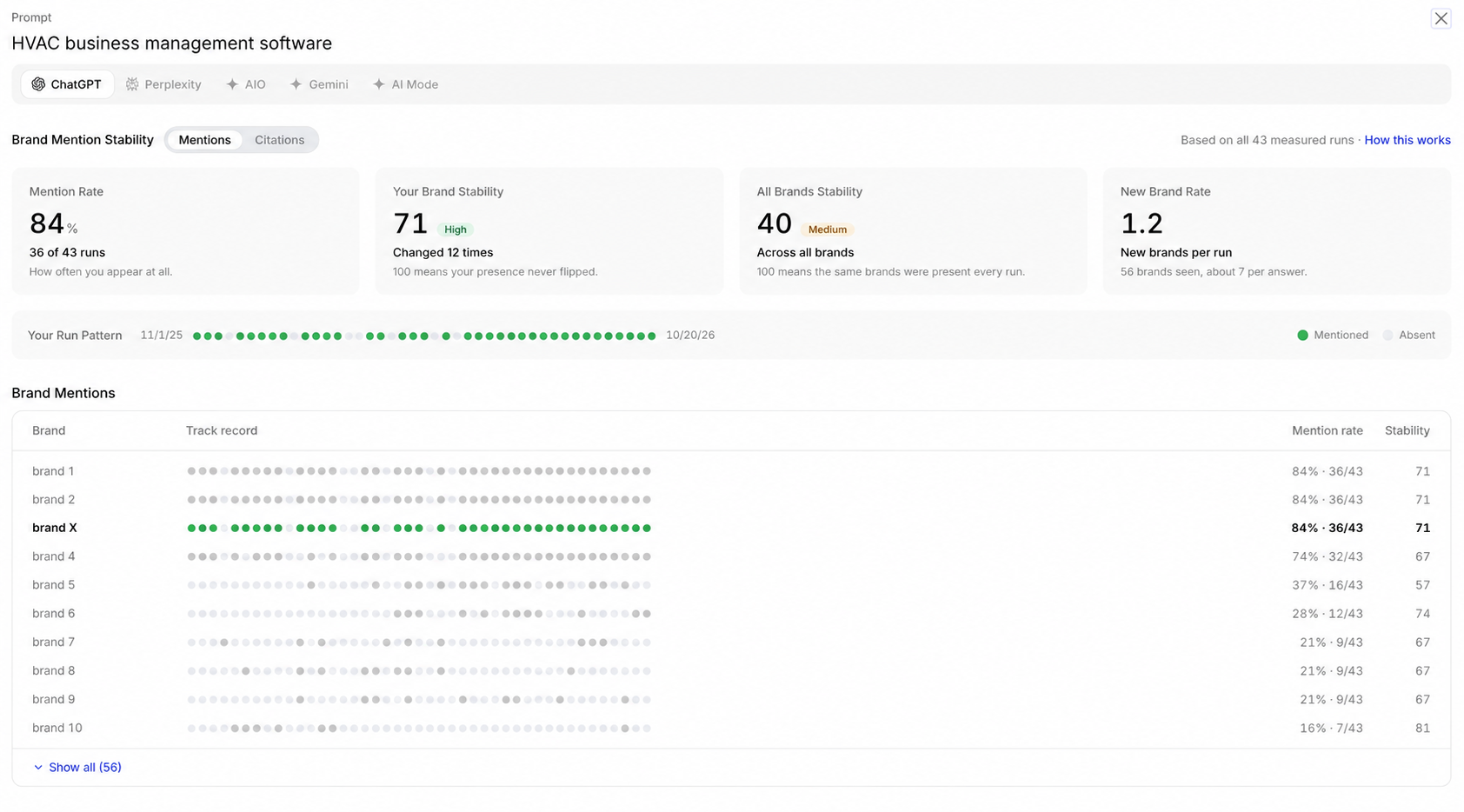
And the stability view shows every run of every prompt rather than only the latest. A weekly refresh and date comparison give each brand team a before-and-after for its own work.
Viewer logins can give each brand team its own data while the centre can keep admin control, and unlimited users means there’s no procurement hassle.
There’s also an MCP server on every plan, so an AI assistant can query the whole portfolio directly, questions like “which of our brands gained ChatGPT visibility this quarter” or “which articles do the engines cite most in this category but never mention us,” and each topic’s Analyze & Improve view turns the answer into the cited sources and competitor gaps for that specific brand.
Traqer is available on a 14-day free trial, no credit card required.
Profound
Profound is the category’s most enterprise-focused platform, and each brand lives in its own individually priced workspace with the platform’s full analytical depth behind it. That structure favours a group of two or three major brands with enterprise budgets over a long tail of smaller ones, since every brand added is a line item and the full LLM set sits on custom enterprise tiers. Whether a consolidated view exists across workspaces is a demo question, since it isn’t described in the public material.
Peec
Peec handles multiple brands through client projects, unlimited on its agency plans, with unlimited seats for brand teams and consolidated billing on one invoice. The structural challenge is the credit model: one prompt against one model for one day is one credit, so the bill scales with prompts, models, and run frequency across every brand at once. Whether a group view exists across projects, and what your portfolio’s credit burn looks like at your real prompt volume, are the two things to put to them directly.
Scrunch
Scrunch, now owned by Sitecore, is strongest on source discovery and site-side analytics, and it has the most clearly documented group view of the tools here: its agency program describes a single unified workspace across every brand, with role-based access and Looker Studio reporting on top. The structure to weigh is per-brand pricing, with brand count stepping the cost in tiers and wider coverage on custom terms, which suits a small number of well-funded brands better than a wide portfolio.
Otterly
Otterly is one of the cheapest ways in, structured as one workspace per brand with unlimited users on every plan and unlimited workspaces from its mid tier. The structural point is that the prompt allowance is shared across the whole account, so it spreads thinner with every brand you add, and some engines are per-account add-ons on top. Reporting runs through a Looker Studio connector rather than a native portfolio view. Sensible for testing the water on two or three brands; the allowance math is what to check beyond that.
SE Visible
SE Visible, from SE Ranking, pitches itself on cross-brand dashboards, and you get a good amount of prompts for the money. The catch for a portfolio is that brands are sold in slots. Each plan includes a fixed number, and the published plans top out at a level a wide portfolio will outgrow. Claude isn’t in its engine set, either. Some practical information: SE Ranking sells several AI tracking products with similar names and different limits, so if you get a quote, pin down exactly which product it covers. We haven’t run a large portfolio through it ourselves, so check the current limits against your own brand count.
How to choose the right AI tracking tool for your multi-brand company
A few questions are worth considering for any AI visibility tool on your shortlist. For instance, what does it cost at your current (and prospective) brand count and prompt volume? When you view the whole group, can you still see each brand on each engine, or does it all blend into one score? Can it show you how each brand is described and not just how often it appears, and can every brand team see its own data without the centre losing ownership of the setup?
Traqer was built specifically for teams to track multiple companies at the same time, whether that’s an agency with dozens of clients or an organization with different brands.
Try it for free for 14 days. No credit card required.
-
Traqer is built by Grow and Convert. For the measurement thinking behind it, Personalized GEO and Prioritized GEO explain the approach in more depth.