Most of what’s written about private equity and AI visibility is either a consultancy playbook or a study of how visible PE firms themselves are when founders ask AI about sponsors. That’s an important subject, but it isn’t the job most operating teams are being handed: the partners want to know which of the portfolio companies show up when buyers ask ChatGPT, Gemini, or Claude about their categories, and they want it reported the way everything else in the portfolio is reported, consistently, quarter after quarter.
We run AI visibility across dozens of brands on a single account at our agency, Grow and Convert, and we built Traqer because the tools we tried didn’t measure visibility the way we think it should be measured, and the cost didn’t work at that brand count. A portfolio of ten or fifteen companies has the same problems, so this is written from doing the work rather than from theory.
This article covers:
How to set up tracking so the numbers mean something to an investment team
What it costs to track a whole portfolio, tool by tool
How to set up AI visibility tracking across a portfolio
In our experience, there are five things to get right when setting up AI visibility tracking.
One brand per portfolio company, on one account. Every company gets its own tracked brand, with its own name variants, since the short names buyers actually type are the ones that get missed. If the firm’s own visibility matters, when founders and LPs ask AI about sponsors in your space, the firm can sit on the account as one more brand. It’s the same measurement problem.
Topics from each company’s real buying questions. A portfolio isn’t one market, so a shared prompt template produces numbers that look comparable and aren’t. For example, let’s say the portfolio holds a payments company and a home-services brand. The payments company gets tracked on the questions its buyers ask (“best payment processor for marketplaces”), the home-services brand on its own (“franchise software for plumbing businesses”), and each is measured against its own competitors.
In our experience, 10 to 25 well-chosen prompts per company is enough to start. Traqer generates starter prompts when you set a topic up, which makes onboarding quicker, but we’d treat those as a first draft: edit them against the buying questions each company would stand behind before the runs you plan to report on.
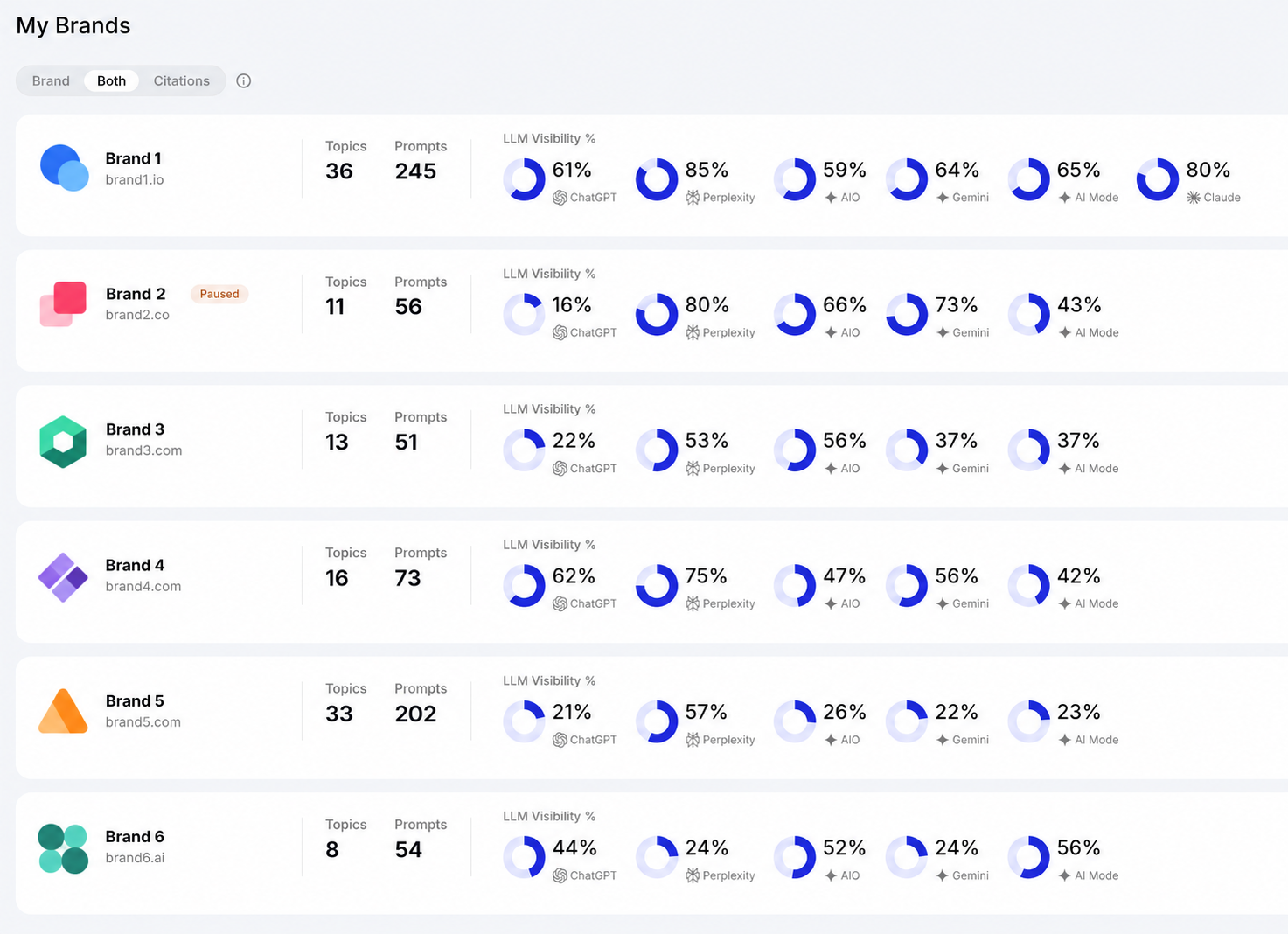
The reasoning behind topic-level tracking is outlined in our guide to Personalized GEO, and Invisible Prompts explains why chasing individual high-volume prompts misleads.Keep the results per company and per engine. The portfolio average is the number everyone asks for and the one that hides the most. Companies in the same portfolio sit at completely different stages: in our published GEO work, an established brand measured between 59% and 85% visibility across the engines while a younger brand sat between 8% and 24%.
Average those and you’ve hidden a strategically important weak asset inside a comfortable number. The same applies across engines, since a company can be recommended consistently on Perplexity and barely appear on ChatGPT. Report per company, per engine, and let the group view be something you combine deliberately rather than the default. The metrics are covered in AI search visibility metrics.Track what the models say, not just whether a company appears. Mentions and citations are different outcomes: being recommended by name is not the same as having a page used as a source, and an investment team should know which one each company has.
And the characterizations matter as much as the counts. Sentiment analysis shows the specific things each engine says a company is, which for a portfolio is close to a thesis check: if the investment case says a company is the category leader in its niche and the models describe it as a budget alternative, that’s worth knowing early. Our guide to AI brand monitoring goes into this.Put it on a reporting rhythm from the start. AI answers vary run to run, so a one-off audit mostly measures the day it was done. Weekly runs, a view across every run rather than the latest, and a quarter-over-quarter date comparison give you numbers that behave like the rest of the board pack. How to structure that reporting is covered in our guide to AI visibility reports.
Operationally, each portfolio company’s marketing lead gets a login to their own data, the operating team keeps admin, and portfolio questions get asked directly: Traqer includes an MCP server on every plan, so an AI assistant can answer things like “which of our companies gained ChatGPT visibility this quarter” across the whole account. There’s a worked example in our MCP case study.
What does it cost to track AI visibility across a portfolio?
Here’s a comparison of the main tools in the space, using their published pricing in late 2026. For scale, we’ve costed the same portfolio on each: ten companies at 25 tracked prompts apiece.
Traqer, our tool, prices by tracked prompt, with unlimited brands and unlimited users on every plan, from $25 a month for 50 prompts. Ten companies at 25 prompts each is 250 prompts, the $100 a month plan, about $10 per company. Copilot is included and Claude is an at-cost add-on, and there’s a 14-day free trial (no credit card required). Try it now.
Profound, one of the most established enterprise platforms. Brand plans are a free trial and then custom Enterprise quotes; the published route is the agency plan at $99 a month plus $399 a month per company workspace, each covering 100 prompts on ChatGPT, Perplexity, and Google AI Overviews. Ten companies would add up to about $4,000 a month.
Peec sells brand plans at $95, $245, and $495 a month, but they’re capped at one, two, and five projects, so a portfolio points you at its agency track: credit-based plans from $245 to $795 a month plus a custom tier, where credits are spent per prompt, per model, per day, so the final bill depends on how much you run.
Otterly runs $29, $189, and $489 a month for 15, 100, and 400 prompts, shared across the whole account, with unlimited workspaces from the $189 plan. Ten companies at 25 prompts each is 250 prompts, which means the $489 plan (or the $189 plan plus add-on packs at $99 per 100 prompts), around $387 a month either way before engine add-ons, and Gemini, AI Mode, and Claude are per-engine extras on top, with Claude at $29 to $439 a month depending on plan.
Scrunch, now owned by Sitecore, prices its agency track at $500 a month for Agency Core, which covers three brand workspaces, 250 prompts, and unlimited users on four engines (ChatGPT, Perplexity, Google AI Overviews, and Copilot). That’s the plan a portfolio likely would start on, working out at about $167 per company for the first three, and anything beyond three workspaces, or any of the other engines including Claude, means the custom Enterprise tier.
SE Visible, from SE Ranking, sells brand slots in steps: $99 a month covers 200 prompts and three brands, $189 covers five, $355 covers ten, and the published plans top out at $519 for fifteen. Ten companies lands on the $355 plan, about $35 per company, with no Claude in the engine set at the time of writing.
The published pricing in this category changes often, so it’s best to treat these as guideline reading and check each vendor’s page before you commit anything. We outline our wider reasoning on pricing in this category in our article about affordable AI visibility solutions.
Why you should consider Traqer (apart from the low cost)
We built Traqer to run the twenty-plus brands we manage ourselves at Grow and Convert, and a portfolio has the same problem. There are a few things about Traqer that make it work for operating teams:
Each company is tracked on its own terms.
Every portfolio company is its own brand on the account, with its own topics, its own competitors, and its own name variants. A payments company and a home-services brand don’t share a prompt template. Results are reported per company and per LLM across ChatGPT, Copilot, Gemini, and Google’s AI Overviews and AI Mode, with Claude and Perplexity available as affordable add-ons, so a company that’s strong on one engine and nearly absent on another shows up as exactly that.
You can see what the LLMs say, not just whether a company appears.
Sentiment analysis has three parts: Described As, which shows the categories and characterizations each engine attaches to a company, and the positive and negative themes.
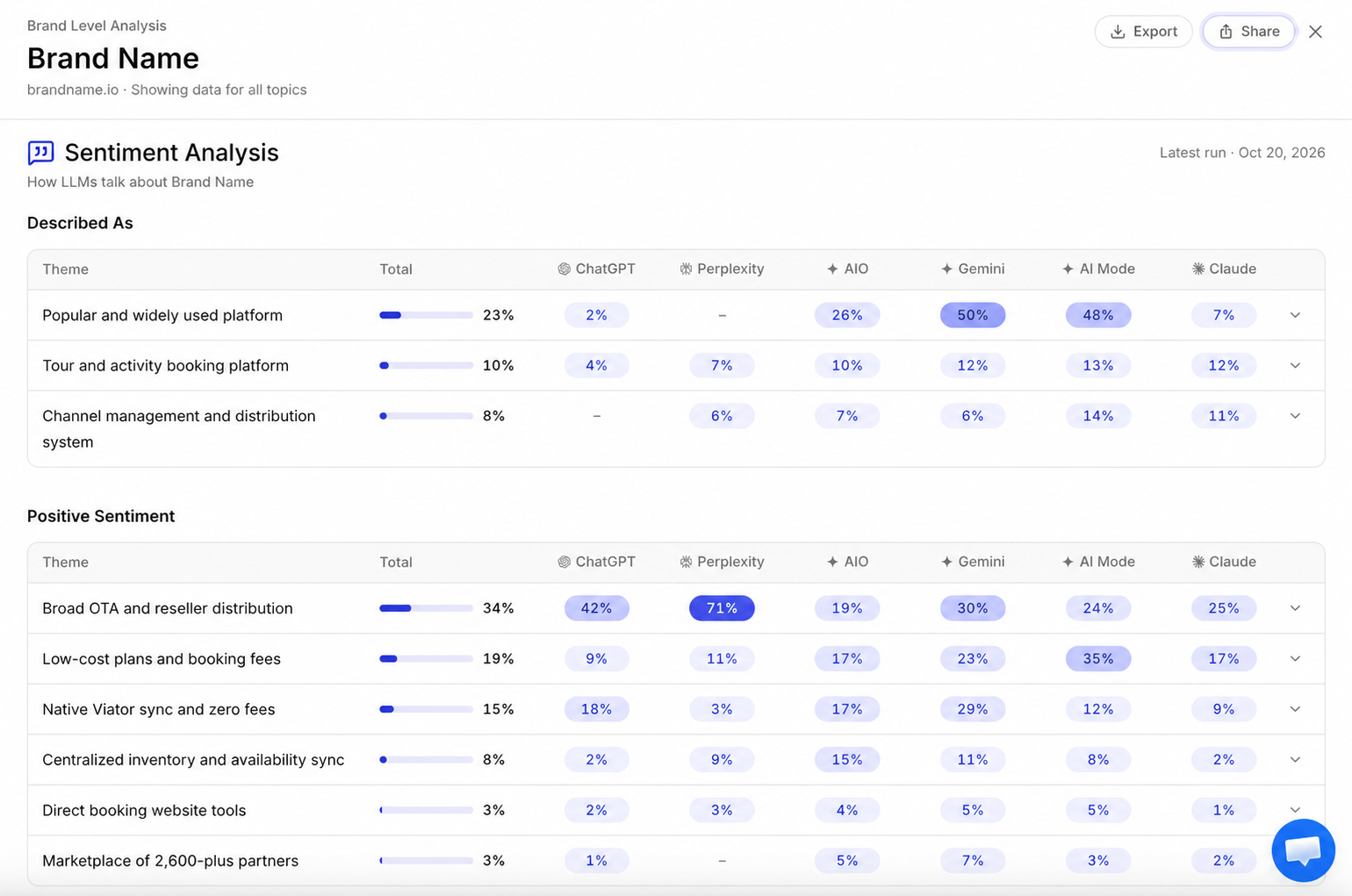
Each is broken out per engine, with the prompt and answer behind it a click away. For an investment team, Described As works as a thesis check. If the case for a company rests on it being the category leader in its niche and the models describe it as a budget alternative, you’ll see that, and which engines say it. Below that, every mention is listed by topic with the full response one click away, so a number in a board pack can be traced to the words behind it.
Mentions and citations are measured separately by default.
Being recommended by name and having a page used as a source are different outcomes, and each company gets both numbers. For each topic, the Analyze & Improve view lists the sources the engines keep citing and the prompts where competitors are named and the company isn’t. That gives each company’s marketing lead a specific place to start with content production and outreach.
The numbers are built to be reported.
AI answers vary from run to run, so Traqer refreshes weekly and keeps every run of every prompt, with a stability view showing how consistently a company appears rather than how it looked on one day.
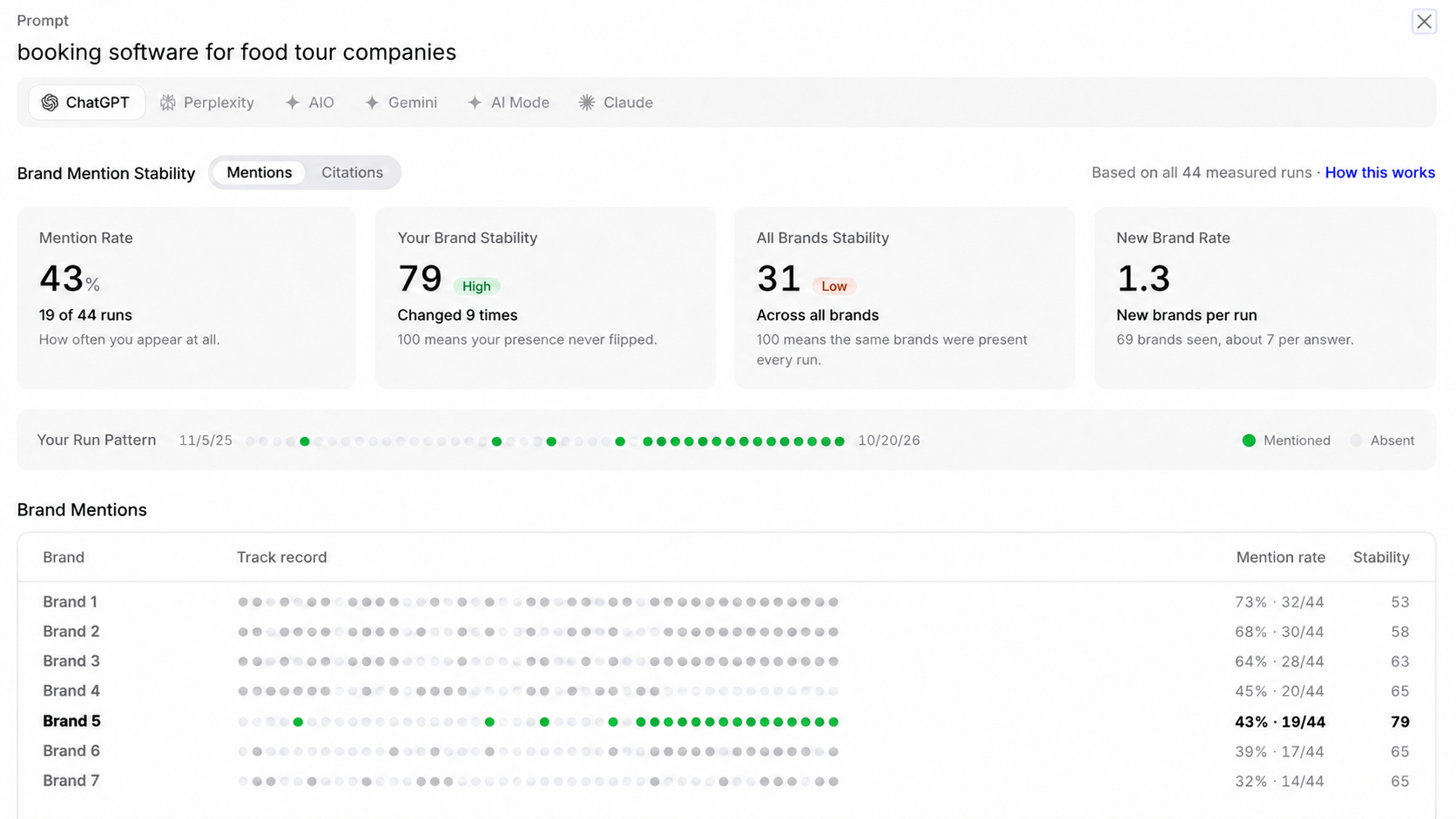
Date comparison then gives you before-and-after movement for each company across a quarter. The headline metrics can’t be flattered by trimming what you track: alongside the visibility percentage you get a raw count of prompts where the company appears and a topic-level high, medium, or low view, which matters when portfolio companies are reporting numbers upward.
It fits how an operating team works.
The operating team keeps admin and sees every company. Each company’s marketing lead gets a Viewer login to their own data, and unlimited users means that isn’t a licensing conversation across fifteen management teams. An MCP server on every plan lets an AI assistant query the whole account, so you can ask things like “which of our companies gained ChatGPT visibility this quarter” or “which articles do the engines cite most in this category but never mention us.”
Where to start with AI visibility tracking for your PE portfolio
A reasonable first quarter looks like this: set up every portfolio company as a brand, give each one a small, carefully-chosen prompt set, run it weekly, and bring the per-company, per-engine numbers to the next portfolio review alongside one or two recommended content programmes.
If you want to see what that looks like at your portfolio’s size, Traqer has a 14-day free trial, no credit card required, and our pricing lays out the per-prompt model in full.
—
Traqer is built by Grow and Convert. For the measurement thinking behind it, Personalized GEO and Prioritized GEO explain the approach in more depth.